500 (number)
Template:Other uses Template:More citations needed Template:Use mdy dates Template:Infobox number Template:Wiktionary 500 (five hundred) is the natural number following 499 and preceding 501. Template:TOC limit
Mathematical properties
500 = 22 × 53. It is an Achilles number, meaning that it is divisible by the squares of its prime factors (i.e. 4 and 25) but is not a power itself, and a Harshad number, meaning it is divisible by the sum of its digits. It is the number of planar partitions of 10.[1]
Integers from 501 to 599
500s
501
502
502 = 2 × 251. It is a vertically symmetric number.[2]
503
503 is a prime number, a safe prime,[3] a Chen prime,[4] an Eisenstein prime with no imaginary part,[5] an index of a prime Lucas number,[6] and an isolated prime. It is the sum of three consecutive primes (163 + 167 + 173)[7] and the sum of the cubes of the first four primes.[8]
504
504 = 23 × 32 × 7. It is a tribonacci number,[9] a semi-meandric number, a refactorable number,[10] a Harshad number and a largely composite number.[11] It is the sum of the smallest pair of amicable numbers: (220, 284).[12] The group order of the fourth smallest non-cyclic simple group, A1(8) = 2G2(3)′, is 504. There are 504 symmetries of the simple group PSL(2,8) that is the automorphism group of the Macbeath surface.[13]
is prime.[14]
505
505 = 5 × 101. It is the magic constant of n×n normal magic square and n-queens problem for n = 10.
506
506 = 2 × 11 × 23. It is a sphenic number, a square pyramidal number,[15] a pronic number,[16] a Harshad number.
is a prime number. Its decimal expansion is 252 nines, an eight, and 253 more nines.
507
507 = 3 × 132. it is a central polygonal number because 507=232 - 23 + 1.[17]
508
508 = 22 × 127. It is the sum of four consecutive primes (113 + 127 + 131 + 137). There are 508 graphical forest partitions of 30.[18] Since 508 = 222 + 22 + 2, it is the maximum number of regions into which 23 intersecting circles divide the plane.[19]
509
509 is a prime number, a Chen prime, an Eisenstein prime with no imaginary part, a highly cototient number[20] and a prime index prime.
It is a Sophie Germain prime, additionally, it is the smallest Sophie Germain prime to start a 4-term Cunningham chain of the first kind {509, 1019, 2039, 4079}.
510s
510
510 = 2 × 3 × 5 × 17. It is a nontotient, a sparsely totient number,[21] and a Harshad number. There are 510 nonempty proper subsets of an 9-element set.[22]
It is the sum of eight consecutive primes (47 + 53 + 59 + 61 + 67 + 71 + 73 + 79), the sum of ten consecutive primes (31 + 37 + 41 + 43 + 47 + 53 + 59 + 61 + 67 + 71), and the sum of twelve consecutive primes (19 + 23 + 29 + 31 + 37 + 41 + 43 + 47 + 53 + 59 + 61 + 67).
511
512
513
513 = 33 × 19. It is a Harshad number and a Leyland number of the second kind,[23] using 3 & 6 (36 - 63). It is palindromic in bases 2 (10000000012) and 8 (10018).
514
514 = 2 × 257. It is a centered triangular number[24] and a nontotient. It is a palindrome in bases 4 (200024), 16 (20216), and 19 (18119).
515
515 = 5 × 10³. It is the sum of nine consecutive primes (41 + 43 + 47 + 53 + 59 + 61 + 67 + 71 + 73). There are 515 complete compositions of 11.[25]
516
516 = 22 × 3 × 43. It is a nontotient, an untouchable number,[26] a refactorable number,[10] and a Harshad number.
517
517 = 11 × 47. It is a Smith number[27] and the sum of five consecutive primes (97 + 101 + 103 + 107 + 109).
518
518 = 2 × 7 × 37. It is a sphenic number, a nontotient, an untouchable number,[26] and a Harshad number. It is a repdigit (and is therefore palindromic) in bases 6 (22226) and 36 (EE36).
518= 51 + 12 + 83, a property shared with 175 and 598.[28]
519
519 = 3 × 173. It is palindromic in bases 9 (6369) and 12 (37312), and it is a D-number.[29] It is the sum of three consecutive primes (167 + 173 + 179).
520s
520
520 = 23 × 5 × 13. It is an untouchable number,[26] an idoneal number, and a palindromic number in base 14 (29214).
521
521 is a prime number, a Lucas prime.[30] a Chen prime, and an Eisenstein prime with no imaginary part. It is palindromic in bases 11 (43411) and 20 (16120).
It is a Mersenne exponent, i.e. 2521−1 is prime. It is the largest known such exponent that is the lesser of twin primes.[31]
4521 - 3521 is prime.[32]
522
522 = 2 × 32 × 29. It is a repdigit in bases 28 (II28) and 57 (9957) and a Harshad number. It is the sum of six consecutive primes (73 + 79 + 83 + 89 + 97 + 101).
There are 522 series-parallel networks with 8 unlabeled edges.[33]
523
523 is a prime number and a prime with a prime number of prime digits.[34] It is palindromic in bases 13 (31313) and 18 (1B118). It is the smallest prime number that starts a prime gap of length greater than 14. It is the sum of seven consecutive primes (61 + 67 + 71 + 73 + 79 + 83 + 89).
524
524 = 22 × 131. There are 524 partitions of 44 into powers of 2.[35]
525
525 = 3 × 52 × 7. It is a self number, [36] and it is palindromic in base ten.
It is the sum of all prime numbers that divide the orders of the twenty-six sporadic groups (2, 3, 5, ..., 71; aside from 53 and 61).[37]
It is the sum of the dimensions of all five exceptional Lie algebras (14, 52, 78, 133, 248).[38]
526
526 = 2 × 263. It is a centered pentagonal number,[39] a nontotient, and a Smith number.[27]
527
527 = 17 × 31. It is palindromic in base 15 (25215).
There are 527 diagonals in a 34-gon[40]
528
528 = 24 × 3 × 11. It is palindromic in bases 9 (6469) and 17 (1E117). It is the 32nd triangular number,[41] and the 167th Totient number.[42]
529
529 = 232. It is a centered octagonal number[43] and a lazy caterer number.[44]
530s
530
530 = 2 × 5 × 53. It is an untouchable number,[26] a sphenic number, and a nontotient. It is palindromic in bases 4 (201024), 16 (21216), and 23 (10123). It is the sum of totient function for first 41 integers and the sum of the first three perfect numbers.
531
531 = 32 × 59. It is palindromic in base 12 (38312) and a Harshad number.
There are 531 symmetric matrices with nonnegative integer entries and without zero rows or columns such that sum of all entries is equal to 6.[45]
532
532 = 22 × 7 × 19. It is a pentagonal number,[46] a nontotient, and an admirable number. It is a repdigit and thus palindromic in bases 11 (44411), 27 (JJ27), and 37 (EE37).
533
533 = 13 × 41. It is palindromic in base 19 (19119) and a generalized octagonal number.[47] It is the sum of three consecutive primes (173 + 179 + 181) and the sum of five consecutive primes (101 + 103 + 107 + 109 + 113).
534
534 = 2 × 3 × 89. It is a sphenic number, a nontotient and an admirable number. It is palindromic in bases 5 (41145) and 14 (2A214). It is the sum of four consecutive primes (127 + 131 + 137 + 139).
- is prime[14]
535
535 = 5 × 10⁷. It is a Smith number.[27]
for ; this polynomial plays an essential role in Apéry's proof that is irrational.
535 is used as an abbreviation for May 35, which is used in China instead of June 4 to evade censorship by the Chinese government of references on the Internet to the Tiananmen Square protests of 1989.[48]
536
536 = 23 × 67. It is a refactorable number,[10] the 168th Totient number,[49] and the lowest happy number beginning with the digit 5.
There are 536 ways to arrange the pieces of the ostomachion into a square, not counting rotation or reflection.
There are 536 1's in all partitions of 23 into odd parts.[50]
537
537 = 3 × 179. It is a Blum integer, a D-number,[29] and a zero of the Mertens function.
538
538 = 2 × 269. It is a nontotient and an open meandric number.
Other fields:
There are a total of 538 votes in the United States Electoral College. The US political news site, FiveThirtyEight, is a reference to the electoral college.
Radio 538 is a Dutch commercial radio station.
539
539 = 72 × 11.
is prime.[14]
540s
540
540 = 22 × 33 × 5. It is a largely composite number,[11] an untouchable number,[26] a heptagonal number, and a decagonal number.[51]
It is the sum of a pair of twin primes (269 + 271) and a repdigit in bases 26 (KK26), 29 (II29), 35 (FF35), 44 (CC44), 53 (AA53), and 59 (9959).
541
541 is the 100th prime, a lucky prime, [52] a Chen prime, a zero of the Mertens function and a star number.[53] It is palindromic in bases 18 (1C118) and 20 (17120). It is the fifth ordered Bell number that represents the number of ordered partitions of .[54]
4541 - 3541 is prime.[55]
542
542 = 2 × 271. It is a nontotient and the sum of totient function for the first 42 integers.[56]
543
543 = 3 × 181. It is palindromic in bases 11 (45411) and 12 (39312) and a D-number.[29]
is prime[14]
544
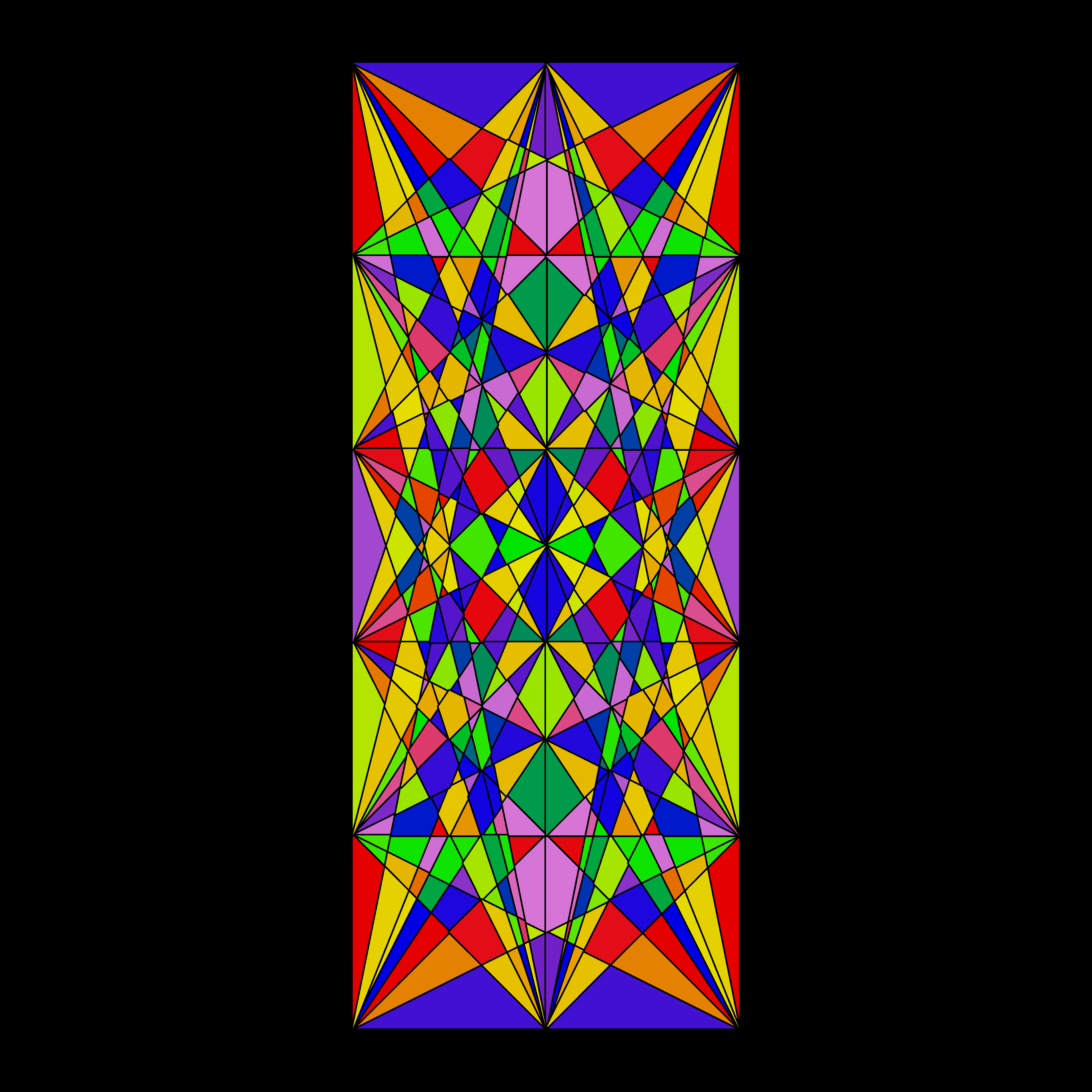
544 = 25 × 17. Take a grid of 2 times 5 points. There are 14 points on the perimeter. Join every pair of the perimeter points by a line segment. The lines do not extend outside the grid. 544 is the number of regions formed by these lines. Template:Oeis
544 is also the number of pieces that could be seen in a 5×5×5×5 Rubik's Tesseract. As a standard 5×5×5 has 98 visible pieces (53 − 33), a 5×5×5×5 has 544 visible pieces (54 − 34).
545
545 = 5 × 10⁹. It is a centered square number,[57] and it is palindromic in bases 10 (54510) and 17 (1F117).
546
546 = 2 × 3 × 7 × 13. It is a repdigit in bases 9 and 16, and it is palindromic in bases 4 (202024), 9 (6669), and 16 (22216). It is the sum of eight consecutive primes (53 + 59 + 61 + 67 + 71 + 73 + 79 + 83).
546! − 1 is prime.
547
547 is a prime number, a cuban prime,[58] a centered hexagonal number,[59] a centered heptagonal number,[60] and a prime index prime.
548
548 = 22 × 137. It is a nontotient. Every positive integer is the sum of at most 548 ninth powers.
549
549 = 32 × 61. It is a repdigit in bases 13 (33313) and 60 (9960).
φ(549) = φ(σ(549)).[61]
550s
550
550 = 2 × 52 × 11. It is a pentagonal pyramidal number,[62] a primitive abundant number,[63] a nontotient, and a Harshad number. It is a repdigit in bases 24 (MM24), 49 (BB49), and 54 (AA54).
551
551 = 19 × 29. It is palindromic in base 22 (13122) and the sum of three consecutive primes (179 + 181 + 191).
There are 551 mathematical trees on 12 unlabeled nodes.[64]
552
552 = 23 × 3 × 23. It is a pronic number,[16] an untouchable number, and a Harshad number.[26] It is palindromic in base 19 (1A119). It is the sum of six consecutive primes (79 + 83 + 89 + 97 + 101 + 103) and the sum of ten consecutive primes (37 + 41 + 43 + 47 + 53 + 59 + 61 + 67 + 71 + 73).
There are 552 prime knots with 11 crossings.[65]
553
553 = 7 × 79. It is a central polygonal number[17] and the sum of nine consecutive primes (43 + 47 + 53 + 59 + 61 + 67 + 71 + 73 + 79).
554
554 = 2 × 277. It is a nontotient and a 2-Knödel number.
Mertens function(554) = 6, a record high that stands until 586.
555
555= 3 × 5 × 37. It is a sphenic number.[66] It is a repdigit in base 10 and base 36. It is palindromic in bases 9 (6769), 10 (55510), and 12 (3A312). Because it is divisible by the sum of its digits (15), it is a Harshad number. It is also a Harshad number in binary, base 11, base 13 and hexadecimal.
555 is also a Moran number, because 555 ÷ (5+5+5) = 555 ÷ 15 = 37, and 37 is prime.[66]
556
556 = 22 × 139. It is a happy number and an untouchable number, because it is never the sum of the proper divisors of any integer.[26] It is the sum of four consecutive primes (131 + 137 + 139 + 149).
557
557 is a prime number, a Chen prime, and an Eisenstein prime with no imaginary part.
There are 557 parallelogram polyominoes with 9 cells.[67]
558
558 = 2 × 32 × 31. It is a nontotient, a Harshad number, and a repdigit in bases 30 (II30) and 61 (9961).
559
559 = 13 × 43. It is a nonagonal number[68] and a centered cube number.[69] It is palindromic in base 18 (1D118). It is the sum of five consecutive primes (103 + 107 + 109 + 113 + 127) and the sum of seven consecutive primes (67 + 71 + 73 + 79 + 83 + 89 + 97).
560s
560
560 = 24 × 5 × 7. It is a tetrahedral number,[70] an octagonal number, and a refactorable number. It is palindromic in bases 3 (2022023) and 6 (23326). There are 560 diagonals in a 35-gon.[40]
561
562
562 = 2 × 281. It is a Smith number,[27] an untouchable number.[26] and a lazy caterer number.[71] It is palindromic in bases 4 (203024), 13 (34313), 14 (2C214), 16 (23216), and 17 (1G117). It is the sum of twelve consecutive primes (23 + 29 + 31 + 37 + 41 + 43 + 47 + 53 + 59 + 61 + 67 + 71).
563
563 is a prime number a safe prime,[3] a Chen prime, an Eisenstein prime with no imaginary part, a balanced prime,[72] a sexy prime, a happy prime, a prime index prime, and a strictly non-palindromic number.[73] It is the largest known Wilson prime.[74]
5563 - 4563 is prime.[75]
564
564 = 22 × 3 × 47. It is a refactorable number and the sum of a pair of twin primes (281 + 283). It is palindromic in bases 5 (42245) and 9 (6869). There are 564 primes less than or equal to 212.[76]
565
565 = 5 × 113. It is a member of the Mian–Chowla sequence[77] and a happy number. It is palindromic in bases 10 (56510) and 11 (47411). It is the sum of three consecutive primes (181 + 191 + 193).
566
566 = 2 × 283. It is a nontotient, a happy number, and a 2-Knödel number.
567
567 = 34 × 7. It is palindromic in base 12 (3B312).
- is prime[14]
568
568 = 23 × 71. It is a refactorable number, and it is palindromic in bases 7 (14417) and 21 (16121). It is the sum of the first nineteen primes.[78] It is the smallest number whose seventh power is the sum of 7 seventh powers.
There are 568 millilitres in an imperial pint.
569
569 is a prime number, a Chen prime, an Eisenstein prime with no imaginary part, and a strictly non-palindromic number.[73]
570s
570
570 = 2 × 3 × 5 × 19. It is a triangular matchstick number[79] and a balanced number.[80]
571
571 is a prime number, a Chen prime, and a centered triangular number.[24] There are 571 domino tilings of a 3x10 rectangle.
572
572 = 22 × 11 × 13. It is a primitive abundant number[63] and a nontotient. It is palindromic in bases 3 (2100123) and 15 (28215).
573
573 = 3 × 191. It is a Blum integer.
It is known as the Konami number, since "ko-na-mi" is associated with 573 in the Japanese wordplay Goroawase.
574
574 = 2 × 7 × 41. It is a sphenic number and a nontotient. It is palindromic in base 9 (7079). There are 574 partitions of 27 that do not contain 1 as a part.[81]
There are 574 amino acid residues in a hemoglobin molecule.
575
575 = 52 × 23. It is palindromic in bases 10 (57510) and 13 (35313), and it is a centered octahedral number.[82]
The sum of the squares of the first 575 primes is divisible by 575.[83]
576
576 = 26 × 32 = 242. It is a highly totient number,[84] a Smith number,[27] an untouchable number,[26] a Harshad number, and a cake number. It is the sum of four consecutive primes (137 + 139 + 149 + 151). It is palindromic in bases 11 (48411), 14 (2D214), and 23 (12123). There are 576 parts in all compositions of 8.[85]
577
577 is a prime number, a Proth prime,[86] and a Chen prime. It is palindromic in bases 18 (1E118) and 24 (10124).
578
578 = 2 × 172. It is palindromic in base 16 (24216), and it is a nontotient. The area of a square with diagonal 34[87] is 578.
579
579 = 3 × 193. It is a semiprime and a ménage number.[88]
580s
580
580 = 22 × 5 × 29. It is palindromic in bases 12 (40412) and 17 (20217), and it is the sum of six consecutive primes (83 + 89 + 97 + 101 + 103 + 107).
581
581 = 7 × 83. It is a Blum integer and the sum of three consecutive primes (191 + 193 + 197).
582
582 = 2 × 3 × 97. It is a sphenic number, a nontotient, a vertically symmetric number,[89] and an admirable number. It is the sum of eight consecutive primes (59 + 61 + 67 + 71 + 73 + 79 + 83 + 89).
583
583 = 11 × 53. It is palindromic in base 9 (7179). There are 583 compositions of 11 whose run-lengths are either weakly increasing or weakly decreasing.[90]
584
584 = 23 × 73. It is an untouchable number,[26] a refactorable number and the sum of totient function for first 43 integers.
585
585 = 32 × 5 × 13. It is palindromic in bases 2 (10010010012), 8 (11118), and 10 (58510). It is a repdigit in bases 8, 38, 44, and 64. It is the sum of powers of 8 from 0 to 3.
When counting in binary with fingers, expressing 585 as 1001001001, results in the isolation of the index and little fingers of each hand, "throwing up the horns".
586
586 = 2 × 293. It is a 2-Knödel number.
Mertens function(586) = 7 a record high that stands until 1357.
587
587 is a prime number, a safe prime,[3] a Chen prime, an Eisenstein prime with no imaginary part, and a prime index prime. It is the sum of five consecutive primes (107 + 109 + 113 + 127 + 131). It is palindromic in bases 11 (49411) and 15 (29215).
588
588 = 22 × 3 × 72. It is a Smith number[27] and a Harshad number. It is palindromic in base 13 (36313).
589
589 = 19 × 31. It is a centered tetrahedral number and the sum of three consecutive primes (193 + 197 + 199). It is palindromic in base 21 (17121).
590s
590
590 = 2 × 5 × 59. It is a sphenic number, a pentagonal number,[46] and a nontotient. It is palindromic in base 19 (1C119).
591
591 = 3 × 197. It is a D-number[29]
592
592 = 24 × 37. It is a Harshad number. It is palindromic in bases 9 (7279) and 12 (41412).
593
593 is a prime number. a Sophie Germain prime, an Eisenstein prime with no imaginary part, a balanced prime,[72] a Leyland prime[91] using 2 & 9 (29 + 92), a member of the Mian–Chowla sequence,[77] and a strictly non-palindromic number.[73] It is the sum of seven consecutive primes (71 + 73 + 79 + 83 + 89 + 97 + 101) and the sum of nine consecutive primes (47 + 53 + 59 + 61 + 67 + 71 + 73 + 79 + 83).
594
594 = 2 × 33 × 11. It is a nontotient, a Harshad number, and a balanced number.[80] It is palindromic in bases 5 (43345) and 16 (25216). It is the sum of ten consecutive primes (41 + 43 + 47 + 53 + 59 + 61 + 67 + 71 + 73 + 79). There are 594 of diagonals in a 36-gon.[40]
595
595 = 5 × 7 × 17. It is a sphenic number, a centered nonagonal number,[92] and the 34th triangular number.[93] It is palindromic in bases 10 (59510) and 18 (1F118).
596
596 = 22 × 149. It is a nontotient and a lazy caterer number.[94] It is the sum of four consecutive primes (139 + 149 + 151 + 157).
597
597 = 3 × 199. It is a Blum integer
598
598 = 2 × 13 × 23 = 51 + 92 + 83. It is palindromic in bases 4 (211124) and 11 (4A411), and it is a sphenic number. There are 598 non-alternating permutations of {1...6}.
599
599 is a prime number, a Chen prime, an Eisenstein prime with no imaginary part, and a prime index prime.
References
- ↑ Template:Cite OEIS
- ↑ Template:Cite web
- ↑ 3.0 3.1 3.2 Template:Cite OEIS
- ↑ since 503+2 is a product of two primes, 5 and 101
- ↑ since it is a prime which is congruent to 2 modulo 3.
- ↑ Template:Cite OEIS
- ↑ that is, a term of the sequence Template:OEIS2C
- ↑ that is, the first term of the sequence Template:OEIS2C
- ↑ Template:Cite OEIS
- ↑ 10.0 10.1 10.2 Template:Cite OEIS
- ↑ 11.0 11.1 Template:Cite OEIS
- ↑ Template:Cite OEIS
- ↑ Template:Cite journal
- ↑ 14.0 14.1 14.2 14.3 14.4 Template:Cite OEIS
- ↑ Template:Cite OEIS
- ↑ 16.0 16.1 Template:Cite OEIS
- ↑ 17.0 17.1 Template:Cite OEIS
- ↑ Template:Cite OEIS
- ↑ Template:Cite OEIS
- ↑ Template:Cite OEIS
- ↑ Template:Cite OEIS
- ↑ Template:Cite OEIS
- ↑ Template:Cite OEIS
- ↑ 24.0 24.1 Template:Cite OEIS
- ↑ Template:Cite OEIS
- ↑ 26.00 26.01 26.02 26.03 26.04 26.05 26.06 26.07 26.08 26.09 Template:Cite OEIS
- ↑ 27.0 27.1 27.2 27.3 27.4 27.5 Template:Cite OEIS
- ↑ Template:Cite web
- ↑ 29.0 29.1 29.2 29.3 Template:Cite OEIS
- ↑ Template:Cite OEIS
- ↑ Template:Cite web
- ↑ Template:Cite web
- ↑ Template:Cite OEIS
- ↑ Template:Cite OEIS
- ↑ Template:Cite OEIS
- ↑ Template:Cite OEIS
- ↑ Template:Cite OEIS
- ↑ Template:Cite OEIS
- ↑ Template:Cite OEIS
- ↑ 40.0 40.1 40.2 Template:Cite OEIS
- ↑ Template:Cite web
- ↑ Template:Cite web
- ↑ Template:Cite OEIS
- ↑ Template:Cite web
- ↑ Template:Cite OEIS
- ↑ 46.0 46.1 Template:Cite OEIS
- ↑ Template:Cite OEIS
- ↑ Template:Cite news
- ↑ Template:Cite web
- ↑ Template:Cite OEIS
- ↑ Template:Cite OEIS
- ↑ Template:Cite OEIS
- ↑ Template:Cite OEIS
- ↑ Template:Cite OEIS
- ↑ Template:Cite OEIS
- ↑ Template:Cite OEIS
- ↑ Template:Cite OEIS
- ↑ Template:Cite OEIS
- ↑ Template:Cite OEIS
- ↑ Template:Cite OEIS
- ↑ Template:Cite OEIS
- ↑ Template:Cite OEIS
- ↑ 63.0 63.1 Template:Cite OEIS
- ↑ Template:Cite web
- ↑ Template:Cite OEIS
- ↑ 66.0 66.1 Template:Cite web
- ↑ Template:Cite OEIS
- ↑ Template:Cite OEIS
- ↑ Template:Cite OEIS
- ↑ Template:Cite OEIS
- ↑ Template:Cite web
- ↑ 72.0 72.1 Template:Cite OEIS
- ↑ 73.0 73.1 73.2 Template:Cite OEIS
- ↑ Template:Cite OEIS
- ↑ Template:Cite OEIS
- ↑ Template:Cite OEIS
- ↑ 77.0 77.1 Template:Cite OEIS
- ↑ Template:Cite web
- ↑ Template:Cite OEIS
- ↑ 80.0 80.1 Template:Cite OEIS
- ↑ Template:Cite OEIS
- ↑ Template:Cite OEIS
- ↑ Template:Cite OEIS
- ↑ Template:Cite OEIS
- ↑ Template:Cite OEIS
- ↑ Template:Cite OEIS
- ↑ Template:Cite OEIS
- ↑ Template:Cite OEIS
- ↑ Template:Cite web
- ↑ Template:Cite OEIS
- ↑ Template:Cite OEIS
- ↑ Template:Cite OEIS
- ↑ Template:Cite web
- ↑ Template:Cite web