Complex polytope
Template:Dark mode problems In geometry, a complex polytope is a generalization of a polytope in real space to an analogous structure in a complex Hilbert space, where each real dimension is accompanied by an imaginary one.
A complex polytope may be understood as a collection of complex points, lines, planes, and so on, where every point is the junction of multiple lines, every line of multiple planes, and so on.
Precise definitions exist only for the regular complex polytopes, which are configurations. The regular complex polytopes have been completely characterized, and can be described using a symbolic notation developed by Coxeter.
Some complex polytopes which are not fully regular have also been described.
Definitions and introduction
The complex line has one dimension with real coordinates and another with imaginary coordinates. Applying real coordinates to both dimensions is said to give it two dimensions over the real numbers. A real plane, with the imaginary axis labelled as such, is called an Argand diagram. Because of this it is sometimes called the complex plane. Complex 2-space (also sometimes called the complex plane) is thus a four-dimensional space over the reals, and so on in higher dimensions.
A complex n-polytope in complex n-space is the analogue of a real n-polytope in real n-space. However, there is no natural complex analogue of the ordering of points on a real line (or of the associated combinatorial properties). Because of this a complex polytope cannot be seen as a contiguous surface and it does not bound an interior in the way that a real polytope does.
In the case of regular polytopes, a precise definition can be made by using the notion of symmetry. For any regular polytope the symmetry group (here a complex reflection group, called a Shephard group) acts transitively on the flags, that is, on the nested sequences of a point contained in a line contained in a plane and so on.
More fully, say that a collection P of affine subspaces (or flats) of a complex unitary space V of dimension n is a regular complex polytope if it meets the following conditions:[1][2]
- for every Template:Math, if Template:Math is a flat in P of dimension i and Template:Math is a flat in P of dimension k such that Template:Math then there are at least two flats G in P of dimension j such that Template:Math;
- for every Template:Math such that Template:Math, if Template:Math are flats of P of dimensions i, j, then the set of flats between F and G is connected, in the sense that one can get from any member of this set to any other by a sequence of containments; and
- the subset of unitary transformations of V that fix P are transitive on the flags Template:Math of flats of P (with Template:Math of dimension i for all i).
(Here, a flat of dimension −1 is taken to mean the empty set.) Thus, by definition, regular complex polytopes are configurations in complex unitary space.
The regular complex polytopes were discovered by Shephard (1952), and the theory was further developed by Coxeter (1974).
 This complex polygon has 8 edges (complex lines), labeled as a..h, and 16 vertices. Four vertices lie in each edge and two edges intersect at each vertex. In the left image, the outlined squares are not elements of the polytope but are included merely to help identify vertices lying in the same complex line. The octagonal perimeter of the left image is not an element of the polytope, but it is a petrie polygon.[3] In the middle image, each edge is represented as a real line and the four vertices in each line can be more clearly seen. |
 A perspective sketch representing the 16 vertex points as large black dots and the 8 4-edges as bounded squares within each edge. The green path represents the octagonal perimeter of the left hand image. |
A complex polytope exists in the complex space of equivalent dimension. For example, the vertices of a complex polygon are points in the complex plane (a plane in which each point has two complex numbers as its coordinates, not to be confused with the Argand plane of complex numbers), and the edges are complex lines existing as (affine) subspaces of the plane and intersecting at the vertices. Thus, as a one-dimensional complex space, an edge can be given its own coordinate system, within which the points of the edge are each represented by a single complex number.
In a regular complex polytope the vertices incident on the edge are arranged symmetrically about their centroid, which is often used as the origin of the edge's coordinate system (in the real case the centroid is just the midpoint of the edge). The symmetry arises from a complex reflection about the centroid; this reflection will leave the magnitude of any vertex unchanged, but change its argument by a fixed amount, moving it to the coordinates of the next vertex in order. So we may assume (after a suitable choice of scale) that the vertices on the edge satisfy the equation where p is the number of incident vertices. Thus, in the Argand diagram of the edge, the vertex points lie at the vertices of a regular polygon centered on the origin.
Three real projections of regular complex polygon 4{4}2 are illustrated above, with edges a, b, c, d, e, f, g, h. It has 16 vertices, which for clarity have not been individually marked. Each edge has four vertices and each vertex lies on two edges, hence each edge meets four other edges. In the first diagram, each edge is represented by a square. The sides of the square are not parts of the polygon but are drawn purely to help visually relate the four vertices. The edges are laid out symmetrically. (Note that the diagram looks similar to the B4 Coxeter plane projection of the tesseract, but it is structurally different).
The middle diagram abandons octagonal symmetry in favour of clarity. Each edge is shown as a real line, and each meeting point of two lines is a vertex. The connectivity between the various edges is clear to see.
The last diagram gives a flavour of the structure projected into three dimensions: the two cubes of vertices are in fact the same size but are seen in perspective at different distances away in the fourth dimension.
Regular complex one-dimensional polytopes

A real 1-dimensional polytope exists as a closed segment in the real line , defined by its two end points or vertices in the line. Its Schläfli symbol is {} .
Analogously, a complex 1-polytope exists as a set of p vertex points in the complex line . These may be represented as a set of points in an Argand diagram (x,y)=x+iy. A regular complex 1-dimensional polytope p{} has p (p ≥ 2) vertex points arranged to form a convex regular polygon {p} in the Argand plane.[4]
Unlike points on the real line, points on the complex line have no natural ordering. Thus, unlike real polytopes, no interior can be defined.[5] Despite this, complex 1-polytopes are often drawn, as here, as a bounded regular polygon in the Argand plane.

A regular real 1-dimensional polytope is represented by an empty Schläfli symbol {}, or Coxeter-Dynkin diagram Template:CDD. The dot or node of the Coxeter-Dynkin diagram itself represents a reflection generator while the circle around the node means the generator point is not on the reflection, so its reflective image is a distinct point from itself. By extension, a regular complex 1-dimensional polytope in has Coxeter-Dynkin diagram Template:CDD, for any positive integer p, 2 or greater, containing p vertices. p can be suppressed if it is 2. It can also be represented by an empty Schläfli symbol p{}, }p{, {}p, or p{2}1. The 1 is a notational placeholder, representing a nonexistent reflection, or a period 1 identity generator. (A 0-polytope, real or complex is a point, and is represented as } {, or 1{2}1.)
The symmetry is denoted by the Coxeter diagram Template:CDD, and can alternatively be described in Coxeter notation as p[], []p or ]p[, p[2]1 or p[1]p. The symmetry is isomorphic to the cyclic group, order p.[6] The subgroups of p[] are any whole divisor d, d[], where d≥2.
A unitary operator generator for Template:CDD is seen as a rotation by 2π/p radians counter clockwise, and a Template:CDD edge is created by sequential applications of a single unitary reflection. A unitary reflection generator for a 1-polytope with p vertices is Template:Math. When p = 2, the generator is eπi = –1, the same as a point reflection in the real plane.
In higher complex polytopes, 1-polytopes form p-edges. A 2-edge is similar to an ordinary real edge, in that it contains two vertices, but need not exist on a real line.
Regular complex polygons
While 1-polytopes can have unlimited p, finite regular complex polygons, excluding the double prism polygons p{4}2, are limited to 5-edge (pentagonal edges) elements, and infinite regular apeirogons also include 6-edge (hexagonal edges) elements.
Notations
Shephard's modified Schläfli notation
Shephard originally devised a modified form of Schläfli's notation for regular polytopes. For a polygon bounded by p1-edges, with a p2-set as vertex figure and overall symmetry group of order g, we denote the polygon as p1(g)p2.
The number of vertices V is then g/p2 and the number of edges E is g/p1.
The complex polygon illustrated above has eight square edges (p1=4) and sixteen vertices (p2=2). From this we can work out that g = 32, giving the modified Schläfli symbol 4(32)2.
Coxeter's revised modified Schläfli notation
A more modern notation p1{q}p2 is due to Coxeter,[7] and is based on group theory. As a symmetry group, its symbol is p1[q]p2.
The symmetry group p1[q]p2 is represented by 2 generators R1, R2, where: R1p1 = R2p2 = I. If q is even, (R2R1)q/2 = (R1R2)q/2. If q is odd, (R2R1)(q−1)/2R2 = (R1R2)(q−1)/2R1. When q is odd, p1=p2.
For 4[4]2 has R14 = R22 = I, (R2R1)2 = (R1R2)2.
For 3[5]3 has R13 = R23 = I, (R2R1)2R2 = (R1R2)2R1.
Coxeter-Dynkin diagrams
Coxeter also generalised the use of Coxeter-Dynkin diagrams to complex polytopes, for example the complex polygon p{q}r is represented by Template:CDD and the equivalent symmetry group, p[q]r, is a ringless diagram Template:CDD. The nodes p and r represent mirrors producing p and r images in the plane. Unlabeled nodes in a diagram have implicit 2 labels. For example, a real regular polygon is 2{q}2 or {q} or Template:CDD.
One limitation, nodes connected by odd branch orders must have identical node orders. If they do not, the group will create "starry" polygons, with overlapping element. So Template:CDD and Template:CDD are ordinary, while Template:CDD is starry.
12 Irreducible Shephard groups

p[2q]2 → p[q]p, index 2.
p[4]q → p[q]p, index q.

p[4]2 → [p], index p
p[4]2 → p[]×p[], index 2
Coxeter enumerated this list of regular complex polygons in . A regular complex polygon, p{q}r or Template:CDD, has p-edges, and r-gonal vertex figures. p{q}r is a finite polytope if (p+r)q>pr(q-2).
Its symmetry is written as p[q]r, called a Shephard group, analogous to a Coxeter group, while also allowing unitary reflections.
For nonstarry groups, the order of the group p[q]r can be computed as .[9]
The Coxeter number for p[q]r is , so the group order can also be computed as . A regular complex polygon can be drawn in orthogonal projection with h-gonal symmetry.
The rank 2 solutions that generate complex polygons are:
| Group | G3=G(q,1,1) | G2=G(p,1,2) | G4 | G6 | G5 | G8 | G14 | G9 | G10 | G20 | G16 | G21 | G17 | G18 |
|---|---|---|---|---|---|---|---|---|---|---|---|---|---|---|
| 2[q]2, q=3,4... | p[4]2, p=2,3... | 3[3]3 | 3[6]2 | 3[4]3 | 4[3]4 | 3[8]2 | 4[6]2 | 4[4]3 | 3[5]3 | 5[3]5 | 3[10]2 | 5[6]2 | 5[4]3 | |
| Template:CDD | Template:CDD | Template:CDD | Template:CDD | Template:CDD | Template:CDD | Template:CDD | Template:CDD | Template:CDD | Template:CDD | Template:CDD | Template:CDD | Template:CDD | Template:CDD | |
| Order | 2q | 2p2 | 24 | 48 | 72 | 96 | 144 | 192 | 288 | 360 | 600 | 720 | 1200 | 1800 |
| h | q | 2p | 6 | 12 | 24 | 30 | 60 | |||||||
Excluded solutions with odd q and unequal p and r are: 6[3]2, 6[3]3, 9[3]3, 12[3]3, ..., 5[5]2, 6[5]2, 8[5]2, 9[5]2, 4[7]2, 9[5]2, 3[9]2, and 3[11]2.
Other whole q with unequal p and r, create starry groups with overlapping fundamental domains: Template:CDD, Template:CDD, Template:CDD, Template:CDD, Template:CDD, and Template:CDD.
The dual polygon of p{q}r is r{q}p. A polygon of the form p{q}p is self-dual. Groups of the form p[2q]2 have a half symmetry p[q]p, so a regular polygon Template:CDD is the same as quasiregular Template:CDD. As well, regular polygon with the same node orders, Template:CDD, have an alternated construction Template:CDD, allowing adjacent edges to be two different colors.[10]
The group order, g, is used to compute the total number of vertices and edges. It will have g/r vertices, and g/p edges. When p=r, the number of vertices and edges are equal. This condition is required when q is odd.
Matrix generators
The group p[q]r, Template:CDD, can be represented by two matrices:[11]
| Name | R1 Template:CDD |
R2 Template:CDD |
|---|---|---|
| Order | p | r |
| Matrix |
|
|
With
- k=
- Examples
|
|
| |||||||||||||||||||||||||||
|
|
|
Enumeration of regular complex polygons
Coxeter enumerated the complex polygons in Table III of Regular Complex Polytopes.[12]
| Group | Order | Coxeter number |
Polygon | Vertices | Edges | Notes | ||
|---|---|---|---|---|---|---|---|---|
| G(q,q,2) 2[q]2 = [q] q=2,3,4,... |
2q | q | 2{q}2 | Template:CDD | q | q | {} | Real regular polygons Same as Template:CDD Same as Template:CDD if q even |
| Group | Order | Coxeter number |
Polygon | Vertices | Edges | Notes | |||
|---|---|---|---|---|---|---|---|---|---|
| G(p,1,2) p[4]2 p=2,3,4,... |
2p2 | 2p | p(2p2)2 | p{4}2 | Template:CDD |
p2 | 2p | p{} | same as p{}×p{} or Template:CDD representation as p-p duoprism |
| 2(2p2)p | 2{4}p | Template:CDD | 2p | p2 | {} | representation as p-p duopyramid | |||
| G(2,1,2) 2[4]2 = [4] |
8 | 4 | 2{4}2 = {4} | Template:CDD | 4 | 4 | {} | same as {}×{} or Template:CDD Real square | |
| G(3,1,2) 3[4]2 |
18 | 6 | 6(18)2 | 3{4}2 | Template:CDD | 9 | 6 | 3{} | same as 3{}×3{} or Template:CDD representation as 3-3 duoprism |
| 2(18)3 | 2{4}3 | Template:CDD | 6 | 9 | {} | representation as 3-3 duopyramid | |||
| G(4,1,2) 4[4]2 |
32 | 8 | 8(32)2 | 4{4}2 | Template:CDD | 16 | 8 | 4{} | same as 4{}×4{} or Template:CDD representation as 4-4 duoprism or {4,3,3} |
| 2(32)4 | 2{4}4 | Template:CDD | 8 | 16 | {} | representation as 4-4 duopyramid or {3,3,4} | |||
| G(5,1,2) 5[4]2 |
50 | 25 | 5(50)2 | 5{4}2 | Template:CDD | 25 | 10 | 5{} | same as 5{}×5{} or Template:CDD representation as 5-5 duoprism |
| 2(50)5 | 2{4}5 | Template:CDD | 10 | 25 | {} | representation as 5-5 duopyramid | |||
| G(6,1,2) 6[4]2 |
72 | 36 | 6(72)2 | 6{4}2 | Template:CDD | 36 | 12 | 6{} | same as 6{}×6{} or Template:CDD representation as 6-6 duoprism |
| 2(72)6 | 2{4}6 | Template:CDD | 12 | 36 | {} | representation as 6-6 duopyramid | |||
| G4=G(1,1,2) 3[3]3 <2,3,3> |
24 | 6 | 3(24)3 | 3{3}3 | Template:CDD | 8 | 8 | 3{} | Möbius–Kantor configuration self-dual, same as Template:CDD representation as {3,3,4} |
| G6 3[6]2 |
48 | 12 | 3(48)2 | 3{6}2 | Template:CDD | 24 | 16 | 3{} | same as Template:CDD |
| 3{3}2 | Template:CDD | starry polygon | |||||||
| 2(48)3 | 2{6}3 | Template:CDD | 16 | 24 | {} | ||||
| 2{3}3 | Template:CDD | starry polygon | |||||||
| G5 3[4]3 |
72 | 12 | 3(72)3 | 3{4}3 | Template:CDD | 24 | 24 | 3{} | self-dual, same as Template:CDD representation as {3,4,3} |
| G8 4[3]4 |
96 | 12 | 4(96)4 | 4{3}4 | Template:CDD | 24 | 24 | 4{} | self-dual, same as Template:CDD representation as {3,4,3} |
| G14 3[8]2 |
144 | 24 | 3(144)2 | 3{8}2 | Template:CDD | 72 | 48 | 3{} | same as Template:CDD |
| 3{8/3}2 | Template:CDD | starry polygon, same as Template:CDD | |||||||
| 2(144)3 | 2{8}3 | Template:CDD | 48 | 72 | {} | ||||
| 2{8/3}3 | Template:CDD | starry polygon | |||||||
| G9 4[6]2 |
192 | 24 | 4(192)2 | 4{6}2 | Template:CDD | 96 | 48 | 4{} | same as Template:CDD |
| 2(192)4 | 2{6}4 | Template:CDD | 48 | 96 | {} | ||||
| 4{3}2 | Template:CDD | 96 | 48 | {} | starry polygon | ||||
| 2{3}4 | Template:CDD | 48 | 96 | {} | starry polygon | ||||
| G10 4[4]3 |
288 | 24 | 4(288)3 | 4{4}3 | Template:CDD | 96 | 72 | 4{} | |
| 12 | 4{8/3}3 | Template:CDD | starry polygon | ||||||
| 24 | 3(288)4 | 3{4}4 | Template:CDD | 72 | 96 | 3{} | |||
| 12 | 3{8/3}4 | Template:CDD | starry polygon | ||||||
| G20 3[5]3 |
360 | 30 | 3(360)3 | 3{5}3 | Template:CDD | 120 | 120 | 3{} | self-dual, same as Template:CDD representation as {3,3,5} |
| 3{5/2}3 | Template:CDD | self-dual, starry polygon | |||||||
| G16 5[3]5 |
600 | 30 | 5(600)5 | 5{3}5 | Template:CDD | 120 | 120 | 5{} | self-dual, same as Template:CDD representation as {3,3,5} |
| 10 | 5{5/2}5 | Template:CDD | self-dual, starry polygon | ||||||
| G21 3[10]2 |
720 | 60 | 3(720)2 | 3{10}2 | Template:CDD | 360 | 240 | 3{} | same as Template:CDD |
| 3{5}2 | Template:CDD | starry polygon | |||||||
| 3{10/3}2 | Template:CDD | starry polygon, same as Template:CDD | |||||||
| 3{5/2}2 | Template:CDD | starry polygon | |||||||
| 2(720)3 | 2{10}3 | Template:CDD | 240 | 360 | {} | ||||
| 2{5}3 | Template:CDD | starry polygon | |||||||
| 2{10/3}3 | Template:CDD | starry polygon | |||||||
| 2{5/2}3 | Template:CDD | starry polygon | |||||||
| G17 5[6]2 |
1200 | 60 | 5(1200)2 | 5{6}2 | Template:CDD | 600 | 240 | 5{} | same as Template:CDD |
| 20 | 5{5}2 | Template:CDD | starry polygon | ||||||
| 20 | 5{10/3}2 | Template:CDD | starry polygon | ||||||
| 60 | 5{3}2 | Template:CDD | starry polygon | ||||||
| 60 | 2(1200)5 | 2{6}5 | Template:CDD | 240 | 600 | {} | |||
| 20 | 2{5}5 | Template:CDD | starry polygon | ||||||
| 20 | 2{10/3}5 | Template:CDD | starry polygon | ||||||
| 60 | 2{3}5 | Template:CDD | starry polygon | ||||||
| G18 5[4]3 |
1800 | 60 | 5(1800)3 | 5{4}3 | Template:CDD | 600 | 360 | 5{} | |
| 15 | 5{10/3}3 | Template:CDD | starry polygon | ||||||
| 30 | 5{3}3 | Template:CDD | starry polygon | ||||||
| 30 | 5{5/2}3 | Template:CDD | starry polygon | ||||||
| 60 | 3(1800)5 | 3{4}5 | Template:CDD | 360 | 600 | 3{} | |||
| 15 | 3{10/3}5 | Template:CDD | starry polygon | ||||||
| 30 | 3{3}5 | Template:CDD | starry polygon | ||||||
| 30 | 3{5/2}5 | Template:CDD | starry polygon | ||||||
Visualizations of regular complex polygons
Polygons of the form p{2r}q can be visualized by q color sets of p-edge. Each p-edge is seen as a regular polygon, while there are no faces.
- 2D orthogonal projections of complex polygons 2{r}q
Polygons of the form 2{4}q are called generalized orthoplexes. They share vertices with the 4D q-q duopyramids, vertices connected by 2-edges.
-
 2{4}2, Template:CDD, with 4 vertices, and 4 edges
 -
![2{4}3, Template:CDD, with 6 vertices, and 9 edges[13]](https://upload.wikimedia.org/wikipedia/commons/thumb/7/70/Complex_polygon_2-4-3-bipartite_graph.png/120px-Complex_polygon_2-4-3-bipartite_graph.png) 2{4}3, Template:CDD, with 6 vertices, and 9 edges[13]
2{4}3, Template:CDD, with 6 vertices, and 9 edges[13] -
 2{4}4, Template:CDD, with 8 vertices, and 16 edges
 -
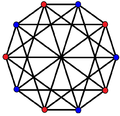 2{4}5, Template:CDD, with 10 vertices, and 25 edges
 -
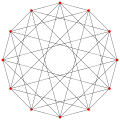 2{4}6, Template:CDD, with 12 vertices, and 36 edges
 -
 2{4}7, Template:CDD, with 14 vertices, and 49 edges
 -
 2{4}8, Template:CDD, with 16 vertices, and 64 edges
 -
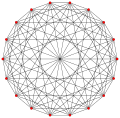 2{4}9, Template:CDD, with 18 vertices, and 81 edges
 -
 2{4}10, Template:CDD, with 20 vertices, and 100 edges

![2{4}3, Template:CDD, with 6 vertices, and 9 edges[13]](/wiki/File:Complex_polygon_2-4-3-bipartite_graph.png)


- Complex polygons p{4}2
Polygons of the form p{4}2 are called generalized hypercubes (squares for polygons). They share vertices with the 4D p-p duoprisms, vertices connected by p-edges. Vertices are drawn in green, and p-edges are drawn in alternate colors, red and blue. The perspective is distorted slightly for odd dimensions to move overlapping vertices from the center.
-
 2{4}2, Template:CDD or Template:CDD, with 4 vertices, and 4 2-edges
 -
![3{4}2, Template:CDD or Template:CDD, with 9 vertices, and 6 (triangular) 3-edges[13]](https://upload.wikimedia.org/wikipedia/commons/thumb/d/dc/3-generalized-2-cube_skew.svg/120px-3-generalized-2-cube_skew.svg.png)
-
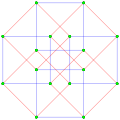 4{4}2, Template:CDD or Template:CDD, with 16 vertices, and 8 (square) 4-edges
 -
 5{4}2, Template:CDD or Template:CDD, with 25 vertices, and 10 (pentagonal) 5-edges
 -
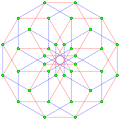 6{4}2, Template:CDD or Template:CDD, with 36 vertices, and 12 (hexagonal) 6-edges
 -
 7{4}2, Template:CDD or Template:CDD, with 49 vertices, and 14 (heptagonal)7-edges
 -
 8{4}2, Template:CDD or Template:CDD, with 64 vertices, and 16 (octagonal) 8-edges
 -
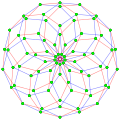 9{4}2, Template:CDD or Template:CDD, with 81 vertices, and 18 (enneagonal) 9-edges
 -
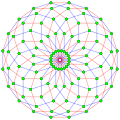 10{4}2, Template:CDD or Template:CDD, with 100 vertices, and 20 (decagonal) 10-edges


- 3D perspective projections of complex polygons p{4}2. The duals 2{4}p
- are seen by adding vertices inside the edges, and adding edges in place of vertices.
-
 3{4}2, Template:CDD or Template:CDD with 9 vertices, 6 3-edges in 2 sets of colors
 -
 2{4}3, Template:CDD with 6 vertices, 9 edges in 3 sets
 -
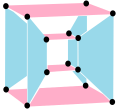 4{4}2, Template:CDD or Template:CDD with 16 vertices, 8 4-edges in 2 sets of colors and filled square 4-edges
 -
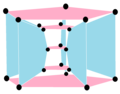 5{4}2, Template:CDD or Template:CDD with 25 vertices, 10 5-edges in 2 sets of colors


- Other Complex polygons p{r}2
-
![3{6}2, Template:CDD or Template:CDD, with 24 vertices in black, and 16 3-edges colored in 2 sets of 3-edges in red and blue[14]](https://upload.wikimedia.org/wikipedia/commons/thumb/3/36/Complex_polygon_3-6-2.png/120px-Complex_polygon_3-6-2.png) 3{6}2, Template:CDD or Template:CDD, with 24 vertices in black, and 16 3-edges colored in 2 sets of 3-edges in red and blue[14]
3{6}2, Template:CDD or Template:CDD, with 24 vertices in black, and 16 3-edges colored in 2 sets of 3-edges in red and blue[14] -
![3{8}2, Template:CDD or Template:CDD, with 72 vertices in black, and 48 3-edges colored in 2 sets of 3-edges in red and blue[15]](https://upload.wikimedia.org/wikipedia/commons/thumb/0/00/Complex_polygon_3-8-2.png/120px-Complex_polygon_3-8-2.png) 3{8}2, Template:CDD or Template:CDD, with 72 vertices in black, and 48 3-edges colored in 2 sets of 3-edges in red and blue[15]
3{8}2, Template:CDD or Template:CDD, with 72 vertices in black, and 48 3-edges colored in 2 sets of 3-edges in red and blue[15]
- 2D orthogonal projections of complex polygons, p{r}p
Polygons of the form p{r}p have equal number of vertices and edges. They are also self-dual.
-
![3{3}3, Template:CDD or Template:CDD, with 8 vertices in black, and 8 3-edges colored in 2 sets of 3-edges in red and blue[16]](https://upload.wikimedia.org/wikipedia/commons/thumb/6/6c/Complex_polygon_3-3-3.svg/120px-Complex_polygon_3-3-3.svg.png) 3{3}3, Template:CDD or Template:CDD, with 8 vertices in black, and 8 3-edges colored in 2 sets of 3-edges in red and blue[16]
3{3}3, Template:CDD or Template:CDD, with 8 vertices in black, and 8 3-edges colored in 2 sets of 3-edges in red and blue[16] -
![3{4}3, Template:CDD or Template:CDD, with 24 vertices and 24 3-edges shown in 3 sets of colors, one set filled[17]](https://upload.wikimedia.org/wikipedia/commons/thumb/d/de/Complex_polygon_3-4-3-fill1.png/120px-Complex_polygon_3-4-3-fill1.png) 3{4}3, Template:CDD or Template:CDD, with 24 vertices and 24 3-edges shown in 3 sets of colors, one set filled[17]
3{4}3, Template:CDD or Template:CDD, with 24 vertices and 24 3-edges shown in 3 sets of colors, one set filled[17] -
![4{3}4, Template:CDD or Template:CDD, with 24 vertices and 24 4-edges shown in 4 sets of colors[17]](https://upload.wikimedia.org/wikipedia/commons/thumb/4/46/Complex_polygon_4-3-4.png/120px-Complex_polygon_4-3-4.png)
-
![3{5}3, Template:CDD or Template:CDD, with 120 vertices and 120 3-edges[18]](https://upload.wikimedia.org/wikipedia/commons/thumb/2/20/Complex_polygon_3-5-3.png/120px-Complex_polygon_3-5-3.png)
-
![5{3}5, Template:CDD or Template:CDD, with 120 vertices and 120 5-edges[19]](https://upload.wikimedia.org/wikipedia/commons/thumb/b/b9/Complex_polygon_5-3-5.png/120px-Complex_polygon_5-3-5.png)
![3{4}3, Template:CDD or Template:CDD, with 24 vertices and 24 3-edges shown in 3 sets of colors, one set filled[17]](/wiki/File:Complex_polygon_3-4-3-fill1.png)
![4{3}4, Template:CDD or Template:CDD, with 24 vertices and 24 4-edges shown in 4 sets of colors[17]](/wiki/File:Complex_polygon_4-3-4.png)
![3{5}3, Template:CDD or Template:CDD, with 120 vertices and 120 3-edges[18]](/wiki/File:Complex_polygon_3-5-3.png)
![5{3}5, Template:CDD or Template:CDD, with 120 vertices and 120 5-edges[19]](/wiki/File:Complex_polygon_5-3-5.png)
Regular complex polytopes
In general, a regular complex polytope is represented by Coxeter as p{z1}q{z2}r{z3}s... or Coxeter diagram Template:CDD..., having symmetry p[z1]q[z2]r[z3]s... or Template:CDD....[20]
There are infinite families of regular complex polytopes that occur in all dimensions, generalizing the hypercubes and cross polytopes in real space. Shephard's "generalized orthotope" generalizes the hypercube; it has symbol given by γTemplate:Supsub = p{4}2{3}2...2{3}2 and diagram Template:CDD...Template:CDD. Its symmetry group has diagram p[4]2[3]2...2[3]2; in the Shephard–Todd classification, this is the group G(p, 1, n) generalizing the signed permutation matrices. Its dual regular polytope, the "generalized cross polytope", is represented by the symbol βTemplate:Supsub = 2{3}2{3}2...2{4}p and diagram Template:CDD...Template:CDD.[21]
A 1-dimensional regular complex polytope in is represented as Template:CDD, having p vertices, with its real representation a regular polygon, {p}. Coxeter also gives it symbol γTemplate:Supsub or βTemplate:Supsub as 1-dimensional generalized hypercube or cross polytope. Its symmetry is p[] or Template:CDD, a cyclic group of order p. In a higher polytope, p{} or Template:CDD represents a p-edge element, with a 2-edge, {} or Template:CDD, representing an ordinary real edge between two vertices.[21]
A dual complex polytope is constructed by exchanging k and (n-1-k)-elements of an n-polytope. For example, a dual complex polygon has vertices centered on each edge, and new edges are centered at the old vertices. A v-valence vertex creates a new v-edge, and e-edges become e-valence vertices.[22] The dual of a regular complex polytope has a reversed symbol. Regular complex polytopes with symmetric symbols, i.e. p{q}p, p{q}r{q}p, p{q}r{s}r{q}p, etc. are self dual.
Enumeration of regular complex polyhedra

Coxeter enumerated this list of nonstarry regular complex polyhedra in , including the 5 platonic solids in .[23]
A regular complex polyhedron, p{n1}q{n2}r or Template:CDD, has Template:CDD faces, Template:CDD edges, and Template:CDD vertex figures.
A complex regular polyhedron p{n1}q{n2}r requires both g1 = order(p[n1]q) and g2 = order(q[n2]r) be finite.
Given g = order(p[n1]q[n2]r), the number of vertices is g/g2, and the number of faces is g/g1. The number of edges is g/pr.
| Space | Group | Order | Coxeter number | Polygon | Vertices | Edges | Faces | Vertex figure |
Van Oss polygon |
Notes | |||
|---|---|---|---|---|---|---|---|---|---|---|---|---|---|
| G(1,1,3) 2[3]2[3]2 = [3,3] |
24 | 4 | α3 = 2{3}2{3}2 = {3,3} |
Template:CDD | 4 | 6 | {} | 4 | {3} | {3} | none | Real tetrahedron Same as Template:CDD | |
| G23 2[3]2[5]2 = [3,5] |
120 | 10 | 2{3}2{5}2 = {3,5} | Template:CDD | 12 | 30 | {} | 20 | {3} | {5} | none | Real icosahedron | |
| 2{5}2{3}2 = {5,3} | Template:CDD | 20 | 30 | {} | 12 | {5} | {3} | none | Real dodecahedron | ||||
| G(2,1,3) 2[3]2[4]2 = [3,4] |
48 | 6 | βTemplate:Supsub = β3 = {3,4} | Template:CDD | 6 | 12 | {} | 8 | {3} | {4} | {4} | Real octahedron Same as {}+{}+{}, order 8 Same as Template:CDD, order 24 | |
| γTemplate:Supsub = γ3 = {4,3} | Template:CDD | 8 | 12 | {} | 6 | {4} | {3} | none | Real cube Same as {}×{}×{} or Template:CDD | ||||
| G(p,1,3) 2[3]2[4]p p=2,3,4,... |
6p3 | 3p | βTemplate:Supsub = 2{3}2{4}p | Template:CDD |
3p | 3p2 | {} | p3 | {3} | 2{4}p | 2{4}p | Generalized octahedron Same as p{}+p{}+p{}, order p3 Same as Template:CDD, order 6p2 | |
| γTemplate:Supsub = p{4}2{3}2 | Template:CDD | p3 | 3p2 | p{} | 3p | p{4}2 | {3} | none | Generalized cube Same as p{}×p{}×p{} or Template:CDD | ||||
| G(3,1,3) 2[3]2[4]3 |
162 | 9 | βTemplate:Supsub = 2{3}2{4}3 | Template:CDD | 9 | 27 | {} | 27 | {3} | 2{4}3 | 2{4}3 | Same as 3{}+3{}+3{}, order 27 Same as Template:CDD, order 54 | |
| γTemplate:Supsub = 3{4}2{3}2 | Template:CDD | 27 | 27 | 3{} | 9 | 3{4}2 | {3} | none | Same as 3{}×3{}×3{} or Template:CDD | ||||
| G(4,1,3) 2[3]2[4]4 |
384 | 12 | βTemplate:Supsub = 2{3}2{4}4 | Template:CDD | 12 | 48 | {} | 64 | {3} | 2{4}4 | 2{4}4 | Same as 4{}+4{}+4{}, order 64 Same as Template:CDD, order 96 | |
| γTemplate:Supsub = 4{4}2{3}2 | Template:CDD | 64 | 48 | 4{} | 12 | 4{4}2 | {3} | none | Same as 4{}×4{}×4{} or Template:CDD | ||||
| G(5,1,3) 2[3]2[4]5 |
750 | 15 | βTemplate:Supsub = 2{3}2{4}5 | Template:CDD | 15 | 75 | {} | 125 | {3} | 2{4}5 | 2{4}5 | Same as 5{}+5{}+5{}, order 125 Same as Template:CDD, order 150 | |
| γTemplate:Supsub = 5{4}2{3}2 | Template:CDD | 125 | 75 | 5{} | 15 | 5{4}2 | {3} | none | Same as 5{}×5{}×5{} or Template:CDD | ||||
| G(6,1,3) 2[3]2[4]6 |
1296 | 18 | βTemplate:Supsub = 2{3}2{4}6 | Template:CDD | 36 | 108 | {} | 216 | {3} | 2{4}6 | 2{4}6 | Same as 6{}+6{}+6{}, order 216 Same as Template:CDD, order 216 | |
| γTemplate:Supsub = 6{4}2{3}2 | Template:CDD | 216 | 108 | 6{} | 18 | 6{4}2 | {3} | none | Same as 6{}×6{}×6{} or Template:CDD | ||||
| G25 3[3]3[3]3 |
648 | 9 | 3{3}3{3}3 | Template:CDD | 27 | 72 | 3{} | 27 | 3{3}3 | 3{3}3 | 3{4}2 | Same as Template:CDD. representation as 221 Hessian polyhedron | |
| G26 2[4]3[3]3 |
1296 | 18 | 2{4}3{3}3 | Template:CDD | 54 | 216 | {} | 72 | 2{4}3 | 3{3}3 | {6} | ||
| 3{3}3{4}2 | Template:CDD | 72 | 216 | 3{} | 54 | 3{3}3 | 3{4}2 | 3{4}3 | Same as Template:CDD[24] representation as 122 | ||||
Visualizations of regular complex polyhedra
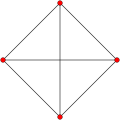
- 2D orthogonal projections of complex polyhedra, p{s}t{r}r
-
-
![3{3}3{3}3, Template:CDD or Template:CDD, has 27 vertices, 72 3-edges, and 27 faces, with one face highlighted blue.[25]](https://upload.wikimedia.org/wikipedia/commons/thumb/d/df/Complex_polyhedron_3-3-3-3-3-one-blue-face.png/120px-Complex_polyhedron_3-3-3-3-3-one-blue-face.png) 3{3}3{3}3, Template:CDD or Template:CDD, has 27 vertices, 72 3-edges, and 27 faces, with one face highlighted blue.[25]
3{3}3{3}3, Template:CDD or Template:CDD, has 27 vertices, 72 3-edges, and 27 faces, with one face highlighted blue.[25] -
![2{4}3{3}3, Template:CDD has 54 vertices, 216 simple edges, and 72 faces, with one face highlighted blue.[26]](https://upload.wikimedia.org/wikipedia/commons/thumb/1/1d/Complex_polyhedron_2-4-3-3-3_blue-edge.png/120px-Complex_polyhedron_2-4-3-3-3_blue-edge.png) 2{4}3{3}3, Template:CDD has 54 vertices, 216 simple edges, and 72 faces, with one face highlighted blue.[26]
2{4}3{3}3, Template:CDD has 54 vertices, 216 simple edges, and 72 faces, with one face highlighted blue.[26] -
![3{3}3{4}2, Template:CDD or Template:CDD, has 72 vertices, 216 3-edges, and 54 vertices, with one face highlighted blue.[27]](https://upload.wikimedia.org/wikipedia/commons/thumb/8/86/Complex_polyhedron_3-3-3-4-2-one-blue-face.png/120px-Complex_polyhedron_3-3-3-4-2-one-blue-face.png) 3{3}3{4}2, Template:CDD or Template:CDD, has 72 vertices, 216 3-edges, and 54 vertices, with one face highlighted blue.[27]
3{3}3{4}2, Template:CDD or Template:CDD, has 72 vertices, 216 3-edges, and 54 vertices, with one face highlighted blue.[27]

![3{3}3{3}3, Template:CDD or Template:CDD, has 27 vertices, 72 3-edges, and 27 faces, with one face highlighted blue.[25]](/wiki/File:Complex_polyhedron_3-3-3-3-3-one-blue-face.png)
![2{4}3{3}3, Template:CDD has 54 vertices, 216 simple edges, and 72 faces, with one face highlighted blue.[26]](/wiki/File:Complex_polyhedron_2-4-3-3-3_blue-edge.png)
![3{3}3{4}2, Template:CDD or Template:CDD, has 72 vertices, 216 3-edges, and 54 vertices, with one face highlighted blue.[27]](/wiki/File:Complex_polyhedron_3-3-3-4-2-one-blue-face.png)
- Generalized octahedra
Generalized octahedra have a regular construction as Template:CDD and quasiregular form as Template:CDD. All elements are simplexes.
-

-
 2{3}2{4}3, Template:CDD or Template:CDD, with 9 vertices, 27 edges, and 27 faces
 -
 2{3}2{4}4, Template:CDD or Template:CDD, with 12 vertices, 48 edges, and 64 faces
 -
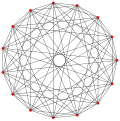 2{3}2{4}5, Template:CDD or Template:CDD, with 15 vertices, 75 edges, and 125 faces
 -
 2{3}2{4}6, Template:CDD or Template:CDD, with 18 vertices, 108 edges, and 216 faces
 -
 2{3}2{4}7, Template:CDD or Template:CDD, with 21 vertices, 147 edges, and 343 faces
 -
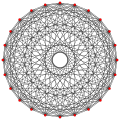 2{3}2{4}8, Template:CDD or Template:CDD, with 24 vertices, 192 edges, and 512 faces
 -
 2{3}2{4}9, Template:CDD or Template:CDD, with 27 vertices, 243 edges, and 729 faces
 -
 2{3}2{4}10, Template:CDD or Template:CDD, with 30 vertices, 300 edges, and 1000 faces


- Generalized cubes
Generalized cubes have a regular construction as Template:CDD and prismatic construction as Template:CDD, a product of three p-gonal 1-polytopes. Elements are lower dimensional generalized cubes.
-
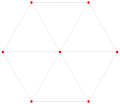
-
![3{4}2{3}2, Template:CDD or Template:CDD has 27 vertices, 27 3-edges, and 9 faces[25]](https://upload.wikimedia.org/wikipedia/commons/thumb/8/8d/3-generalized-3-cube.svg/120px-3-generalized-3-cube.svg.png)
-
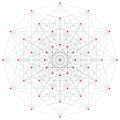 4{4}2{3}2, Template:CDD or Template:CDD, with 64 vertices, 48 edges, and 12 faces
 -
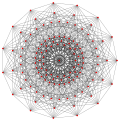 5{4}2{3}2, Template:CDD or Template:CDD, with 125 vertices, 75 edges, and 15 faces
 -
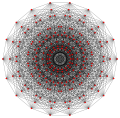 6{4}2{3}2, Template:CDD or Template:CDD, with 216 vertices, 108 edges, and 18 faces
 -
 7{4}2{3}2, Template:CDD or Template:CDD, with 343 vertices, 147 edges, and 21 faces
 -
 8{4}2{3}2, Template:CDD or Template:CDD, with 512 vertices, 192 edges, and 24 faces
 -
 9{4}2{3}2, Template:CDD or Template:CDD, with 729 vertices, 243 edges, and 27 faces
 -
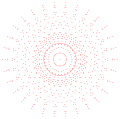 10{4}2{3}2, Template:CDD or Template:CDD, with 1000 vertices, 300 edges, and 30 faces
![3{4}2{3}2, Template:CDD or Template:CDD has 27 vertices, 27 3-edges, and 9 faces[25]](/wiki/File:3-generalized-3-cube.svg)


Enumeration of regular complex 4-polytopes
Coxeter enumerated this list of nonstarry regular complex 4-polytopes in , including the 6 convex regular 4-polytopes in .[23]
| Space | Group | Order | Coxeter number |
Polytope | Vertices | Edges | Faces | Cells | Van Oss polygon |
Notes |
|---|---|---|---|---|---|---|---|---|---|---|
| G(1,1,4) 2[3]2[3]2[3]2 = [3,3,3] |
120 | 5 | α4 = 2{3}2{3}2{3}2 = {3,3,3} Template:CDD |
5 | 10 {} |
10 {3} |
5 {3,3} |
none | Real 5-cell (simplex) | |
| G28 2[3]2[4]2[3]2 = [3,4,3] |
1152 | 12 | 2{3}2{4}2{3}2 = {3,4,3} Template:CDD |
24 | 96 {} |
96 {3} |
24 {3,4} |
{6} | Real 24-cell | |
| G30 2[3]2[3]2[5]2 = [3,3,5] |
14400 | 30 | 2{3}2{3}2{5}2 = {3,3,5} Template:CDD |
120 | 720 {} |
1200 {3} |
600 {3,3} |
{10} | Real 600-cell | |
| 2{5}2{3}2{3}2 = {5,3,3} Template:CDD |
600 | 1200 {} |
720 {5} |
120 {5,3} |
Real 120-cell | |||||
| G(2,1,4) 2[3]2[3]2[4]p =[3,3,4] |
384 | 8 | βTemplate:Supsub = β4 = {3,3,4} Template:CDD |
8 | 24 {} |
32 {3} |
16 {3,3} |
{4} | Real 16-cell Same as Template:CDD, order 192 | |
| γTemplate:Supsub = γ4 = {4,3,3} Template:CDD |
16 | 32 {} |
24 {4} |
8 {4,3} |
none | Real tesseract Same as {}4 or Template:CDD, order 16 | ||||
| G(p,1,4) 2[3]2[3]2[4]p p=2,3,4,... |
24p4 | 4p | βTemplate:Supsub = 2{3}2{3}2{4}p Template:CDD |
4p | 6p2 {} |
4p3 {3} |
p4 {3,3} |
2{4}p | Generalized 4-orthoplex Same as Template:CDD, order 24p3 | |
| γTemplate:Supsub = p{4}2{3}2{3}2 Template:CDD |
p4 | 4p3 p{} |
6p2 p{4}2 |
4p p{4}2{3}2 |
none | Generalized tesseract Same as p{}4 or Template:CDD, order p4 | ||||
| G(3,1,4) 2[3]2[3]2[4]3 |
1944 | 12 | βTemplate:Supsub = 2{3}2{3}2{4}3 Template:CDD |
12 | 54 {} |
108 {3} |
81 {3,3} |
2{4}3 | Generalized 4-orthoplex Same as Template:CDD, order 648 | |
| γTemplate:Supsub = 3{4}2{3}2{3}2 Template:CDD |
81 | 108 3{} |
54 3{4}2 |
12 3{4}2{3}2 |
none | Same as 3{}4 or Template:CDD, order 81 | ||||
| G(4,1,4) 2[3]2[3]2[4]4 |
6144 | 16 | βTemplate:Supsub = 2{3}2{3}2{4}4 Template:CDD |
16 | 96 {} |
256 {3} |
64 {3,3} |
2{4}4 | Same as Template:CDD, order 1536 | |
| γTemplate:Supsub = 4{4}2{3}2{3}2 Template:CDD |
256 | 256 4{} |
96 4{4}2 |
16 4{4}2{3}2 |
none | Same as 4{}4 or Template:CDD, order 256 | ||||
| G(5,1,4) 2[3]2[3]2[4]5 |
15000 | 20 | βTemplate:Supsub = 2{3}2{3}2{4}5 Template:CDD |
20 | 150 {} |
500 {3} |
625 {3,3} |
2{4}5 | Same as Template:CDD, order 3000 | |
| γTemplate:Supsub = 5{4}2{3}2{3}2 Template:CDD |
625 | 500 5{} |
150 5{4}2 |
20 5{4}2{3}2 |
none | Same as 5{}4 or Template:CDD, order 625 | ||||
| G(6,1,4) 2[3]2[3]2[4]6 |
31104 | 24 | βTemplate:Supsub = 2{3}2{3}2{4}6 Template:CDD |
24 | 216 {} |
864 {3} |
1296 {3,3} |
2{4}6 | Same as Template:CDD, order 5184 | |
| γTemplate:Supsub = 6{4}2{3}2{3}2 Template:CDD |
1296 | 864 6{} |
216 6{4}2 |
24 6{4}2{3}2 |
none | Same as 6{}4 or Template:CDD, order 1296 | ||||
| G32 3[3]3[3]3[3]3 |
155520 | 30 | 3{3}3{3}3{3}3 Template:CDD |
240 | 2160 3{} |
2160 3{3}3 |
240 3{3}3{3}3 |
3{4}3 | Witting polytope representation as 421 |
Visualizations of regular complex 4-polytopes
-
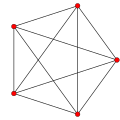 Real {3,3,3}, Template:CDD, had 5 vertices, 10 edges, 10 {3} faces, and 5 {3,3} cells
 -
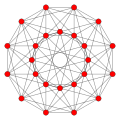 Real {3,4,3}, Template:CDD, had 24 vertices, 96 edges, 96 {3} faces, and 24 {3,4} cells
 -
 Real {5,3,3}, Template:CDD, had 600 vertices, 1200 edges, 720 {5} faces, and 120 {5,3} cells
 -
 Real {3,3,5}, Template:CDD, had 120 vertices, 720 edges, 1200 {3} faces, and 600 {3,3} cells
 -
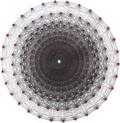 Witting polytope, Template:CDD, has 240 vertices, 2160 3-edges, 2160 3{3}3 faces, and 240 3{3}3{3}3 cells


- Generalized 4-orthoplexes
Generalized 4-orthoplexes have a regular construction as Template:CDD and quasiregular form as Template:CDD. All elements are simplexes.
-

-
 2{3}2{3}2{4}3, Template:CDD or Template:CDD, with 12 vertices, 54 edges, 108 faces, and 81 cells
 -
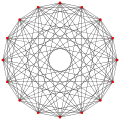 2{3}2{3}2{4}4, Template:CDD or Template:CDD, with 16 vertices, 96 edges, 256 faces, and 256 cells
 -
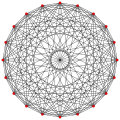 2{3}2{3}2{4}5, Template:CDD or Template:CDD, with 20 vertices, 150 edges, 500 faces, and 625 cells
 -
 2{3}2{3}2{4}6, Template:CDD or Template:CDD, with 24 vertices, 216 edges, 864 faces, and 1296 cells
 -
 2{3}2{3}2{4}7, Template:CDD or Template:CDD, with 28 vertices, 294 edges, 1372 faces, and 2401 cells
 -
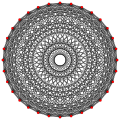 2{3}2{3}2{4}8, Template:CDD or Template:CDD, with 32 vertices, 384 edges, 2048 faces, and 4096 cells
 -
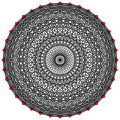 2{3}2{3}2{4}9, Template:CDD or Template:CDD, with 36 vertices, 486 edges, 2916 faces, and 6561 cells
 -
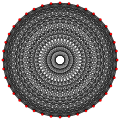 2{3}2{3}2{4}10, Template:CDD or Template:CDD, with 40 vertices, 600 edges, 4000 faces, and 10000 cells


- Generalized 4-cubes
Generalized tesseracts have a regular construction as Template:CDD and prismatic construction as Template:CDD, a product of four p-gonal 1-polytopes. Elements are lower dimensional generalized cubes.
-

-
 3{4}2{3}2{3}2, Template:CDD or Template:CDD, with 81 vertices, 108 edges, 54 faces, and 12 cells
 -
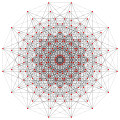 4{4}2{3}2{3}2, Template:CDD or Template:CDD, with 256 vertices, 96 edges, 96 faces, and 16 cells
 -
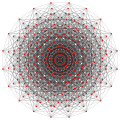 5{4}2{3}2{3}2, Template:CDD or Template:CDD, with 625 vertices, 500 edges, 150 faces, and 20 cells
 -
 6{4}2{3}2{3}2, Template:CDD or Template:CDD, with 1296 vertices, 864 edges, 216 faces, and 24 cells
 -
 7{4}2{3}2{3}2, Template:CDD or Template:CDD, with 2401 vertices, 1372 edges, 294 faces, and 28 cells
 -
 8{4}2{3}2{3}2, Template:CDD or Template:CDD, with 4096 vertices, 2048 edges, 384 faces, and 32 cells
 -
 9{4}2{3}2{3}2, Template:CDD or Template:CDD, with 6561 vertices, 2916 edges, 486 faces, and 36 cells
 -
 10{4}2{3}2{3}2, Template:CDD or Template:CDD, with 10000 vertices, 4000 edges, 600 faces, and 40 cells


Enumeration of regular complex 5-polytopes
Regular complex 5-polytopes in or higher exist in three families, the real simplexes and the generalized hypercube, and orthoplex.
| Space | Group | Order | Polytope | Vertices | Edges | Faces | Cells | 4-faces | Van Oss polygon |
Notes |
|---|---|---|---|---|---|---|---|---|---|---|
| G(1,1,5) = [3,3,3,3] |
720 | α5 = {3,3,3,3} Template:CDD |
6 | 15 {} |
20 {3} |
15 {3,3} |
6 {3,3,3} |
none | Real 5-simplex | |
| G(2,1,5) =[3,3,3,4] |
3840 | βTemplate:Supsub = β5 = {3,3,3,4} Template:CDD |
10 | 40 {} |
80 {3} |
80 {3,3} |
32 {3,3,3} |
{4} | Real 5-orthoplex Same as Template:CDD, order 1920 | |
| γTemplate:Supsub = γ5 = {4,3,3,3} Template:CDD |
32 | 80 {} |
80 {4} |
40 {4,3} |
10 {4,3,3} |
none | Real 5-cube Same as {}5 or Template:CDD, order 32 | |||
| G(p,1,5) 2[3]2[3]2[3]2[4]p |
120p5 | βTemplate:Supsub = 2{3}2{3}2{3}2{4}p Template:CDD |
5p | 10p2 {} |
10p3 {3} |
5p4 {3,3} |
p5 {3,3,3} |
2{4}p | Generalized 5-orthoplex Same as Template:CDD, order 120p4 | |
| γTemplate:Supsub = p{4}2{3}2{3}2{3}2 Template:CDD |
p5 | 5p4 p{} |
10p3 p{4}2 |
10p2 p{4}2{3}2 |
5p p{4}2{3}2{3}2 |
none | Generalized 5-cube Same as p{}5 or Template:CDD, order p5 | |||
| G(3,1,5) 2[3]2[3]2[3]2[4]3 |
29160 | βTemplate:Supsub = 2{3}2{3}2{3}2{4}3 Template:CDD |
15 | 90 {} |
270 {3} |
405 {3,3} |
243 {3,3,3} |
2{4}3 | Same as Template:CDD, order 9720 | |
| γTemplate:Supsub = 3{4}2{3}2{3}2{3}2 Template:CDD |
243 | 405 3{} |
270 3{4}2 |
90 3{4}2{3}2 |
15 3{4}2{3}2{3}2 |
none | Same as 3{}5 or Template:CDD, order 243 | |||
| G(4,1,5) 2[3]2[3]2[3]2[4]4 |
122880 | βTemplate:Supsub = 2{3}2{3}2{3}2{4}4 Template:CDD |
20 | 160 {} |
640 {3} |
1280 {3,3} |
1024 {3,3,3} |
2{4}4 | Same as Template:CDD, order 30720 | |
| γTemplate:Supsub = 4{4}2{3}2{3}2{3}2 Template:CDD |
1024 | 1280 4{} |
640 4{4}2 |
160 4{4}2{3}2 |
20 4{4}2{3}2{3}2 |
none | Same as 4{}5 or Template:CDD, order 1024 | |||
| G(5,1,5) 2[3]2[3]2[3]2[4]5 |
375000 | βTemplate:Supsub = 2{3}2{3}2{3}2{5}5 Template:CDD |
25 | 250 {} |
1250 {3} |
3125 {3,3} |
3125 {3,3,3} |
2{5}5 | Same as Template:CDD, order 75000 | |
| γTemplate:Supsub = 5{4}2{3}2{3}2{3}2 Template:CDD |
3125 | 3125 5{} |
1250 5{5}2 |
250 5{5}2{3}2 |
25 5{4}2{3}2{3}2 |
none | Same as 5{}5 or Template:CDD, order 3125 | |||
| G(6,1,5) 2[3]2[3]2[3]2[4]6 |
933210 | βTemplate:Supsub = 2{3}2{3}2{3}2{4}6 Template:CDD |
30 | 360 {} |
2160 {3} |
6480 {3,3} |
7776 {3,3,3} |
2{4}6 | Same as Template:CDD, order 155520 | |
| γTemplate:Supsub = 6{4}2{3}2{3}2{3}2 Template:CDD |
7776 | 6480 6{} |
2160 6{4}2 |
360 6{4}2{3}2 |
30 6{4}2{3}2{3}2 |
none | Same as 6{}5 or Template:CDD, order 7776 |
Visualizations of regular complex 5-polytopes
- Generalized 5-orthoplexes
Generalized 5-orthoplexes have a regular construction as Template:CDD and quasiregular form as Template:CDD. All elements are simplexes.
-
 Real {3,3,3,4}, Template:CDD, with 10 vertices, 40 edges, 80 faces, 80 cells, and 32 4-faces
 -
 2{3}2{3}2{3}2{4}3, Template:CDD, with 15 vertices, 90 edges, 270 faces, 405 cells, and 243 4-faces
 -
 2{3}2{3}2{3}2{4}4, Template:CDD, with 20 vertices, 160 edges, 640 faces, 1280 cells, and 1024 4-faces
 -
 2{3}2{3}2{3}2{4}5, Template:CDD, with 25 vertices, 250 edges, 1250 faces, 3125 cells, and 3125 4-faces
 -
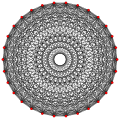 2{3}2{3}2{3}2{4}6, Template:CDD, with 30 vertices, 360 edges, 2160 faces, 6480 cells, 7776 4-faces
 -
 2{3}2{3}2{3}2{4}7, Template:CDD, with 35 vertices, 490 edges, 3430 faces, 12005 cells, 16807 4-faces
 -
 2{3}2{3}2{3}2{4}8, Template:CDD, with 40 vertices, 640 edges, 5120 faces, 20480 cells, 32768 4-faces
 -
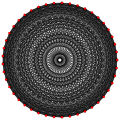 2{3}2{3}2{3}2{4}9, Template:CDD, with 45 vertices, 810 edges, 7290 faces, 32805 cells, 59049 4-faces
 -
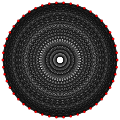 2{3}2{3}2{3}2{4}10, Template:CDD, with 50 vertices, 1000 edges, 10000 faces, 50000 cells, 100000 4-faces


- Generalized 5-cubes
Generalized 5-cubes have a regular construction as Template:CDD and prismatic construction as Template:CDD, a product of five p-gonal 1-polytopes. Elements are lower dimensional generalized cubes.
-
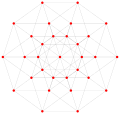 Real {4,3,3,3}, Template:CDD, with 32 vertices, 80 edges, 80 faces, 40 cells, and 10 4-faces
 -
 3{4}2{3}2{3}2{3}2, Template:CDD, with 243 vertices, 405 edges, 270 faces, 90 cells, and 15 4-faces
 -
 4{4}2{3}2{3}2{3}2, Template:CDD, with 1024 vertices, 1280 edges, 640 faces, 160 cells, and 20 4-faces
 -
 5{4}2{3}2{3}2{3}2, Template:CDD, with 3125 vertices, 3125 edges, 1250 faces, 250 cells, and 25 4-faces
 -
 6{4}2{3}2{3}2{3}2, Template:CDD, with 7776 vertices, 6480 edges, 2160 faces, 360 cells, and 30 4-faces


Enumeration of regular complex 6-polytopes
| Space | Group | Order | Polytope | Vertices | Edges | Faces | Cells | 4-faces | 5-faces | Van Oss polygon |
Notes |
|---|---|---|---|---|---|---|---|---|---|---|---|
| G(1,1,6) = [3,3,3,3,3] |
720 | α6 = {3,3,3,3,3} Template:CDD |
7 | 21 {} |
35 {3} |
35 {3,3} |
21 {3,3,3} |
7 {3,3,3,3} |
none | Real 6-simplex | |
| G(2,1,6) [3,3,3,4] |
46080 | βTemplate:Supsub = β6 = {3,3,3,4} Template:CDD |
12 | 60 {} |
160 {3} |
240 {3,3} |
192 {3,3,3} |
64 {3,3,3,3} |
{4} | Real 6-orthoplex Same as Template:CDD, order 23040 | |
| γTemplate:Supsub = γ6 = {4,3,3,3} Template:CDD |
64 | 192 {} |
240 {4} |
160 {4,3} |
60 {4,3,3} |
12 {4,3,3,3} |
none | Real 6-cube Same as {}6 or Template:CDD, order 64 | |||
| G(p,1,6) 2[3]2[3]2[3]2[4]p |
720p6 | βTemplate:Supsub = 2{3}2{3}2{3}2{4}p Template:CDD |
6p | 15p2 {} |
20p3 {3} |
15p4 {3,3} |
6p5 {3,3,3} |
p6 {3,3,3,3} |
2{4}p | Generalized 6-orthoplex Same as Template:CDD, order 720p5 | |
| γTemplate:Supsub = p{4}2{3}2{3}2{3}2 Template:CDD |
p6 | 6p5 p{} |
15p4 p{4}2 |
20p3 p{4}2{3}2 |
15p2 p{4}2{3}2{3}2 |
6p p{4}2{3}2{3}2{3}2 |
none | Generalized 6-cube Same as p{}6 or Template:CDD, order p6 |
Visualizations of regular complex 6-polytopes
- Generalized 6-orthoplexes
Generalized 6-orthoplexes have a regular construction as Template:CDD and quasiregular form as Template:CDD. All elements are simplexes.
-
 Real {3,3,3,3,4}, Template:CDD, with 12 vertices, 60 edges, 160 faces, 240 cells, 192 4-faces, and 64 5-faces
 -
 2{3}2{3}2{3}2{3}2{4}3, Template:CDD, with 18 vertices, 135 edges, 540 faces, 1215 cells, 1458 4-faces, and 729 5-faces
 -
 2{3}2{3}2{3}2{3}2{4}4, Template:CDD, with 24 vertices, 240 edges, 1280 faces, 3840 cells, 6144 4-faces, and 4096 5-faces
 -
 2{3}2{3}2{3}2{3}2{4}5, Template:CDD, with 30 vertices, 375 edges, 2500 faces, 9375 cells, 18750 4-faces, and 15625 5-faces
 -
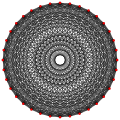 2{3}2{3}2{3}2{3}2{4}6, Template:CDD, with 36 vertices, 540 edges, 4320 faces, 19440 cells, 46656 4-faces, and 46656 5-faces
 -
 2{3}2{3}2{3}2{3}2{4}7, Template:CDD, with 42 vertices, 735 edges, 6860 faces, 36015 cells, 100842 4-faces, 117649 5-faces
 -
 2{3}2{3}2{3}2{3}2{4}8, Template:CDD, with 48 vertices, 960 edges, 10240 faces, 61440 cells, 196608 4-faces, 262144 5-faces
 -
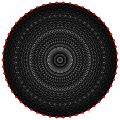 2{3}2{3}2{3}2{3}2{4}9, Template:CDD, with 54 vertices, 1215 edges, 14580 faces, 98415 cells, 354294 4-faces, 531441 5-faces
 -
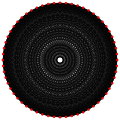 2{3}2{3}2{3}2{3}2{4}10, Template:CDD, with 60 vertices, 1500 edges, 20000 faces, 150000 cells, 600000 4-faces, 1000000 5-faces


- Generalized 6-cubes
Generalized 6-cubes have a regular construction as Template:CDD and prismatic construction as Template:CDD, a product of six p-gonal 1-polytopes. Elements are lower dimensional generalized cubes.
-
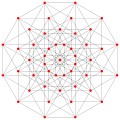 Real {3,3,3,3,3,4}, Template:CDD, with 64 vertices, 192 edges, 240 faces, 160 cells, 60 4-faces, and 12 5-faces
 -
 3{4}2{3}2{3}2{3}2{3}2, Template:CDD, with 729 vertices, 1458 edges, 1215 faces, 540 cells, 135 4-faces, and 18 5-faces
 -
 4{4}2{3}2{3}2{3}2{3}2, Template:CDD, with 4096 vertices, 6144 edges, 3840 faces, 1280 cells, 240 4-faces, and 24 5-faces
 -
 5{4}2{3}2{3}2{3}2{3}2, Template:CDD, with 15625 vertices, 18750 edges, 9375 faces, 2500 cells, 375 4-faces, and 30 5-faces


Enumeration of regular complex apeirotopes
Coxeter enumerated this list of nonstarry regular complex apeirotopes or honeycombs.[28]
For each dimension there are 12 apeirotopes symbolized as δTemplate:Supsub exists in any dimensions , or if p=q=2. Coxeter calls these generalized cubic honeycombs for n>2.[29]
Each has proportional element counts given as:
- k-faces = , where and n! denotes the factorial of n.
Regular complex 1-polytopes
The only regular complex 1-polytope is ∞{}, or Template:CDD. Its real representation is an apeirogon, {∞}, or Template:CDD.
Regular complex apeirogons


Rank 2 complex apeirogons have symmetry p[q]r, where 1/p + 2/q + 1/r = 1. Coxeter expresses them as δTemplate:Supsub where q is constrained to satisfy Template:Math.[30]
There are 8 solutions:
| 2[∞]2 | 3[12]2 | 4[8]2 | 6[6]2 | 3[6]3 | 6[4]3 | 4[4]4 | 6[3]6 |
| Template:CDD | Template:CDD | Template:CDD | Template:CDD | Template:CDD | Template:CDD | Template:CDD | Template:CDD |
There are two excluded solutions odd q and unequal p and r: 10[5]2 and 12[3]4, or Template:CDD and Template:CDD.
A regular complex apeirogon p{q}r has p-edges and r-gonal vertex figures. The dual apeirogon of p{q}r is r{q}p. An apeirogon of the form p{q}p is self-dual. Groups of the form p[2q]2 have a half symmetry p[q]p, so a regular apeirogon Template:CDD is the same as quasiregular Template:CDD.[31]
Apeirogons can be represented on the Argand plane share four different vertex arrangements. Apeirogons of the form 2{q}r have a vertex arrangement as {q/2,p}. The form p{q}2 have vertex arrangement as r{p,q/2}. Apeirogons of the form p{4}r have vertex arrangements {p,r}.
Including affine nodes, and , there are 3 more infinite solutions: ∞[2]∞, ∞[4]2, ∞[3]3, and Template:CDD, Template:CDD, and Template:CDD. The first is an index 2 subgroup of the second. The vertices of these apeirogons exist in .


Regular complex apeirohedra
There are 22 regular complex apeirohedra, of the form p{a}q{b}r. 8 are self-dual (p=r and a=b), while 14 exist as dual polytope pairs. Three are entirely real (p=q=r=2).
Coxeter symbolizes 12 of them as δTemplate:Supsub or p{4}2{4}r is the regular form of the product apeirotope δTemplate:Supsub × δTemplate:Supsub or p{q}r × p{q}r, where q is determined from p and r.
Template:CDD is the same as Template:CDD, as well as Template:CDD, for p,r=2,3,4,6. Also Template:CDD = Template:CDD.[33]
| Space | Group | Apeirohedron | Vertex | Edge | Face | van Oss apeirogon |
Notes | |||
|---|---|---|---|---|---|---|---|---|---|---|
| 2[3]2[4]∞ | ∞{4}2{3}2 | Template:CDD | ∞{} | ∞{4}2 | Same as ∞{}×∞{}×∞{} or Template:CDD Real representation {4,3,4} | |||||
| p[4]2[4]r | p{4}2{4}r | Template:CDD |
p2 | 2pr | p{} | r2 | p{4}2 | 2{q}r | Same as Template:CDD, p,r=2,3,4,6 | |
| [4,4] | δTemplate:Supsub = {4,4} | Template:CDD | 4 | 8 | {} | 4 | {4} | {∞} | Real square tiling Same as Template:CDD or Template:CDD or Template:CDD | |
| 3[4]2[4]2 3[4]2[4]3 4[4]2[4]2 4[4]2[4]4 6[4]2[4]2 6[4]2[4]3 6[4]2[4]6 |
3{4}2{4}2 2{4}2{4}3 3{4}2{4}3 4{4}2{4}2 2{4}2{4}4 4{4}2{4}4 6{4}2{4}2 2{4}2{4}6 6{4}2{4}3 3{4}2{4}6 6{4}2{4}6 |
Template:CDD Template:CDD Template:CDD Template:CDD Template:CDD Template:CDD Template:CDD Template:CDD Template:CDD Template:CDD Template:CDD |
9 4 9 16 4 16 36 4 36 9 36 |
12 12 18 16 16 32 24 24 36 36 72 |
3{} {} 3{} 4{} {} 4{} 6{} {} 6{} 3{} 6{} |
4 9 9 4 16 16 4 36 9 36 36 |
3{4}2 {4} 3{4}2 4{4}2 {4} 4{4}2 6{4}2 {4} 6{4}2 3{4}2 6{4}2 |
p{q}r | Same as Template:CDD or Template:CDD or Template:CDD Same as Template:CDD Same as Template:CDD Same as Template:CDD or Template:CDD or Template:CDD Same as Template:CDD Same as Template:CDD Same as Template:CDD or Template:CDD or Template:CDD Same as Template:CDD Same as Template:CDD Same as Template:CDD Same as Template:CDD | |
| Space | Group | Apeirohedron | Vertex | Edge | Face | van Oss apeirogon |
Notes | |||
|---|---|---|---|---|---|---|---|---|---|---|
| 2[4]r[4]2 | 2{4}r{4}2 | Template:CDD |
2 | {} | 2 | p{4}2' | 2{4}r | Same as Template:CDD and Template:CDD, r=2,3,4,6 | ||
| [4,4] | {4,4} | Template:CDD | 2 | 4 | {} | 2 | {4} | {∞} | Same as Template:CDD and Template:CDD | |
| 2[4]3[4]2 2[4]4[4]2 2[4]6[4]2 |
2{4}3{4}2 2{4}4{4}2 2{4}6{4}2 |
Template:CDD Template:CDD Template:CDD |
2 | 9 16 36 |
{} | 2 | 2{4}3 2{4}4 2{4}6 |
2{q}r | Same as Template:CDD and Template:CDD Same as Template:CDD and Template:CDD Same as Template:CDD and Template:CDD[34] | |
| Space | Group | Apeirohedron | Vertex | Edge | Face | van Oss apeirogon |
Notes | |||
|---|---|---|---|---|---|---|---|---|---|---|
| 2[6]2[3]2 = [6,3] |
{3,6} | Template:CDD |
1 | 3 | {} | 2 | {3} | {∞} | Real triangular tiling | |
| {6,3} | Template:CDD | 2 | 3 | {} | 1 | {6} | none | Real hexagonal tiling | ||
| 3[4]3[3]3 | 3{3}3{4}3 | Template:CDD | 1 | 8 | 3{} | 3 | 3{3}3 | 3{4}6 | Same as Template:CDD | |
| 3{4}3{3}3 | Template:CDD | 3 | 8 | 3{} | 1 | 3{4}3 | 3{12}2 | |||
| 4[3]4[3]4 | 4{3}4{3}4 | Template:CDD | 1 | 6 | 4{} | 1 | 4{3}4 | 4{4}4 | Self-dual, same as Template:CDD | |
| 4[3]4[4]2 | 4{3}4{4}2 | Template:CDD | 1 | 12 | 4{} | 3 | 4{3}4 | 2{8}4 | Same as Template:CDD | |
| 2{4}4{3}4 | Template:CDD | 3 | 12 | {} | 1 | 2{4}4 | 4{4}4 | |||
Regular complex 3-apeirotopes
There are 16 regular complex apeirotopes in . Coxeter expresses 12 of them by δTemplate:Supsub where q is constrained to satisfy Template:Math. These can also be decomposed as product apeirotopes: Template:CDD = Template:CDD. The first case is the cubic honeycomb.
| Space | Group | 3-apeirotope | Vertex | Edge | Face | Cell | van Oss apeirogon |
Notes |
|---|---|---|---|---|---|---|---|---|
| p[4]2[3]2[4]r | δTemplate:Supsub = p{4}2{3}2{4}r Template:CDD |
p{} | p{4}2 | p{4}2{3}2 | p{q}r | Same as Template:CDD | ||
| 2[4]2[3]2[4]2 =[4,3,4] |
δTemplate:Supsub = 2{4}2{3}2{4}2 Template:CDD |
{} | {4} | {4,3} | Cubic honeycomb Same as Template:CDD or Template:CDD or Template:CDD | |||
| 3[4]2[3]2[4]2 | δTemplate:Supsub = 3{4}2{3}2{4}2 Template:CDD |
3{} | 3{4}2 | 3{4}2{3}2 | Same as Template:CDD or Template:CDD or Template:CDD | |||
| δTemplate:Supsub = 2{4}2{3}2{4}3 Template:CDD |
{} | {4} | {4,3} | Same as Template:CDD | ||||
| 3[4]2[3]2[4]3 | δTemplate:Supsub = 3{4}2{3}2{4}3 Template:CDD |
3{} | 3{4}2 | 3{4}2{3}2 | Same as Template:CDD | |||
| 4[4]2[3]2[4]2 | δTemplate:Supsub = 4{4}2{3}2{4}2 Template:CDD |
4{} | 4{4}2 | 4{4}2{3}2 | Same as Template:CDD or Template:CDD or Template:CDD | |||
| δTemplate:Supsub = 2{4}2{3}2{4}4 Template:CDD |
{} | {4} | {4,3} | Same as Template:CDD | ||||
| 4[4]2[3]2[4]4 | δTemplate:Supsub = 4{4}2{3}2{4}4 Template:CDD |
4{} | 4{4}2 | 4{4}2{3}2 | Same as Template:CDD | |||
| 6[4]2[3]2[4]2 | δTemplate:Supsub = 6{4}2{3}2{4}2 Template:CDD |
6{} | 6{4}2 | 6{4}2{3}2 | Same as Template:CDD or Template:CDD or Template:CDD | |||
| δTemplate:Supsub = 2{4}2{3}2{4}6 Template:CDD |
{} | {4} | {4,3} | Same as Template:CDD | ||||
| 6[4]2[3]2[4]3 | δTemplate:Supsub = 6{4}2{3}2{4}3 Template:CDD |
6{} | 6{4}2 | 6{4}2{3}2 | Same as Template:CDD | |||
| δTemplate:Supsub = 3{4}2{3}2{4}6 Template:CDD |
3{} | 3{4}2 | 3{4}2{3}2 | Same as Template:CDD | ||||
| 6[4]2[3]2[4]6 | δTemplate:Supsub = 6{4}2{3}2{4}6 Template:CDD |
6{} | 6{4}2 | 6{4}2{3}2 | Same as Template:CDD |
| Space | Group | 3-apeirotope | Vertex | Edge | Face | Cell | van Oss apeirogon |
Notes |
|---|---|---|---|---|---|---|---|---|
| 2[4]3[3]3[3]3 | 3{3}3{3}3{4}2 Template:CDD |
1 | 24 3{} | 27 3{3}3 | 2 3{3}3{3}3 | 3{4}6 | Same as Template:CDD | |
| 2{4}3{3}3{3}3 Template:CDD |
2 | 27 {} | 24 2{4}3 | 1 2{4}3{3}3 | 2{12}3 | |||
| 2[3]2[4]3[3]3 | 2{3}2{4}3{3}3 Template:CDD |
1 | 27 {} | 72 2{3}2 | 8 2{3}2{4}3 | 2{6}6 | ||
| 3{3}3{4}2{3}2 Template:CDD |
8 | 72 3{} | 27 3{3}3 | 1 3{3}3{4}2 | 3{6}3 | Same as Template:CDD or Template:CDD |
Regular complex 4-apeirotopes
There are 15 regular complex apeirotopes in . Coxeter expresses 12 of them by δTemplate:Supsub where q is constrained to satisfy Template:Math. These can also be decomposed as product apeirotopes: Template:CDD = Template:CDD. The first case is the tesseractic honeycomb. The 16-cell honeycomb and 24-cell honeycomb are real solutions. The last solution is generated has Witting polytope elements.
| Space | Group | 4-apeirotope | Vertex | Edge | Face | Cell | 4-face | van Oss apeirogon |
Notes |
|---|---|---|---|---|---|---|---|---|---|
| p[4]2[3]2[3]2[4]r | δTemplate:Supsub = p{4}2{3}2{3}2{4}r Template:CDD |
p{} | p{4}2 | p{4}2{3}2 | p{4}2{3}2{3}2 | p{q}r | Same as Template:CDD | ||
| 2[4]2[3]2[3]2[4]2 | δTemplate:Supsub = {4,3,3,3} Template:CDD |
{} | {4} | {4,3} | {4,3,3} | {∞} | Tesseractic honeycomb Same as Template:CDD | ||
| 2[3]2[4]2[3]2[3]2 =[3,4,3,3] |
{3,3,4,3} Template:CDD |
1 | 12 {} | 32 {3} | 24 {3,3} | 3 {3,3,4} | Real 16-cell honeycomb Same as Template:CDD | ||
| {3,4,3,3} Template:CDD |
3 | 24 {} | 32 {3} | 12 {3,4} | 1 {3,4,3} | Real 24-cell honeycomb Same as Template:CDD or Template:CDD | |||
| 3[3]3[3]3[3]3[3]3 | 3{3}3{3}3{3}3{3}3 Template:CDD |
1 | 80 3{} | 270 3{3}3 | 80 3{3}3{3}3 | 1 3{3}3{3}3{3}3 | 3{4}6 | representation 521 |
Regular complex 5-apeirotopes and higher
There are only 12 regular complex apeirotopes in or higher,[35] expressed δTemplate:Supsub where q is constrained to satisfy Template:Math. These can also be decomposed a product of n apeirogons: Template:CDD ... Template:CDD = Template:CDD ... Template:CDD. The first case is the real hypercube honeycomb.
| Space | Group | 5-apeirotopes | Vertices | Edge | Face | Cell | 4-face | 5-face | van Oss apeirogon |
Notes |
|---|---|---|---|---|---|---|---|---|---|---|
| p[4]2[3]2[3]2[3]2[4]r | δTemplate:Supsub = p{4}2{3}2{3}2{3}2{4}r Template:CDD |
p{} | p{4}2 | p{4}2{3}2 | p{4}2{3}2{3}2 | p{4}2{3}2{3}2{3}2 | p{q}r | Same as Template:CDD | ||
| 2[4]2[3]2[3]2[3]2[4]2 =[4,3,3,3,4] |
δTemplate:Supsub = {4,3,3,3,4} Template:CDD |
{} | {4} | {4,3} | {4,3,3} | {4,3,3,3} | {∞} | 5-cubic honeycomb Same as Template:CDD |
van Oss polygon

A van Oss polygon is a regular polygon in the plane (real plane , or unitary plane ) in which both an edge and the centroid of a regular polytope lie, and formed of elements of the polytope. Not all regular polytopes have Van Oss polygons.
For example, the van Oss polygons of a real octahedron are the three squares whose planes pass through its center. In contrast a cube does not have a van Oss polygon because the edge-to-center plane cuts diagonally across two square faces and the two edges of the cube which lie in the plane do not form a polygon.
Infinite honeycombs also have van Oss apeirogons. For example, the real square tiling and triangular tiling have apeirogons {∞} van Oss apeirogons.[36]
If it exists, the van Oss polygon of regular complex polytope of the form p{q}r{s}t... has p-edges. Template:Clear
Non-regular complex polytopes
Product complex polytopes
 Complex product polygon Template:CDD or {}×5{} has 10 vertices connected by 5 2-edges and 2 5-edges, with its real representation as a 3-dimensional pentagonal prism. |
 The dual polygon,{}+5{} has 7 vertices centered on the edges of the original, connected by 10 edges. Its real representation is a pentagonal bipyramid. |
Some complex polytopes can be represented as Cartesian products. These product polytopes are not strictly regular since they'll have more than one facet type, but some can represent lower symmetry of regular forms if all the orthogonal polytopes are identical. For example, the product p{}×p{} or Template:CDD of two 1-dimensional polytopes is the same as the regular p{4}2 or Template:CDD. More general products, like p{}×q{} have real representations as the 4-dimensional p-q duoprisms. The dual of a product polytope can be written as a sum p{}+q{} and have real representations as the 4-dimensional p-q duopyramid. The p{}+p{} can have its symmetry doubled as a regular complex polytope 2{4}p or Template:CDD.
Similarly, a complex polyhedron can be constructed as a triple product: p{}×p{}×p{} or Template:CDD is the same as the regular generalized cube, p{4}2{3}2 or Template:CDD, as well as product p{4}2×p{} or Template:CDD.[37]
Quasiregular polygons
A quasiregular polygon is a truncation of a regular polygon. A quasiregular polygon Template:CDD contains alternate edges of the regular polygons Template:CDD and Template:CDD. The quasiregular polygon has p vertices on the p-edges of the regular form.
| p[q]r | 2[4]2 | 3[4]2 | 4[4]2 | 5[4]2 | 6[4]2 | 7[4]2 | 8[4]2 | 3[3]3 | 3[4]3 |
|---|---|---|---|---|---|---|---|---|---|
| Regular Template:CDD |
 Template:CDD 4 2-edges |
 Template:CDD 9 3-edges |
 Template:CDD 16 4-edges |
 Template:CDD 25 5-edges |
 Template:CDD 36 6-edges |
 Template:CDD 49 8-edges |
 Template:CDD 64 8-edges |
 Template:CDD |
 Template:CDD |
| Quasiregular Template:CDD |
 Template:CDD = Template:CDD 4+4 2-edges |
 Template:CDD 6 2-edges 9 3-edges |
 Template:CDD 8 2-edges 16 4-edges |
 Template:CDD 10 2-edges 25 5-edges |
 Template:CDD 12 2-edges 36 6-edges |
 Template:CDD 14 2-edges 49 7-edges |
 Template:CDD 16 2-edges 64 8-edges |
 Template:CDD = Template:CDD |
 Template:CDD = Template:CDD |
| Regular Template:CDD |
 Template:CDD 4 2-edges |
 Template:CDD 6 2-edges |
 Template:CDD 8 2-edges |
 Template:CDD 10 2-edges |
 Template:CDD 12 2-edges |
 Template:CDD 14 2-edges |
 Template:CDD 16 2-edges |
Template:CDD |
Template:CDD |
Quasiregular apeirogons
There are 7 quasiregular complex apeirogons which alternate edges of a regular apeirogon and its regular dual. The vertex arrangements of these apeirogon have real representations with the regular and uniform tilings of the Euclidean plane. The last column for the 6{3}6 apeirogon is not only self-dual, but the dual coincides with itself with overlapping hexagonal edges, thus their quasiregular form also has overlapping hexagonal edges, so it can't be drawn with two alternating colors like the others. The symmetry of the self-dual families can be doubled, so creating an identical geometry as the regular forms: Template:CDD = Template:CDD
| p[q]r | 4[8]2 | 4[4]4 | 6[6]2 | 6[4]3 | 3[12]2 | 3[6]3 | 6[3]6 |
|---|---|---|---|---|---|---|---|
| Regular Template:CDD or p{q}r |
 Template:CDD |
 Template:CDD |
 Template:CDD |
 Template:CDD |
 Template:CDD |
 Template:CDD |
 Template:CDD |
| Quasiregular Template:CDD |
 Template:CDD |
 Template:CDD = Template:CDD |
 Template:CDD |
 Template:CDD |
 Template:CDD |
 Template:CDD = Template:CDD |
 Template:CDD = Template:CDD |
| Regular dual Template:CDD or r{q}p |
 Template:CDD |
 Template:CDD |
 Template:CDD |
 Template:CDD |
 Template:CDD |
 Template:CDD |
 Template:CDD |
Quasiregular polyhedra

Like real polytopes, a complex quasiregular polyhedron can be constructed as a rectification (a complete truncation) of a regular polyhedron. Vertices are created mid-edge of the regular polyhedron and faces of the regular polyhedron and its dual are positioned alternating across common edges.
For example, a p-generalized cube, Template:CDD, has p3 vertices, 3p2 edges, and 3p p-generalized square faces, while the p-generalized octahedron, Template:CDD, has 3p vertices, 3p2 edges and p3 triangular faces. The middle quasiregular form p-generalized cuboctahedron, Template:CDD, has 3p2 vertices, 3p3 edges, and 3p+p3 faces.
Also the rectification of the Hessian polyhedron Template:CDD, is Template:CDD, a quasiregular form sharing the geometry of the regular complex polyhedron Template:CDD.
| Generalized cube/octahedra | Hessian polyhedron | |||||
|---|---|---|---|---|---|---|
| p=2 (real) | p=3 | p=4 | p=5 | p=6 | ||
| Generalized cubes Template:CDD (regular) |
 Cube Template:CDD, 8 vertices, 12 2-edges, and 6 faces. |
 Template:CDD, 27 vertices, 27 3-edges, and 9 faces, with one Template:CDD face blue and red |
 Template:CDD, 64 vertices, 48 4-edges, and 12 faces. |
 Template:CDD, 125 vertices, 75 5-edges, and 15 faces. |
 Template:CDD, 216 vertices, 108 6-edges, and 18 faces. |
 Template:CDD, 27 vertices, 72 6-edges, and 27 faces. |
| Generalized cuboctahedra Template:CDD (quasiregular) |
 Cuboctahedron Template:CDD, 12 vertices, 24 2-edges, and 6+8 faces. |
 Template:CDD, 27 vertices, 81 2-edges, and 9+27 faces, with one Template:CDD face blue |
 Template:CDD, 48 vertices, 192 2-edges, and 12+64 faces, with one Template:CDD face blue |
 Template:CDD, 75 vertices, 375 2-edges, and 15+125 faces. |
 Template:CDD, 108 vertices, 648 2-edges, and 18+216 faces. |
 Template:CDD = Template:CDD, 72 vertices, 216 3-edges, and 54 faces. |
| Generalized octahedra Template:CDD (regular) |
 Octahedron Template:CDD, 6 vertices, 12 2-edges, and 8 {3} faces. |
 Template:CDD, 9 vertices, 27 2-edges, and 27 {3} faces. |
 Template:CDD, 12 vertices, 48 2-edges, and 64 {3} faces. |
 Template:CDD, 15 vertices, 75 2-edges, and 125 {3} faces. |
 Template:CDD, 18 vertices, 108 2-edges, and 216 {3} faces. |
 Template:CDD, 27 vertices, 72 6-edges, and 27 faces. |
Other complex polytopes with unitary reflections of period two
Other nonregular complex polytopes can be constructed within unitary reflection groups that don't make linear Coxeter graphs. In Coxeter diagrams with loops Coxeter marks a special period interior, like Template:CDD or symbol (11 1 1)3, and group [1 1 1]3.[38][39] These complex polytopes have not been systematically explored beyond a few cases.
The group Template:CDD is defined by 3 unitary reflections, R1, R2, R3, all order 2: R12 = R12 = R32 = (R1R2)3 = (R2R3)3 = (R3R1)3 = (R1R2R3R1)p = 1. The period p can be seen as a double rotation in real .
As with all Wythoff constructions, polytopes generated by reflections, the number of vertices of a single-ringed Coxeter diagram polytope is equal to the order of the group divided by the order of the subgroup where the ringed node is removed. For example, a real cube has Coxeter diagram Template:CDD, with octahedral symmetry Template:CDD order 48, and subgroup dihedral symmetry Template:CDD order 6, so the number of vertices of a cube is 48/6=8. Facets are constructed by removing one node furthest from the ringed node, for example Template:CDD for the cube. Vertex figures are generated by removing a ringed node and ringing one or more connected nodes, and Template:CDD for the cube.
Coxeter represents these groups by the following symbols. Some groups have the same order, but a different structure, defining the same vertex arrangement in complex polytopes, but different edges and higher elements, like Template:CDD and Template:CDD with p≠3.[40]
| Coxeter diagram | Order | Symbol or Position in Table VII of Shephard and Todd (1954) |
|---|---|---|
| Template:CDD, (Template:CDD and Template:CDD), Template:CDD, Template:CDD ... |
pn − 1 n!, p ≥ 3 | G(p, p, n), [p], [1 1 1]p, [1 1 (n−2)p]3 |
| Template:CDD, Template:CDD | 72·6!, 108·9! | Nos. 33, 34, [1 2 2]3, [1 2 3]3 |
| Template:CDD, (Template:CDD and Template:CDD), (Template:CDD and Template:CDD) | 14·4!, 3·6!, 64·5! | Nos. 24, 27, 29 |
Coxeter calls some of these complex polyhedra almost regular because they have regular facets and vertex figures. The first is a lower symmetry form of the generalized cross-polytope in . The second is a fractional generalized cube, reducing p-edges into single vertices leaving ordinary 2-edges. Three of them are related to the finite regular skew polyhedron in .
| Space | Group | Order | Coxeter symbols |
Vertices | Edges | Faces | Vertex figure |
Notes |
|---|---|---|---|---|---|---|---|---|
| [1 1 1p]3 Template:CDD p=2,3,4... |
6p2 | (1 1 11p)3 Template:CDD |
3p | 3p2 | {3} | {2p} | Shephard symbol (1 1; 11)p same as βTemplate:Supsub = Template:CDD | |
| (11 1 1p)3 Template:CDD |
p2 | {3} | {6} | Shephard symbol (11 1; 1)p 1/p γTemplate:Supsub | ||||
| [1 1 12]3 Template:CDD |
24 | (1 1 112)3 Template:CDD |
6 | 12 | 8 {3} | {4} | Same as βTemplate:Supsub = Template:CDD = real octahedron | |
| (11 1 12)3 Template:CDD |
4 | 6 | 4 {3} | {3} | 1/2 γTemplate:Supsub = Template:CDD = α3 = real tetrahedron | |||
| [1 1 1]3 Template:CDD |
54 | (1 1 11)3 Template:CDD |
9 | 27 | {3} | {6} | Shephard symbol (1 1; 11)3 same as βTemplate:Supsub = Template:CDD | |
| (11 1 1)3 Template:CDD |
9 | 27 | {3} | {6} | Shephard symbol (11 1; 1)3 1/3 γTemplate:Supsub = βTemplate:Supsub | |||
| [1 1 14]3 Template:CDD |
96 | (1 1 114)3 Template:CDD |
12 | 48 | {3} | {8} | Shephard symbol (1 1; 11)4 same as βTemplate:Supsub = Template:CDD | |
| (11 1 14)3 Template:CDD |
16 | {3} | {6} | Shephard symbol (11 1; 1)4 1/4 γTemplate:Supsub | ||||
| [1 1 15]3 Template:CDD |
150 | (1 1 115)3 Template:CDD |
15 | 75 | {3} | {10} | Shephard symbol (1 1; 11)5 same as βTemplate:Supsub = Template:CDD | |
| (11 1 15)3 Template:CDD |
25 | {3} | {6} | Shephard symbol (11 1; 1)5 1/5 γTemplate:Supsub | ||||
| [1 1 16]3 Template:CDD |
216 | (1 1 116)3 Template:CDD |
18 | 216 | {3} | {12} | Shephard symbol (1 1; 11)6 same as βTemplate:Supsub = Template:CDD | |
| (11 1 16)3 Template:CDD |
36 | {3} | {6} | Shephard symbol (11 1; 1)6 1/6 γTemplate:Supsub | ||||
| [1 1 14]4 Template:CDD |
336 | (1 1 114)4 Template:CDD |
42 | 168 | 112 {3} | {8} | representation [[Regular_skew_polyhedron#Finite_regular_skew_polyhedra|{3,8Template:Pipe,4}]] = {3,8}8 | |
| (11 1 14)4 Template:CDD |
56 | {3} | {6} | |||||
| [1 1 15]4 Template:CDD |
2160 | (1 1 115)4 Template:CDD |
216 | 1080 | 720 {3} | {10} | representation {3,10Template:Pipe,4} = {3,10}8 | |
| (11 1 15)4 Template:CDD |
360 | {3} | {6} | |||||
| [1 1 14]5 Template:CDD |
(1 1 114)5 Template:CDD |
270 | 1080 | 720 {3} | {8} | representation {3,8Template:Pipe,5} = {3,8}10 | ||
| (11 1 14)5 Template:CDD |
360 | {3} | {6} |
Coxeter defines other groups with anti-unitary constructions, for example these three. The first was discovered and drawn by Peter McMullen in 1966.[42]
| Space | Group | Order | Coxeter symbols |
Vertices | Edges | Faces | Vertex figure |
Notes |
|---|---|---|---|---|---|---|---|---|
| [1 14 14](3) Template:CDD |
336 | (11 14 14)(3) Template:CDD |
56 | 168 | 84 {4} | {6} | representation {4,6Template:Pipe,3} = {4,6}6 | |
| [15 14 14](3) Template:CDD |
2160 | (115 14 14)(3) Template:CDD |
216 | 1080 | 540 {4} | {10} | representation {4,10Template:Pipe,3} = {4,10}6 | |
| [14 15 15](3) Template:CDD |
(114 15 15)(3) Template:CDD |
270 | 1080 | 432 {5} | {8} | representation {5,8Template:Pipe,3} = {5,8}6 |
| Space | Group | Order | Coxeter symbols |
Vertices | Edges | Facets | Vertex figure |
Notes |
|---|---|---|---|---|---|---|---|---|
| [1 1 3p]3 Template:CDD p=2,3,4... |
120p4 | (1 1 33p)3 Template:CDD |
5p | Template:CDD | Template:CDD | Shephard (33 1; 1)p same as βTemplate:Supsub = Template:CDD | ||
| (11 1 3p)3 Template:CDD |
p4 | Template:CDD Template:CDD |
Template:CDD | Shephard (3 1; 11)p 1/p γTemplate:Supsub | ||||
| [2 2 1]3 Template:CDD |
51840 | (2 1 22)3 Template:CDD |
80 | Template:CDD Template:CDD |
Template:CDD | Shephard (2 1; 22)3 | ||
| (2 11 2)3 Template:CDD |
432 | Template:CDD | Template:CDD | Shephard (2 11; 2)3 |
| Space | Group | Order | Coxeter symbols |
Vertices | Edges | Facets | Vertex figure |
Notes |
|---|---|---|---|---|---|---|---|---|
| [1 1 4p]3 Template:CDD p=2,3,4... |
720p5 | (1 1 44p)3 Template:CDD |
6p | Template:CDD | Template:CDD | Shephard (44 1; 1)p same as βTemplate:Supsub = Template:CDD | ||
| (11 1 4p)3 Template:CDD |
p5 | Template:CDD Template:CDD |
Template:CDD | Shephard (4 1; 11)p 1/p γTemplate:Supsub | ||||
| [1 2 3]3 Template:CDD |
39191040 | (2 1 33)3 Template:CDD |
756 | Template:CDD Template:CDD |
Template:CDD | Shephard (2 1; 33)3 | ||
| (22 1 3)3 Template:CDD |
4032 | Template:CDD Template:CDD |
Template:CDD | Shephard (22 1; 3)3 | ||||
| (2 11 3)3 Template:CDD |
54432 | Template:CDD Template:CDD |
Template:CDD | Shephard (2 11; 3)3 |
Visualizations
-
 (1 1 114)4, Template:CDD has 42 vertices, 168 edges and 112 triangular faces, seen in this 14-gonal projection.
 -
 (14 14 11)(3), Template:CDD has 56 vertices, 168 edges and 84 square faces, seen in this 14-gonal projection.
 -
![(1 1 22)4, Template:CDD has 80 vertices, 640 edges, 1280 triangular faces and 640 tetrahedral cells, seen in this 20-gonal projection.[43]](https://upload.wikimedia.org/wikipedia/commons/thumb/e/ec/Complex_4-polytope_almost_regular_80_vertices.png/120px-Complex_4-polytope_almost_regular_80_vertices.png) (1 1 22)4, Template:CDD has 80 vertices, 640 edges, 1280 triangular faces and 640 tetrahedral cells, seen in this 20-gonal projection.[43]
(1 1 22)4, Template:CDD has 80 vertices, 640 edges, 1280 triangular faces and 640 tetrahedral cells, seen in this 20-gonal projection.[43]


![(1 1 22)4, Template:CDD has 80 vertices, 640 edges, 1280 triangular faces and 640 tetrahedral cells, seen in this 20-gonal projection.[43]](/wiki/File:Complex_4-polytope_almost_regular_80_vertices.png)
See also
Notes
References
- Coxeter, H. S. M. and Moser, W. O. J.; Generators and Relations for Discrete Groups (1965), esp pp 67–80.
- Template:Citation
- Coxeter, H. S. M. and Shephard, G.C.; Portraits of a family of complex polytopes, Leonardo Vol 25, No 3/4, (1992), pp 239–244,
- Shephard, G.C.; Regular complex polytopes, Proc. London math. Soc. Series 3, Vol 2, (1952), pp 82–97.
- G. C. Shephard, J. A. Todd, Finite unitary reflection groups, Canadian Journal of Mathematics. 6(1954), 274-304, Template:Doi
- Gustav I. Lehrer and Donald E. Taylor, Unitary Reflection Groups, Cambridge University Press 2009
Further reading
- F. Arthur Sherk, Peter McMullen, Anthony C. Thompson and Asia Ivić Weiss, editors: Kaleidoscopes — Selected Writings of H.S.M. Coxeter., Paper 25, Finite groups generated by unitary reflections, p 415-425, John Wiley, 1995, Template:ISBN
- Template:Citation Chapter 9 Unitary Groups and Hermitian Forms, pp. 289–298
- ↑ Peter Orlik, Victor Reiner, Anne V. Shepler. The sign representation for Shephard groups. Mathematische Annalen. March 2002, Volume 322, Issue 3, pp 477–492. DOI:10.1007/s002080200001 [1]
- ↑ Coxeter, Regular Complex Polytopes, p. 115
- ↑ Coxeter, Regular Complex Polytopes, 11.3 Petrie Polygon, a simple h-gon formed by the orbit of the flag (O0,O0O1) for the product of the two generating reflections of any nonstarry regular complex polygon, p1{q}p2.
- ↑ Complex Regular Polytopes,11.1 Regular complex polygons p.103
- ↑ Shephard, 1952; "It is from considerations such as these that we derive the notion of the interior of a polytope, and it will be seen that in unitary space where the numbers cannot be so ordered such a concept of interior is impossible. [Para break] Hence ... we have to consider unitary polytopes as configurations."
- ↑ Coxeter, Regular Complex polytopes, p. 96
- ↑ Coxeter, Regular Complex Polytopes, p. xiv
- ↑ Coxeter, Complex Regular Polytopes, p. 177, Table III
- ↑ Lehrer & Taylor 2009, p. 87
- ↑ Coxeter, Regular Complex Polytopes, Table IV. The regular polygons. pp. 178–179
- ↑ Complex Polytopes, 8.9 The Two-Dimensional Case, p. 88
- ↑ Regular Complex Polytopes, Coxeter, pp. 177-179
- ↑ 13.0 13.1 Coxeter, Regular Complex Polytopes, p. 108
- ↑ Coxeter, Regular Complex Polytopes, p. 109
- ↑ Coxeter, Regular Complex Polytopes, p. 111
- ↑ Coxeter, Regular Complex Polytopes, p. 30 diagram and p. 47 indices for 8 3-edges
- ↑ 17.0 17.1 Coxeter, Regular Complex Polytopes, p. 110
- ↑ Coxeter, Regular Complex Polytopes, p. 48
- ↑ Coxeter, Regular Complex Polytopes, p. 49
- ↑ Coxeter, Regular Complex Polytopes, pp. 116–140.
- ↑ 21.0 21.1 Coxeter, Regular Complex Polytopes, pp. 118–119.
- ↑ Complex Regular Polytopes, p.29
- ↑ 23.0 23.1 Coxeter, Regular Complex Polytopes, Table V. The nonstarry regular polyhedra and 4-polytopes. p. 180.
- ↑ Coxeter, Kaleidoscopes — Selected Writings of H.S.M. Coxeter, Paper 25 Surprising relationships among unitary reflection groups, p. 431.
- ↑ 25.0 25.1 Coxeter, Regular Complex Polytopes, p. 131
- ↑ Coxeter, Regular Complex Polytopes, p. 126
- ↑ Coxeter, Regular Complex Polytopes, p. 125
- ↑ Coxeter, Regular Complex Polytopes, Table VI. The regular honeycombs. p. 180.
- ↑ Complex regular polytope, p.174
- ↑ Coxeter, Regular Complex Polytopes, Table VI. The regular honeycombs. p. 111, 136.
- ↑ Coxeter, Regular Complex Polytopes, Table IV. The regular polygons. pp. 178–179
- ↑ Coxeter, Regular Complex Polytopes, 11.6 Apeirogons, pp. 111-112
- ↑ Coxeter, Complex Regular Polytopes, p.140
- ↑ Coxeter, Regular Complex Polytopes, pp. 139-140
- ↑ Complex Regular Polytopes, p.146
- ↑ Complex Regular Polytopes, p.141
- ↑ Coxeter, Regular Complex Polytopes, pp. 118–119, 138.
- ↑ Coxeter, Regular Complex Polytopes, Chapter 14, Almost regular polytopes, pp. 156–174.
- ↑ Coxeter, Groups Generated by Unitary Reflections of Period Two, 1956
- ↑ Coxeter, Finite Groups Generated by Unitary Reflections, 1966, 4. The Graphical Notation, Table of n-dimensional groups generated by n Unitary Reflections. pp. 422-423
- ↑ 41.0 41.1 41.2 41.3 41.4 Coxeter, Groups generated by Unitary Reflections of Period Two (1956), Table III: Some Complex Polytopes, p.413
- ↑ Coxeter, Complex Regular Polytopes, (1991), 14.6 McMullen's two polyhedral with 84 square faces, pp.166-171
- ↑ Coxeter, Complex Regular Polytopes, pp.172-173