Testwiki:Reference desk/Archives/Mathematics/2022 July 7
From testwiki
Jump to navigation
Jump to search
Template:Error:not substituted
{| width = "100%"
|- ! colspan="3" align="center" | Mathematics desk |- ! width="20%" align="left" | < July 6 ! width="25%" align="center"|<< Jun | July | Aug >> ! width="20%" align="right" |Current desk > |}
| Welcome to the Wikipedia Mathematics Reference Desk Archives |
|---|
| The page you are currently viewing is a transcluded archive page. While you can leave answers for any questions shown below, please ask new questions on one of the current reference desk pages. |
July 7
How to calculate standard deviation increases?
Hypothetical scenario: If 40% of Kyrgyzstan's population wanted to join Kazakhstan before a Kazakh annexation of Kyrgyzstan and this support increased by 1.45 standard deviations after a Kazakh annexation of Kyrgyzstan, what is the new percentage of Kyrgyz who want to join Kazakhstan (or who approve living under Kazakh rule)? Please show all of your steps in detail here. Thank you. 68.4.99.100 (talk) 19:51, 7 July 2022 (UTC)
- The phrase "this support increased by 1.45 standard deviations" implies that there is (or was) a probability distribution for a random variable gauging the Kyrgyz support for unification. As sketched, the scenario does not otherwise imply a viewpoint of that support as a random variable, so it is not clear that the question is meaningful. If the support percentage is viewed as a population parameter, it can be estimated by a poll, and then the estimate becomes a random variable of a binomial distribution whose standard deviation can also be estimated. We may try to interpret the increase by "1.45 standard deviations" (more properly, 1.45 times the standard deviation) as referring to the (estimated) standard deviation of the poll outcome. It depends, however, critically on the size of the sample used in the polling. If the poll showed support by respondents, 1.45 times the standard deviation is like which raises to If this is about , or 47.1%. But if it is only 40.7%. --Lambiam 00:19, 8 July 2022 (UTC)
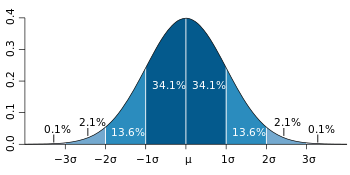
- I meant it like this: 2% is a 1 standard deviation increase from 0.1%. 16% is a 1 standard deviation increase from 2%. 50% is a 1 standard deviation increase from 16%. 84% is a 1 standard deviation increase from 50%. 98% is a 1 standard deviation increase from 84%. 99.9% is a 1 standard deviation increase from 98%. 68.4.99.100 (talk) 03:22, 8 July 2022 (UTC)
- Adding up the cumulative percentages the further that you go on this graph, I mean: https://www.statisticshowto.com/wp-content/uploads/2012/11/Standard_deviation_diagram.svg_.png 68.4.99.100 (talk) 03:26, 8 July 2022 (UTC)
- The standard deviations in these examples conform to the formula the square root of the variance of the outcome of a Bernoulli trial given as or So the model is then apparently that every Kyrgyz flips a biased coin in making up their mind on the issue, where each individual's coin has the same bias. It does not make much sense as a politico-sociological model, and neither does it make sense to measure the increase in the shared bias parameter using the square root of the Bernoulli-trial variance as a measuring stick. I can perform the calculations, but they produce numbers that are devoid of meaning. --Lambiam 09:47, 8 July 2022 (UTC)
- Adding up the cumulative percentages the further that you go on this graph, I mean: https://www.statisticshowto.com/wp-content/uploads/2012/11/Standard_deviation_diagram.svg_.png 68.4.99.100 (talk) 03:26, 8 July 2022 (UTC)
- I meant it like this: 2% is a 1 standard deviation increase from 0.1%. 16% is a 1 standard deviation increase from 2%. 50% is a 1 standard deviation increase from 16%. 84% is a 1 standard deviation increase from 50%. 98% is a 1 standard deviation increase from 84%. 99.9% is a 1 standard deviation increase from 98%. 68.4.99.100 (talk) 03:22, 8 July 2022 (UTC)
- We have a template for that situation, folks:
- Template:Homework
- TigraanClick here for my talk page ("private" contact) 10:11, 8 July 2022 (UTC)
- If this is a homework question, the instructor should apply for a remedial program. --Lambiam 12:23, 8 July 2022 (UTC)
- Template:Tq is quite a strong marker of homework. Regarding the instructor’s competency, I am going to make the bold guess that a question using Kyrgyzstan and Kazakhstan as example countries was not asked originally in English; the original might have used more mathematically precise terms. TigraanClick here for my talk page ("private" contact) 12:46, 8 July 2022 (UTC)
- Those countries were just random examples. 68.4.99.100 (talk) 22:09, 8 July 2022 (UTC)
- Template:Tq is quite a strong marker of homework. Regarding the instructor’s competency, I am going to make the bold guess that a question using Kyrgyzstan and Kazakhstan as example countries was not asked originally in English; the original might have used more mathematically precise terms. TigraanClick here for my talk page ("private" contact) 12:46, 8 July 2022 (UTC)
- If this is a homework question, the instructor should apply for a remedial program. --Lambiam 12:23, 8 July 2022 (UTC)