Testwiki:Reference desk/Archives/Mathematics/2014 April 6
Template:Error:not substituted
|- ! colspan="3" align="center" | Mathematics desk |- ! width="20%" align="left" | < April 5 ! width="25%" align="center"|<< Mar | April | May >> ! width="20%" align="right" |Current desk > |}
| Welcome to the Wikipedia Mathematics Reference Desk Archives |
|---|
| The page you are currently viewing is a transcluded archive page. While you can leave answers for any questions shown below, please ask new questions on one of the current reference desk pages. |
Contents
April 6
sum of reciprocals of numbers with k different prime numbers diverges for all k?
Template:Resolved Is it true that for all k, the sum of the reciprocals of the numbers which contain k factors all different diverges? So for example for k = 4, the sequence starts out 1/(2*3*5*7) + 1/(2*3*5*11) + 1/(2*3*5*13) + 1/(2*3*7*11) +... Naraht (talk) 14:20, 6 April 2014 (UTC)
- It diverges. Use induction on k. Sławomir Biały (talk) 14:43, 6 April 2014 (UTC)
- Why on k? By the time we get to large 4 factor numbers, we will be adding 1/(2*3*5*553105253) which is quite small. It isn't obvious to me. -- SGBailey (talk) 19:14, 6 April 2014 (UTC)
- Well, so the first thing you have to know is that Σ(1/p) diverges, albeit quite slowly (IIRC the sum of the first n reciprocal primes is asymptotic to a constant times log(log(n)). From there it should be pretty easy. --Trovatore (talk) 19:42, 6 April 2014 (UTC)
- I am not going by the induction argument, but just as a nonrigorous intuition on SGBailey's statement: given that the sum of the reciprocals of the primes diverges, and the sum without the constraint that the k factors be different is the kth power of this, and hence this diverges. Those denominators that have duplicated factors forms a vanishingly small part of the series, so removing them to get the original sum should not change the divergence. While this is hand-wavy, it should supply an adequate countering intuition. —Quondum 19:55, 6 April 2014 (UTC)
- You're making it waaayy too hard. It's trivial; you're missing an obvious point. --Trovatore (talk) 20:17, 6 April 2014 (UTC)
- Which is why you're giving no hints. Yes, I can see a simple proof for all k, but it does not use induction. —Quondum 20:59, 6 April 2014 (UTC)
- Alright, let's go ahead and give the hints, or actually the whole answer, now that I've had my coffee and French toast. The point is that, taking the k=4 case as an example, the series contains a subseries that looks like 1/(2*3*5) times the series (1/7+1/11+1/13+1/17+...). The latter series diverges because it's just the sum of the reciprocal primes, leaving off the first three terms. And if you multiply a divergent sequence by a nonzero constant, it's still divergent. I agree, it doesn't "use induction", at least at the level of natural-language proof (it probably does if you try to formulate it as a formal derivation in Peano arithmetic, but then so does practically everything, so that's not very interesting). --Trovatore (talk) 21:24, 6 April 2014 (UTC)
- Which is why you're giving no hints. Yes, I can see a simple proof for all k, but it does not use induction. —Quondum 20:59, 6 April 2014 (UTC)
- You're making it waaayy too hard. It's trivial; you're missing an obvious point. --Trovatore (talk) 20:17, 6 April 2014 (UTC)
Small circles on a 2-sphere
I am not a mathematician. I am involved in some applied aspects due to my hobby so to speak although it is more serious than a simple hobby. Also I want to reassure you, it is not a homework. I read the article "Sphere" in the Wikipedia and could not find what I need.
Imagine a 2-sphere of radius R = 1 with a North Pole and a great circle which is the Equator. Given a point on the sphere which is distinct from the North Pole and the Equator (it is defined by an angle θ between a radius pointing to the point in question and the one going to the North Pole) I want to know the length (in relative units) of a small circle running through this point parallel to the equator. I would appreciate if someone would give me this answer. Thanks, - --AboutFace 22 (talk) 15:01, 6 April 2014 (UTC)
- Well, the length of the equator is 2piR, so just 2pi in your R = 1 case. To reduce that by the angle from the north pole, you'd need to put a sine in there. I'm thinking it would be squared, so sin2(θ)2pi. Can somebody else verify this ? (I believe this works for circles in the southern hemisphere, too.) StuRat (talk) 15:11, 6 April 2014 (UTC)
Wow! So fast! Thank you very much. StuRat is here as always! I don't see the proof though. It seems to be more like intuitive? I hope you guys are correct. It is definitely correct in two extreme cases, theta = 0 and theta = 90. Looie496, thanks. Thanks again. --AboutFace 22 (talk) 15:24, 6 April 2014 (UTC)
- The proof is trivial, although our latitude article is a bit technical to serve as a good starting point. See instead (for instance) this diagram; if you complete the (right) triangle formed by the radius to a point on the surface, a line through that point parallel to the equatorial plane, and a portion of the axis, you will see that the distance from the surface point to the axis is (your θ is the colatitude that mathematicians typically use). That distance is the radius of the parallel at that latitude, so the circumference is , as given. --Tardis (talk) 16:29, 6 April 2014 (UTC)
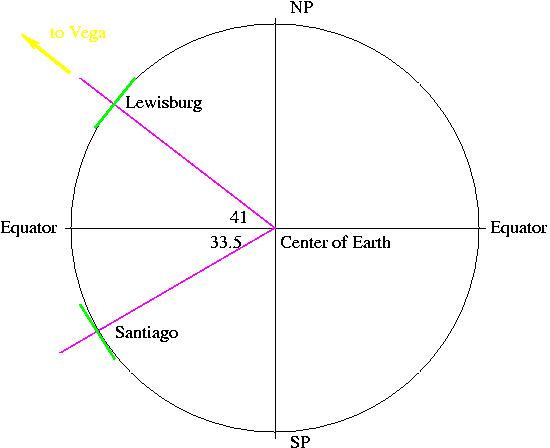
- Oh, and note that this is only for a theoretically perfect sphere. The Earth is actually a lumpy oblate spheroid, so your mileage may vary. StuRat (talk) 17:09, 6 April 2014 (UTC)
Again, I appreciate it. Thanks, --AboutFace 22 (talk) 19:58, 6 April 2014 (UTC)
Well, I am back here. Either there is something wrong with the formula or I am making a mistake somewhere. First I have a small globe in front of me. Then I decided to calculate the latitude as you call it or a small circle on the sphere which is just 3 degrees removed from the North Pole. It is a tiny distance, in fact. This is what I get. The sine ( θ ) = 0.052359... I don't know how to use calculators, it is easy for me to write a short piece of code, so it is C#. Then using your formula I multiply 6.28 * 0.052359 and I get 0.3284. It seems too large a value for me. Could it be true? Thanks, --AboutFace 22 (talk) 21:29, 6 April 2014 (UTC)
- Yup, correct (you missed a digit) for the circumference (what I assume you mean by "length") of the circle. This is 5.2% of the circumference of the equator. Colatitude: 3°, Latitude: 87°, circumference of circle of latitude: 0.3288365⋅R, where you took R = 1. —Quondum 21:53, 6 April 2014 (UTC)
Quondum, thank you but I do not understand what you are trying to say? First you said "correct." In what sense am I correct? That I made a mistake or the result I posted is correct? And what digit did I miss? Could you be more specific? Yes, I am talking about circumference. It is the length of the small circle I meant. On the other hand my result appears to be around 5% of the Equator (great circle). --AboutFace 22 (talk) 22:05, 6 April 2014 (UTC)
- The formula looks right to me. To convince yourself that everything is OK, try what I did: Get a large globe, run a string along it at the equator, and measure the length of the string. Then repeat this while making a circle 3 degrees from the N pole (it helps if your globe has latitude markings). The ratio of the two lengths should be the sine of 3 degrees.
- Note that a larger globe and larger angle on the globe from the pole will both reduce the relative error. StuRat (talk) 22:19, 6 April 2014 (UTC)
- The value 0.32884 is the correct value for the circumference of a circle around the north pole at colatitude 3° on a sphere of radius 1. Your value differed from this in that it omitted one of the '8' digits. Perhaps the little circle seems less that 5% of the size of the equator because the area of the discs differs so much (area ratio 1:365). —Quondum 22:22, 6 April 2014 (UTC)
Thank you StuRat and especially Quondum. Now it is all clear. A rephrased statement did the trick. --AboutFace 22 (talk) 00:41, 7 April 2014 (UTC)