Symbol or
exemplar
|
Name
|
Meaning
|
Standard IPA
equivalent
|
Notes
|
| Template:IPA
|
question mark
|
glottal stop
|
Template:IPA
|
typewriter substitution
|
| Template:IPA
|
digit seven
|
glottal stop
|
Template:IPA
|
typewriter substitution
|
| Template:IPA
|
apostrophe
|
glottal stop
|
Template:IPA
|
typewriter substitution
|
| Template:IPA
|
q
|
glottal stop
|
Template:IPA
|
used in Maltese, Khmer and Malayo–Polynesian languages transcriptions.
|
| Template:IPA
|
q with hook tail
|
bilabial click
|
Template:IPA
|
the tenuis bilabial click, and basis of digraphs for other bilabial clicks; equivalent to IPA [[[:Template:IPAlink]]].[2]
|
| Template:IPA
|
Greek phi
|
voiceless bilabial fricative
|
Template:IPA
|
a mistake, typewriter substitution or similarity of shape
|
| Template:IPA
|
Greek psi
|
retroflex click
|
Template:IPA
|
used by (Doke 1925), printed as  . .
|
| bunched-r
|
Template:IPA
|
proposed by John Laver (1994)
|
| voiced bilabial fricative trill
|
Template:IPA
|
Proposed by Sinologists.[3]
|
| voiceless labio-alveolar affricate
|
p͡s
|
Used by Blench (2008).[4]
|
| Template:IPA
|
sharp s
|
voiced bilabial fricative
|
Template:IPA
|
a mistake, typewriter substitution or similarity of shape
|
| Template:IPA, Template:Su or
|
integral symbol
|
voiceless postalveolar fricative
|
Template:IPA
|
a mistake, typewriter substitution or similarity of shape
|
| Template:IPA
|
digit three
|
voiced postalveolar fricative
|
Template:IPA
|
a mistake, typewriter substitution or similarity of shape; often confused with open-mid central unrounded vowel
|
| Template:IPA
|
d with stroke
|
voiced dental fricative
|
Template:IPA
|
a mistake, typewriter substitution or similarity of shape
|
| Template:IPA
|
thorn
|
voiceless dental fricative
|
Template:IPA
|
a mistake
|
| Template:IPA
|
turned delta
|
labialized voiced alveolar or dental fricative
|
Template:IPA
|
intended for the voiced whistled sibilant, ɀ, of Shona and related languages, withdrawn 1976[5]
|
| Template:IPA
|
sigma
|
labialized voiceless alveolar or dental fricative
|
Template:IPA
|
intended for the voiceless whistled sibilant, ȿ, of Shona and related languages, withdrawn 1976[5]
|
| Template:IPA
|
ezh with tail
|
labialized voiced alveolo-palatal fricative
|
Template:IPA
|
intended for w before front vowels in Twi;[5] may also be used for the lightly rounded English Template:IPA, withdrawn 1976.
|
| Template:IPA
|
reversed esh with top loop
|
labialized voiceless alveolo-palatal fricative
|
Template:IPA
|
intended for hw before front vowels in Twi;[5] may also be used for the lightly rounded English Template:IPA, withdrawn 1976.
|
| Template:IPA
|
barred digit two
|
voiced alveolar affricate
|
Template:IPA
|
withdrawn 1976
|
| Template:IPA or Template:IPA
|
turned voiced epiglottal trill
|
voiceless alveolar affricate
|
Template:IPA
|
withdrawn 1976
|
| Template:IPA
|
superscript digit one and two
|
tonal-stress
|
Template:IPA
|
used in Swedish
|
| Template:IPA
|
superscript digit one, two, three and four
|
Chinese tones
|
Template:IPA or Template:IPA or similar, depending on dialect and analysis, or Chao tone letters
|
used in Chinese studies
|
| Template:IPA
|
superscript digit one, two, three, four and five
|
tones
|
Template:IPA or Template:IPA
|
variant of IPA tones
|
| Template:IPA
|
superscript digit one, two, three, four, five, seven and eight
|
Southern Min tones
|
|
used in Sinologists of Taiwan includes Hokkien
|
| Template:IPA
|
eta
|
moraic nasal
|
Template:IPA, Template:IPA, Template:IPA, Template:IPA
|
Intended for the moraic nasal Template:IPA of Japanese.[5] Withdrawn 1976
|
| Template:IPA (Template:IPA)
|
Template:Anchor palatal hook
|
palatalization
|
Template:IPA
|
Typically used in the transcription of Slavic languages such as Russian. Superseded 1989
|
| Template:IPA
|
Template:Anchor retroflex hook
|
voiced alveolar or retroflex approximant
|
Template:IPA
|
a mistake; an example like /Template:IPA/ was actually [ʒ͡ɻ]
|
| Template:IPA
|
Template:Anchor retroflex hook
|
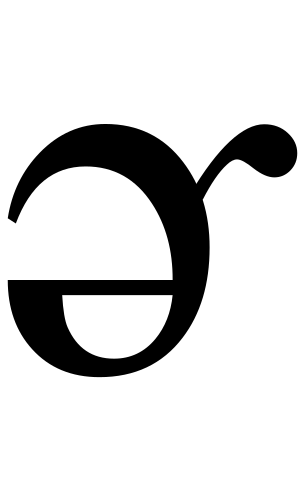
r-colored vowels
|
Template:IPA or Template:IPA
|
Superseded 1989; MODIFIER LETTER RHOTIC HOOK (U+02DE) is now preferred
|
|
Template:Anchor unstressed central rhotic vowel
|
r-colored vowel in American English
|
Template:IPA or Template:IPA
|
Proposed in 1934, MODIFIER LETTER RHOTIC HOOK (U+02DE) is now preferred
|
| Template:IPA
|
|
alveolo-palatal consonants
|
Template:IPA link, Template:IPA link, Template:IPA link, and Template:IPA link; respectively
|
broad transcription; especially Japanologists and Koreanists
|
| Template:IPA
|
a
|
|
any open vowel
|
Often a substitute for Template:IPA link in printing when the distinction between Template:IPA link and Template:IPA link is not needed.
|
| Template:IPA
|
Latin alpha
|
|
any open vowel
|
Often a substitute for Template:IPA link in printing when the distinction between Template:IPA link and Template:IPA link is not needed.
|
| Template:IPA
|
Greek alpha
|
open back unrounded vowel
|
Template:IPA
|
Old form of ⟨ɑ⟩, but still used in some italic fonts as the symbol for [[[:Template:IPAlink]]] to avoid confusion with italic "small letter a" that written as ⟨ɑ⟩ for [[[:Template:IPAlink]]].
|
| Template:IPA
|
turned Greek alpha
|
open back rounded vowel
|
Template:IPA
|
Old form of ⟨ɒ⟩, but still used in some italic fonts as the symbol for [[[:Template:IPAlink]]] to avoid confusion with italic "small turned letter a" that written as ⟨ɒ⟩ for [[[:Template:IPAlink]]].
|
| Template:IPA (a)
|
reversed a
|
near-open front unrounded vowel
|
Template:IPA
|
Proposed in 1989, rejected[6]
|
| Template:IPA
|
c
|
|
Template:IPA link, Template:IPA link or sometimes Template:IPA link.
|
broad transcription
|

|
nv ligature
|
close front rounded vowel
|
Template:IPA
|
proposed in 1989, rejected[6]
|
| Template:IPA
|
barred horseshoe u with hook
|
back sulcal vowel
|
|
proposed in 1989, rejected[6]
|

|
w with left hook
|
voiced labial-velar fricative (labialized voiced velar fricative)
|
Template:IPA
|
proposed in 1989, rejected[6]
|
| Template:IPA
|
letters with left-swinging top hook
|
dental consonants
|
Template:IPA
|
proposed in 1989, rejected;[6] Malayalam transcriptions
|
|
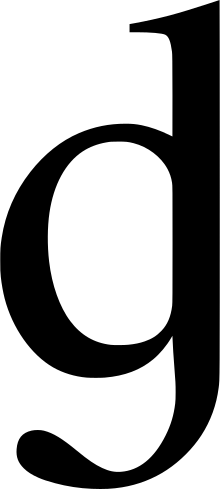
long-leg g
|
voiced velar lateral approximant
|
Template:IPA
|
proposed in 1989, rejected[6]
|
| Template:IPA
|
hooktop ezh
|
voiced velar fricative
|
Template:IPA
|
proposed in 1989, rejected[6]
|

|
double-loop g
|
voiced velar fricative
|
Template:IPA
|
from 1895 to 1900, Template:IPA represented that consonant before 1895, Template:IPA after 1900
|
|
|
double-loop g
|
voiced velar plosive
|
Template:IPA
|
standard Unicode Basic Latin/ASCII lower-case g (U+0067) may have a double-loop g glyph. The preferred IPA single-loop g (U+0261) is in the IPA Extensions Unicode block. For a time it was proposed that the double-loop g might be used for Template:IPA and the single-loop g for Template:IPA,[5] but the distinction never caught on.
|
|
|
double-loop g
|
voiced postalveolar affricate
|
Template:IPA
|
used in Arabic transcriptions
|

|
single-loop g with stroke
|
voiced velar fricative
|
Template:IPA
|
replaced double-loop g in 1900, then replaced by gamma Template:IPA around 1928-1930. the character ǥ may not have the single-loop shape in some fonts.
|
| j
|
j
|
|
Template:IPA link, Template:IPA link or sometimes Template:IPA link
|
|
| Template:IPA
|
barred dotless small j (or turned f in some fonts)
|
|
Template:IPA link or Template:IPA link
|
can be written as ⟨ȷ⟩ or ⟨f⟩
|
| Template:IPA etc.
|
subscript w
|
labialization
|
Template:IPA etc.
|
mark may appear above letters with descenders like Template:IPA or Template:IPA. removed 1989
|
| Template:IPA
|
curly-tail esh
|
voiceless alveolo-palatal fricative
|
Template:IPA
|
variant, also for Russian щ (now Template:Angbr IPA). removed 1989
|
| Template:IPA
|
curly-tail ezh
|
voiced alveolo-palatal fricative
|
Template:IPA
|
variant, removed 1989
|
| Template:IPA
|
curly-tail n, d, t, l
|
alveolo-palatal consonants
|
Template:IPA or Template:IPA
|
used by some Sinologists.
|
| Template:IPA
|
r with háček
|
voiced strident apico-alveolar trill
|
Template:IPA
|
Intended for ř in Czech and related languages. Template:Angbr IPA from 1909, replaced by Template:Angbr IPA in 1949, Withdrawn 1989
|
| Template:IPA
|
long-leg r
|
voiced strident apico-alveolar trill
|
Template:IPA
|
Intended for ř in Czech and related languages. Template:Angbr IPA from 1909, withdrawn 1989.
|
| Template:IPA
|
long-leg r
|
syllabic alveolar trill
|
Template:IPA
|
a mistake
|
Template:IPA ( ) )
|
Greek lambda
|
voiced palatal lateral approximant
|
Template:IPA
|
a mistake
|
| voiced alveolar lateral affricate
|
Template:IPA
|
used by Americanists
|
| Template:IPA
|
barred lambda
|
voiceless alveolar lateral affricate
|
Template:IPA
|
used by Americanists
|
| Template:IPA
|
l with stroke
|
voiceless alveolar lateral fricative
|
Template:IPA
|
used by Americanists, also a typographic substitute
|
| Template:IPA
|
l with stroke
|
velarized voiced alveolar lateral approximant
|
Template:IPA
|
used by Baltic transcriptions
|
| Template:IPA
|
small capital Cyrillic el
|
voiced uvular lateral approximant
|
Template:IPA
|
|
| Template:IPA
|
s c z with háček
|
postalveolar consonants
|
Template:IPA; Template:IPA
|
used by Americanists, Uralicists, Semiticists, Slavicists
|
| Template:IPA
|
j, g, ezh with háček
|
voiced postalveolar affricate
|
Template:IPA; Template:IPA
|
used by Americanists, Slavicists
|
| Template:IPA
|
|
voiceless alveolo-palatal fricative
|
Template:IPA
|
used by Americanists, Slavicists
|
| Template:IPA or Template:IPA
|
|
voiceless retroflex and alveolo-palatal affricate
|
Template:IPA
|
used by Americanists, Slavicists
|
| Template:IPA
|
c l n s z dz with acute accent
|
alveolo-palatals or palatals and postalveolar consonants
|
Template:IPA; Template:IPA
|
used by Slavicists
|
| Template:IPA
|
x, Latin gamma
|
voiceless and voiced uvular fricative (or voiced uvular approximant)
|
Template:IPA or Template:IPA
|
broad transcriptions in Hindi, Arabic and Hebrew transcriptions
|
| Template:IPA
|
x with dot
|
voiceless uvular fricative
|
Template:IPA
|
used by Americanists
|
| Template:IPA
|
uppercase x
|
voiceless uvular fricative
|
Template:IPA
|
a mistake
|
| Template:IPA
|
uppercase y
|
voiced labial–palatal approximant
|
Template:IPA
|
a mistake
|

|
baby gamma
|
close-mid back unrounded vowel
|
Template:IPA
|
used from 1921 to 1989, replaced by ramshorn to avoid confusion with gamma ; LATIN SMALL LETTER RAMS HORN (U+0264) now represents both glyphs
|
| Template:IPA
|
rho
|
bilabial trill
|
Template:IPA
|
common before an official letter was adopted
|
| Template:IPA
|
barred j
|
voiced post-palatal approximant
|
Template:IPA
|
|
| Template:IPA (ɥ̵)
|
barred turned h
|
compressed voiced post-palatal approximant
|
Template:IPA
|
|
| Template:IPA (w̶)
|
barred w
|
protruded voiced post-palatal approximant
|
Template:IPA
|
|
| Template:IPA
|
barred small capital i / upsilon
|
near-close central unrounded / rounded vowel
|
Template:IPA
|
used by some English phoneticians, including the Oxford English Dictionary
|
| Template:IPA
|
closed epsilon
|
open-mid front rounded vowel
|
Template:IPA
|
alternate symbol from 1904-1920s[7]
|
| Template:IPA
|
closed epsilon
|
open-mid central rounded vowel
|
Template:IPA
|
removed 1996
|
| Template:IPA
|
Latin iota
|
near-close near-front unrounded vowel
|
Template:IPA
|
longstanding alternate symbol until 1989
|
| Template:IPA
|
barred Latin iota
|
near-close central unrounded vowel
|
Template:IPA
|
longstanding alternate symbol until 1989
|
| Template:IPA
|
dotless small i
|
near-close near-front unrounded vowel
|
Template:IPA
|
a mistake or typographic substitute; or used by Americanists.
|
| Template:IPA
|
db and qp ligatures or footless phi and headless phi
|
voiced and voiceless labiodential plosives
|
Template:IPA
|
Used by Africanists.
|
| Template:IPA, Template:IPA, or Template:IPA
|
digit zero, slashed digit zero or uppercase slashed o
|
null initial
|
Template:IPA
|
usually used in phonology to mean a spelling with no sound value. however, in Chinese and some Korean linguistics, some scholars use it for a weak glottal stop; the sound value of the first consonant of syllables started by a vowel.
|
| Template:IPA
|
hooktop p, t, ʈ, c, k, q
|
voiceless implosives
|
Template:IPA or Template:IPA
|
brief additions to the IPA; removed 1993
|
| Template:IPA
|
turned t
|
dental click
|
Template:IPA
|
removed 1989; see click letters, but in some African languages still use this symbol to avoid confusion with ⟨Template:IPAlink⟩ (voiced lateral approximant)
|
| Template:IPA
|
stretched (or descended) c
|
alveolar click
|
Template:IPA
|
removed 1989; see click letters
|
| Template:IPA
|
stretched (or descended) c
|
voiced retroflex flap
|
Template:IPA
|
some assumed this symbol was made by combining ⟨ɾ⟩ with ⟨◌̢⟩ and thus was used as the symbol for voiced retroflex flap ([[[:Template:IPAlink]]]); ⟨ɽ⟩ assumed as the symbol of voiced retroflex trill ([[[:Template:IPAlink]]]).[8][9]
|
| Template:IPA
|
turned pharyngeal fricative
|
alveolar lateral click
|
Template:IPA
|
removed 1989; see click letters
|
| Template:IPA
|
turned k
|
originally a palatal click, reinterpreted as a velar click
|
|
velar articulation was judged impossible.[10] later reanalyzed and found paralinguistically. For several years used for a voiceless velodorsal stop in the extIPA.[11]
|
| Template:IPA (⨎)
|
esh with two bars
|
voiced palatal implosive
|
Template:IPA
|
old form of ⟨ʄ⟩.
|
| Template:IPA (⨎)
|
esh with two bars
|
fricated palatal click
|
Template:IPA or Template:IPA
|
uncommon letter in Ekoka !Kung transcription
|
| Template:IPA
|
triple vertical bar
|
retroflex lateral click
|
Template:IPA
|
|
| Template:IPA
|
ou
|
close-mid back unrounded vowel or voiced velar fricative
|
Template:IPA or Template:IPA
|
a common mistake
|
| Template:IPA
|
r
|
alveolar trill
|
any rhotic sound (including r-colored vowels)
|
broad transcription
|
| Template:IPA or Template:IPA
|
small capital or uppercase r
|
long vowel or prolonged moraic N
|
Template:IPA
|
used by Japanologists. This symbol represents phonemic long vowel (such as /Template:IPA/) or /Template:IPA/) or rarely prolonged moraic N (hatsuon).
|
| Template:IPA
|
reversed small capital r
|
voiced epiglottal trillTemplate:Citation needed
|
Template:IPA or Template:IPA
|
rare
|
| Template:IPA
|
dotless long i with fishhook
|
syllabic denti-alveolar approximant
|
Template:IPA,[12] Template:IPA[13]
|
used by Sinologists, and by Japanologists specifically for the Miyako and Tarama languages.
|
| Template:IPA
|
turned iota
|
syllabic denti-alveolar approximant
|
Template:IPA,[12] Template:IPA[13]
|
old form of ⟨ɿ⟩, used by Sinologists, and by Japanologists specifically for the Miyako and Tarama languages.
|
| Template:IPA
|
dotless long i with fishhook and tail
|
syllabic retroflex approximant
|
Template:IPA,[12] Template:IPA
|
used by Sinologists. See Chinese vowels
|
| Template:IPA or Template:IPA
|
reversed (baseline) esh
|
syllabic retroflex approximant
|
Template:IPA,[12] Template:IPA
|
old form of ⟨ʅ⟩, used by Sinologists. See Chinese vowels
|
| Template:IPA
|
turned h with fishhook
|
labialized syllabic denti-alveolar approximant
|
Template:IPA
|
used by Sinologists
|
| Template:IPA
|
turned h with fishhook and tail
|
labialized syllabic retroflex approximant
|
Template:IPA
|
used by Sinologists
|
| Template:IPA
|
small capital a
|
open central unrounded vowel
|
Template:IPA
|
used by Sinologists
|
| Template:IPA
|
small capital turned a
|
close-mid back unrounded vowel
|
Template:IPA
|
withdrawn in 1928.
|
| Template:IPA
|
barred Latin alpha
|
open central unrounded vowel
|
Template:IPA
|
Proposed by Charles-James N. Bailey in 1976[14]
|
| Template:IPA
|
ao ligature
|
open central unrounded vowel
|
Template:IPA
|
Used by Leoni & Maturi (2002).[15]
|
| Template:IPA
|
small capital e
|
mid front unrounded vowel
|
Template:IPA
|
Bloch & Trager (1942). Used by Sinologists and some Koreanists
|
| Template:IPA
|
barred e
|
close-mid central unrounded vowel
|
Template:IPA
|
used by Teuthonista
|
| Template:IPA
|
small capital turned e
|
mid back unrounded vowel
|
Template:IPA
|
used by some Koreanists who study Gyeongsang dialect, where there is no phonemic differentiation between Template:IPA (RR eo; Hangul ㅓ) and Template:IPA (RR eu; Hangul ㅡ).Template:Citation needed
|
| Template:IPA
|
closed omega
|
near-close near-back rounded vowel
|
Template:IPA
|
longstanding alternate symbol until 1989
|
| Template:IPA
|
omega
|
near-close near-back unrounded vowel
|
Template:IPA or Template:IPA
|
made from obsolete Template:IPA symbol.
|
| Template:IPA
|
omega
|
near-open back rounded vowel
|
Template:IPA
|
Proposed by Bloch & Trager (1942) and Sinologists.[16]
|
| Template:IPA
|
small capital omega
|
mid back rounded vowel
|
Template:IPA
|
Used by Sinologists and some Koreanists ; also Bloch & Trager (1942).
|
| Template:IPA
|
barred o
|
close-mid central rounded vowel
|
Template:IPA
|
used by TeuthonistaTemplate:Refnec; variant shape of ɵ in some early 20th century works.[17]
|
| Template:IPA
|
small capital u
|
near-close near-back rounded vowel
|
Template:IPA
|
Americanist notation; also shape of ʊ when it was adopted as a symbol in 1898 or early 20th century works.
|
| Template:IPA
|
barred small capital u
|
near-close central rounded vowel
|
Template:IPA
|
Americanist notation
|
| Template:IPA
|
uppercase letters
|
small caps
|
Template:IPA
|
often mistaken by typing, uppercase alternatives to symbols shaped like small capitals
|
| Template:IPA
|
small capital q
|
pharyngeal stop
|
Template:IPA
|
proposed for the pharyngeal stop of Formosan languages, ExtIPA for same purpose.
|
| Template:IPA
|
small capital q
|
sokuon
|
|
used by Japanologists.
|
| Template:IPA
|
capital Q
|
sokuon
|
|
used by Japanologists.
|
| Template:IPA
|
l
|
all coronal liquid consonants.
|
|
broad transcription, mainly Koreanologists.
|
| Template:IPA
|
belted letters
|
voiceless lateral fricatives (retroflex, palatal, and velar)
|
Template:IPA
|
now in the extIPA[11]
|
| Template:IPA
|
turned y
|
alveolo-palatal lateral approximant
|
[[[:Template:IPA]]] or [[[:Template:IPA]]]
|
broad transcription, mainly Koreanologists and Sinologists
|
| Template:IPA
|
n with left hook
|
alveolo-palatal nasal
|
[[[:Template:IPA]]] or [[[:Template:IPA]]]
|
broad transcription, mainly Koreanologists, Sinologists, and Japanologists
|
| Template:IPA
|
w with hook
|
bilabial flap
|
Template:IPA
|
|
| 𝼈
|
turned r with long leg and retroflex hook
|
retroflex lateral flap
|
Template:IPA
|
|
| ᶘ ᶚ
|
esh or ezh with retroflex hook
|
retroflex palato-alveolar fricatives
|
Template:IPA Template:IPA
|
may be impossible to pronounce[18]
|
| Template:IPA
|
barred y
|
close central compressed vowel
|
Template:IPA
|
|
| Template:IPA
|
small capital barred y
|
near-close central compressed vowel
|
Template:IPA
|
|
| ұ
|
barred straight y (Cyrillic straight u)
|
near-close near-back unrounded vowel
|
[[[:Template:IPA]]] or [[[:Template:IPA]]]
|
used in Mande studies[19]
|
| ◌̣
|
underdot
|
retroflex or r-colored vowels
|
Template:IPA Template:IPA etc.
|
|
| Template:IPA, Template:IPA, etc.
|
apostrophe
|
no audible release
|
Template:IPA, Template:IPA, etc.
|
removed
|
| Template:IPA, Template:IPA, etc.
|
apostrophe
|
palatalization
|
Template:IPA, Template:IPA, etc.
|
common in X-SAMPA
|
| Template:IPA etc.
|
uppercase letters (not small capitals)
|
fortis
|
Template:IPA, etc.
|
used by some Koreanologists
|
| ɔ̩
|
vowel with tilted line below
|
lower-pitched rising / falling tone contour
|
|
for languages that distinguish multiple rising or falling tones
|
| Template:IPA
|
turned comma above
|
weak (sometimes normal) aspiration
|
Template:IPA (sometimes Template:IPA)
|
First symbol may be left single quotation mark (U+2018) or modifier letter apostrophe (U+02BC); second symbol may be single high-reversed-9 quotation mark (U+201B) or modifier letter reversed comma (U+02BD)
|
| Template:IPA
|
ligatures
|
affricates
|
Template:IPA
|
formerly acceptable variants[20]
|
| Template:IPA
|
ligatures with palatal hook
|
palatalized affricates
|
Template:IPA
|
|
| Template:IPA
|
ligatures with retroflex hook
|
retroflex affricates
|
Template:IPA
|
John Laver used Template:IPA in Polish transcription[21]
|
| Template:IPA Template:IPA Template:IPA etc.
|
prime
|
palatalization
|
Template:IPA Template:IPA Template:IPA etc.
|
traditional Irish phonology transcription
|
| Template:IPA Template:IPA Template:IPA etc.
|
combining apostrophe
|
palatalization
|
Template:IPA Template:IPA Template:IPA etc.
|
traditional Russian phonology transcription
|
| Template:IPA
|
asterisk
|
syntactic gemination
|
(none)
|
used in some Italian dictionaries
|
| Template:IPA
|
open corner
|
release/burst
|
(none)
|
IPA number 490
|
| Template:IPA
|
without diacritics
|
dental consonants
|
Template:IPA
|
broad transcriptions; in some English dialects, /Template:IPA/ often described as ⟨Template:IPA link⟩ for /Template:IPA⁓Template:IPA/
|
| Template:IPA or Template:IPA
|
without diacritics
|
approximant consonants or mid vowels
|
Template:IPA or Template:IPA
|
broad transcriptions; in Spanish, /Template:IPA/ and /Template:IPA/ often described as ⟨Template:IPA link⟩ and ⟨Template:IPA link⟩
|
| Template:IPA
|
without diacritics
|
mid vowels
|
Template:IPA
|
broad transcriptions; for example in some languages, /Template:IPA/ and /Template:IPA/ maybe described as ⟨Template:IPA link⟩ and ⟨Template:IPA link⟩, also /Template:IPA/ maybe described as ⟨Template:IPA link⟩ or ⟨Template:IPA link⟩
|
| Template:IPA
|
without diacritics
|
central vowels
|
Template:IPA
|
broad transcriptions; in some English dialects, /Template:IPA/ often described as ⟨Template:IPA link⟩ in English for /Template:IPA/
|
| Template:IPA or Template:IPA
|
c or stroked c
|
voiceless alveolar affricate
|
Template:IPA link
|
Americanist notation
|
| Template:IPA
|
ezh
|
voiced alveolar affricate
|
Template:IPA link
|
Americanist notation
|
| Template:IPA
|
y
|
voiced palatal approximant
|
Template:IPA link
|
Americanist notation
|
| Template:IPA
|
a with diaeresis
|
near-open front unrounded vowel, open-mid front unrounded vowel or open front unrounded vowel
|
Template:IPA link, Template:IPA link or Template:IPA link
|
Uralicist notation
|
| Template:IPA
|
o with diaeresis
|
close-mid front rounded vowel, open-mid front rounded vowel or mid front rounded vowel
|
Template:IPA link, Template:IPA link or Template:IPA link
|
Americanist and Uralicist notation
|
| Template:IPA
|
u with diaeresis
|
close front rounded vowel or near-close near-front rounded vowel
|
Template:IPA link or Template:IPA link
|
Americanist and Uralicist notation
|
| Template:IPA Template:IPA etc.
|
right single quotation mark
|
Korean fortis
|
Template:IPA Template:IPA etc.
|
used by some Koreanists for fortis sounds; equivalent to Template:IPA, etc. above.
|
| Template:IPA
|
box
|
unreleased
|
Template:IPA
|
used where IPA Template:IPA would get confused with the corners used to indicate change of pitch in the Japanese pitch accent system
|
| Template:IPA
|
Modifier h with hook
|
breathy/ voiced aspiration
|
Template:IPA
|
Equivalent on the IPA
|
| Template:IPA
|
Modifier glottal stop
|
creaky voice/ glottalization
|
Template:IPA
|
Equivalent on the IPA
|
| Template:IPA
|
Combining middle tilde
|
velarization
|
Template:IPA
|
Equivalent on the IPA
|
| Template:IPA
|
Modifier high, mid and low macron behind
|
high, mid and low-level tone or intonation
|
|
removed
|
| Template:IPA
|
Modifier high and low equals sign behind
|
extra-high and extra-low level tone or intonation
|
|
removed
|
| Template:IPA
|
Modifier high, mid and low grave behind
|
falling or high falling, mid falling and low-falling tone or intonation
|
|
removed
|
| Template:IPA
|
Modifier high and low acute behind
|
high rising and low rising tone or intonation
|
|
removed
|
| Template:IPA
|
Modifier high and low caron behind
|
high dipping and low dipping (falling-rising) tone or intonation
|
|
removed
|
| Template:IPA
|
Modifier high and low circumflex behind
|
peaking (rising-falling) tone or intonation
|
|
removed
|
| Template:IPA
|
Modifier high and low tilde behind
|
"wavy" tone or intonation
|
|
removed
|
| Template:IPA
|
Modifier high, mid and low dot behind
|
atonic syllable with high, mid, and low pitch; respectively
|
|
removed
|
| Template:IPA
|
Acute accent, circumflex, grave accent, breve
|
stress symbols:
primary stress, weakened primary stress, secondary stress, and no stress; respectively
|
ˈˈ◌, ˈ◌, ˌ◌, ◌
|
some English phoneticians and phonologists use acute and grave accents as primary and secondary stress symbols. Some linguists[22] use the circumflex as weakened primary stress in compound words and the breve as no stress. these symbols are also written on the English spellings not just other IPA symbols.
|
| Template:IPA
|
Vertical line below or above
|
moraic
|
|
used by Japanologists. In the standard IPA, these symbols represents syllabic sounds, but Japanologists use them for phonetic variants (except for nasal vowels) of the moraic N ([[[:Template:IPA]]]).
|
| Template:IPA
|
Macron, acute accent, caron, grave accent
|
Chinese tones
|
Template:IPA or Template:IPA or similar, depending on dialect and analysis, or Chao tone letters
|
used by Sinologists with the values the symbols have in Hanyu Pinyin. the standard IPA values of these diacritics are: mid, high, rising, and low tone.
|
.svg)


