Template:Short description
Modern Arabic mathematical notation is a mathematical notation based on the Arabic script, used especially at pre-university levels of education. Its form is mostly derived from Western notation, but has some notable features that set it apart from its Western counterpart. The most remarkable of those features is the fact that it is written from right to left following the normal direction of the Arabic script. Other differences include the replacement of the Greek and Latin alphabet letters for symbols with Arabic letters and the use of Arabic names for functions and relations.
Features
- It is written from right to left following the normal direction of the Arabic script. Other differences include the replacement of the Latin alphabet letters for symbols with Arabic letters and the use of Arabic names for functions and relations.
- The notation exhibits one of the very few remaining vestiges of non-dotted Arabic scripts, as dots over and under letters (i'jam) are usually omitted.
- Letter cursivity (connectedness) of Arabic is also taken advantage of, in a few cases, to define variables using more than one letter. The most widespread example of this kind of usage is the canonical symbol for the radius of a circle Template:Lang (Template:IPA), which is written using the two letters nūn and qāf. When variable names are juxtaposed (as when expressing multiplication) they are written non-cursively.
Variations
Notation differs slightly from one region to another. In tertiary education, most regions use the Western notation. The notation mainly differs in numeral system used, and in mathematical symbols used.
Numeral systems
There are three numeral systems used in right to left mathematical notation.
Written numerals are arranged with their lowest-value digit to the right, with higher value positions added to the left. That is identical to the arrangement used by Western texts using Hindu-Arabic numerals even though Arabic script is read from right to left: Indeed, Western texts are written with the ones digit on the right because when the arithmetical manuals were translated from the Arabic, the numerals were treated as figures (like in a Euclidean diagram), and so were not flipped to match the Left-Right order of Latin text.[1] The symbols "٫" and "٬" may be used as the decimal mark and the thousands separator respectively when writing with Eastern Arabic numerals, e.g. Template:Lang 3.14159265358, Template:Lang 1,000,000,000. Negative signs are written to the left of magnitudes, e.g. Template:Lang −3. In-line fractions are written with the numerator and denominator on the left and right of the fraction slash respectively, e.g. Template:Lang 2/7.Template:Cn
Symbols
Sometimes, symbols used in Arabic mathematical notation differ according to the region:
Template:Refbegin
Template:Refend
Sometimes, mirrored Latin and Greek symbols are used in Arabic mathematical notation (especially in western Arabic regions):
Template:Refbegin
Template:Refend
However, in Iran, usually Latin and Greek symbols are used.
Examples
| Description
|
Latin
|
Arabic
|
Notes
|
| Euler's number
|
|
 |
Template:Math
|
Initial form of the Arabic letter Template:Lang hāʾ. Both Latin letter e and Arabic letter Template:Lang hāʾ are descendants of Phoenician letter  hē. hē.
|
| imaginary unit
|
|
 |
Template:Math
|
From Template:Lang tāʾ, which is in turn derived from the first letter of the second word of Template:Lang waḥdaẗun taḫīliyya "imaginary unit"
|
| pi
|
|
 |
Template:Math
|
From Template:Lang ṭāʾ; also in some regions
|
| radius
|
|
 |
Template:Math
|
From Template:Lang nūn followed by a dotless Template:Lang qāf, which is in turn derived from Template:Lang nuṣfu l-quṭr "radius"
|
| kilogram
|
kg
|
 |
Template:Math
|
From Template:Lang kāf-jīm-mīm. In some regions alternative symbols like  (Template:Math kāf-ġayn) or (Template:Math kāf-ġayn) or  (Template:Math kāf-lām-ġayn) are used. All three abbreviations are derived from Template:Lang kīlūġrām "kilogram" and its variant spellings. (Template:Math kāf-lām-ġayn) are used. All three abbreviations are derived from Template:Lang kīlūġrām "kilogram" and its variant spellings.
|
| gram
|
g
|
 |
Template:Math
|
From Template:Lang jīm-mīm, which is in turn derived from Template:Lang jrām, a variant spelling of Template:Lang ġrām "gram"
|
| metre
|
m
|
 |
Template:Math
|
From Template:Lang mīm, which is in turn derived from Template:Lang mitr "metre"
|
| centimetre
|
cm
|
 |
Template:Math
|
From Template:Lang sīn-mīm, which is in turn derived from Template:Lang "centimetre"
|
| millimetre
|
mm
|
 |
Template:Math
|
From Template:Lang mīm-mīm, which is in turn derived from Template:Lang millīmitr "millimetre"
|
| kilometre
|
km
|
 |
Template:Math
|
From Template:Lang kāf-mīm; also  (Template:Math kāf-lām-mīm) in some regions; both are derived from Template:Lang kīlūmitr "kilometre". (Template:Math kāf-lām-mīm) in some regions; both are derived from Template:Lang kīlūmitr "kilometre".
|
| second
|
s
|
 |
Template:Math
|
From Template:Lang ṯāʾ, which is in turn derived from Template:Lang ṯāniya "second"
|
| minute
|
min
|
 |
Template:Bigmath
|
From Template:Lang dālʾ, which is in turn derived from Template:Lang daqīqa "minute"; also  (Template:Math, i.e. dotless Template:Lang qāf) in some regions (Template:Math, i.e. dotless Template:Lang qāf) in some regions
|
| hour
|
h
|
 |
Template:Math
|
From Template:Lang sīnʾ, which is in turn derived from Template:Lang sāʿa "hour"
|
| kilometre per hour
|
km/h
|
 |
Template:Math
|
From the symbols for kilometre and hour
|
| degree Celsius
|
°C
|
 |
Template:Math
|
From Template:Lang sīn, which is in turn derived from the second word of Template:Lang darajat sīlsīūs "degree Celsius"; also  (Template:Math) from Template:Lang mīmʾ, which is in turn derived from the first letter of the third word of Template:Lang "degree centigrade" (Template:Math) from Template:Lang mīmʾ, which is in turn derived from the first letter of the third word of Template:Lang "degree centigrade"
|
| degree Fahrenheit
|
°F
|
 |
Template:Math
|
From Template:Lang fāʾ, which is in turn derived from the second word of Template:Lang darajat fahranhāyt "degree Fahrenheit"
|
| millimetres of mercury
|
mmHg
|
 |
Template:Math
|
From Template:Lang mīm-mīm zayn, which is in turn derived from the initial letters of the words Template:Lang "millimetres of mercury"
|
| Ångström
|
Å
|
 |
Template:Math
|
From Template:Lang ʾalif with hamzah and ring above, which is in turn derived from the first letter of "Ångström", variously spelled Template:Lang or Template:Lang
|
Trigonometric and hyperbolic functions
The letter  (Template:Math zayn, from the first letter of the second word of Template:Lang "hyperbolic function") is added to the end of trigonometric functions to express hyperbolic functions. This is similar to the way is added to the end of trigonometric functions in Latin-based notation.
For inverse trigonometric functions, the superscript Template:Math in Arabic notation is similar in usage to the superscript in Latin-based notation.
| Description
|
Latin
|
Arabic
|
Notes
|
| Limit
|
|
 |
Template:Math
|
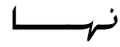
Template:Lang nūn-hāʾ-ʾalif is derived from the first three letters of Arabic Template:Lang nihāya "limit"
|
| Function
|
|
 |
Template:Math
|
Template:Lang dāl is derived from the first letter of Template:Lang "function". Also called Template:Lang, Template:Lang for short, in some regions.
|
| Derivatives
|
|
 |
Template:Math
|
‵ is a mirrored prime ′ while ، is an Arabic comma. The Template:Math signs should be mirrored: ∂.
|
| Integrals
|
|
 |
∮ ،∭ ،∬ ،∫
|
Mirrored ∫, ∬, ∭ and ∮
|
See also
References
Template:Reflist
External links


 hē.
hē.


 (Template:Math kāf-ġayn) or
  (Template:Math kāf-lām-ġayn) are used. All three abbreviations are derived from Template:Lang kīlūġrām "kilogram" and its variant spellings.


 (Template:Math kāf-lām-mīm) in some regions; both are derived from Template:Lang kīlūmitr "kilometre".


 (Template:Math, i.e. dotless Template:Lang qāf) in some regions


 (Template:Math) from Template:Lang mīmʾ, which is in turn derived from the first letter of the third word of Template:Lang "degree centigrade"


 (∑, a mirrored summation sign ∑) in some regions


 (Template:Math) in some regions

.PNG) (Template:Math) is used in some regions as
(Template:Math) is used in some regions as

.PNG) (Template:Math) is used in some regions as and
(Template:Math) is used in some regions as and .PNG) (Template:Math ) as the binomial coefficient
(Template:Math ) as the binomial coefficient

 (Template:Math jīm-bāʾ) is used in some regions (e.g. Syria); Arabic for "sine" is Template:Lang jayb

 (Template:Math tāʾ-jīm-bāʾ) is used in some regions (e.g. Syria); Arabic for "cosine" is Template:Lang

 (Template:Math ẓāʾ-lām) is used in some regions (e.g. Syria); Arabic for "tangent" is Template:Lang ẓill

 (Template:Math tāʾ-ẓāʾ-lām) is used in some regions (e.g. Syria); Arabic for "cotangent" is Template:Lang


 (Template:Math zayn, from the first letter of the second word of Template:Lang "hyperbolic function") is added to the end of trigonometric functions to express hyperbolic functions. This is similar to the way is added to the end of trigonometric functions in Latin-based notation.


.PNG)


