Extremely large telescope
Template:Short description Template:For Template:Comparison optical telescope primary mirrors.svg
An extremely large telescope (ELT) is an astronomical observatory featuring an optical telescope with an aperture for its primary mirror from 20 metres up to 100 metres across,[1][2] when discussing reflecting telescopes of optical wavelengths including ultraviolet (UV), visible, and near infrared wavelengths. Among many planned capabilities, extremely large telescopes are planned to increase the chance of finding Earth-like planets around other stars.[3] Telescopes for radio wavelengths can be much bigger physically, such as the Template:Convert aperture fixed focus radio telescope of the Arecibo Observatory (now defunct). Freely steerable radio telescopes with diameters up to Template:Convert have been in operation since the 1970s.
These telescopes have a number of features in common, in particular the use of a segmented primary mirror (similar to the existing Keck telescopes), and the use of high-order adaptive optics systems.[4][5]
Although extremely large telescope designs are large, they can have smaller apertures than the aperture synthesis on many large optical interferometers. However, they may collect much more light, along with other advantages.
List of telescopes
| # | Image | Name | Aperture (m) | Area (m2) | Primary mirror | Altitude (m) | First light |
Notes | Refs |
|---|---|---|---|---|---|---|---|---|---|
| 1 | 
|
Extremely Large Telescope (ELT) |
39.3 | 978 | 798 × 1.45 m hexagonal Template:F/1 |
3060 | 2028 | Under construction at Cerro Armazones Obs., Chile | [6][7][8] |
| 2 | 
|
Thirty Meter Telescope (TMT) |
30.0 | 655 | 492 × 1.45 m hexagonal Template:F/1 |
4050 | 2030s | Construction approved at Mauna Kea Obs. in Hawaii, USA, halted as of September 2019 due to protests | [4][9][10][11] |
| 3 | 
|
Giant Magellan Telescope (GMT) |
24.5 | 368 | 7 × 8.4 m circular Template:F/0.71 |
2516 | 2029 | Under construction at Las Campanas Obs., Chile; 6/7 mirrors cast |
[5][12][13] |
| 4 | 
|
Large Binocular Telescope (LBT) |
11.8 (equiv. area) 22.8 (equiv. detail limit) |
111 | 2 × 8.4 m circular |
3221 | 2008 | Largest non-segmented mirrors. Located on Mount Graham, Arizona, USA |
[14] |
| Note: Aperture of LBT: the baseline is obtained via aperture synthesis. | |||||||||

Budget
Possible budget figures, which are estimates and can vary over time. For construction costs, it is recommended to estimate the cost of a giant telescope with the following equation:[15]
| Name | Cost (est. USD) |
Alternate |
|---|---|---|
| Extremely Large Telescope (ELT) | $1590 million | €1300 million[16] |
| Thirty Meter Telescope (TMT) | $1400 million | $3600 million[17] |
| Giant Magellan Telescope (GMT) | $1000 million | $2540 million[17] |
| Large Binocular Telescope (LBT) | $120 million |
Projects
| |||||
Extremely large telescopes:
| |||||


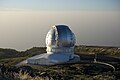

There were several telescopes in various stages in the 1990s and early 2000s, and some developed into construction projects.
- Under construction
- Funded construction
- Projects
Some of these projects have been cancelled, or merged into ongoing extremely large telescopes.
- GSMT:[21] Giant Segmented Mirror Telescope, merged into TMT
- OWL:[22] Overwhelmingly Large Telescope, passed over in favor of ELT
- VLOT:[23] Very Large Optical Telescope, merged into TMT
- LAT:[24] Large Atacama Telescope
- EURO50:[25] European 50-metre Telescope, merged into ELT
- LPT:[26] Large Petal Telescope
- Magellan 20: merged into GMT
- HDRT:[27] High Dynamic Range Telescope
- JELT:[28] Japanese ELT Project; Japan joined the TMT project in 2008
- CELT:[29] California Extremely Large Telescope, became/merged into TMT
- MAXAT:[30] Maximum Aperture Telescope
See also
References
External links
- Template:Commons category-inline
- Australian National Workshop on Extremely Large Telescopes (ELTs)
- The OPTICON ELT Working Group a Europe-wide research project
- The science case for Extremely Large Telescopes (ELTs) from the Royal Observatory, Edinburgh
- Colossus Telescope
Template:Portal bar Template:Astronomy navbox
- ↑ As A Skeleton Science Case For Extremely Large (20m–100m) Ground-based Telescopes (ELTs) and first section of ELT Roadmap Template:Webarchive, PDF
- ↑ Template:Cite news
- ↑ Template:Cite news
- ↑ 4.0 4.1 Template:Cite journal
- ↑ 5.0 5.1 Template:Cite book
- ↑ Template:Cite web
- ↑ Template:Cite news
- ↑ Template:Cite web
- ↑ Template:Citation
- ↑ TMT Timeline, accessed February 11, 2018
- ↑ Template:Cite news
- ↑ Template:Cite news
- ↑ Template:Cite web
- ↑ Template:Cite press release
- ↑ Template:Cite web
- ↑ Template:Cite web
- ↑ 17.0 17.1 Template:Cite web
- ↑ Template:Cite web
- ↑ Template:Cite web
- ↑ Template:Cite web
- ↑ Template:Cite web
- ↑ Template:Cite web
- ↑ Template:Cite web
- ↑ Template:Cite web
- ↑ Template:Cite web
- ↑ Template:Cite web
- ↑ https://home.ifa.hawaii.edu/users/kuhn/tmp.html%25%7Ctitle= 22 March 2002.
- ↑ http://optik2.mtk.nao.ac.jp/futureplan/eltproje.htmTemplate:Dead link
- ↑ Template:Cite web
- ↑ Template:Cite web