Hilbert transform
Template:Short description In mathematics and signal processing, the Hilbert transform is a specific singular integral that takes a function, Template:Math of a real variable and produces another function of a real variable Template:Math. The Hilbert transform is given by the Cauchy principal value of the convolution with the function (see Template:Slink). The Hilbert transform has a particularly simple representation in the frequency domain: It imparts a phase shift of ±90° (Template:Pi/2 radians) to every frequency component of a function, the sign of the shift depending on the sign of the frequency (see Template:Slink). The Hilbert transform is important in signal processing, where it is a component of the analytic representation of a real-valued signal Template:Math. The Hilbert transform was first introduced by David Hilbert in this setting, to solve a special case of the Riemann–Hilbert problem for analytic functions.
Definition
The Hilbert transform of Template:Mvar can be thought of as the convolution of Template:Math with the function Template:Math, known as the Cauchy kernel. Because 1/Template:Mvar is not integrable across Template:Math, the integral defining the convolution does not always converge. Instead, the Hilbert transform is defined using the Cauchy principal value (denoted here by Template:Math). Explicitly, the Hilbert transform of a function (or signal) Template:Math is given by
provided this integral exists as a principal value. This is precisely the convolution of Template:Mvar with the tempered distribution Template:Math.[1] Alternatively, by changing variables, the principal-value integral can be written explicitly[2] as
When the Hilbert transform is applied twice in succession to a function Template:Mvar, the result is
provided the integrals defining both iterations converge in a suitable sense. In particular, the inverse transform is . This fact can most easily be seen by considering the effect of the Hilbert transform on the Fourier transform of Template:Math (see Template:Slink below).
For an analytic function in the upper half-plane, the Hilbert transform describes the relationship between the real part and the imaginary part of the boundary values. That is, if Template:Math is analytic in the upper half complex plane Template:Math, and Template:Math, then Template:Math up to an additive constant, provided this Hilbert transform exists.
Notation
In signal processing the Hilbert transform of Template:Math is commonly denoted by .[3] However, in mathematics, this notation is already extensively used to denote the Fourier transform of Template:Math.[4] Occasionally, the Hilbert transform may be denoted by . Furthermore, many sources define the Hilbert transform as the negative of the one defined here.[5]
History
The Hilbert transform arose in Hilbert's 1905 work on a problem Riemann posed concerning analytic functions,Template:SfnTemplate:Sfn which has come to be known as the Riemann–Hilbert problem. Hilbert's work was mainly concerned with the Hilbert transform for functions defined on the circle.Template:SfnTemplate:Sfn Some of his earlier work related to the Discrete Hilbert Transform dates back to lectures he gave in Göttingen. The results were later published by Hermann Weyl in his dissertation.Template:Sfn Schur improved Hilbert's results about the discrete Hilbert transform and extended them to the integral case.Template:Sfn These results were restricted to the spaces [[Lp space|Template:Math and Template:Math]]. In 1928, Marcel Riesz proved that the Hilbert transform can be defined for u in (Lp space) for Template:Math, that the Hilbert transform is a bounded operator on for Template:Math, and that similar results hold for the Hilbert transform on the circle as well as the discrete Hilbert transform.Template:Sfn The Hilbert transform was a motivating example for Antoni Zygmund and Alberto Calderón during their study of singular integrals.Template:Sfn Their investigations have played a fundamental role in modern harmonic analysis. Various generalizations of the Hilbert transform, such as the bilinear and trilinear Hilbert transforms are still active areas of research today.
Relationship with the Fourier transform
The Hilbert transform is a multiplier operator.Template:Sfn The multiplier of Template:Math is Template:Math, where Template:Math is the signum function. Therefore:
where denotes the Fourier transform. Since Template:Math, it follows that this result applies to the three common definitions of .
By Euler's formula,
Therefore, Template:Math has the effect of shifting the phase of the negative frequency components of Template:Math by +90° (Template:Frac radians) and the phase of the positive frequency components by −90°, and Template:Math has the effect of restoring the positive frequency components while shifting the negative frequency ones an additional +90°, resulting in their negation (i.e., a multiplication by −1).
When the Hilbert transform is applied twice, the phase of the negative and positive frequency components of Template:Math are respectively shifted by +180° and −180°, which are equivalent amounts. The signal is negated; i.e., Template:Math, because
Table of selected Hilbert transforms
In the following table, the frequency parameter is real.
| Signal |
Hilbert transform[fn 1] |
|---|---|
| [fn 2] |
|
| [fn 2] |
|
|
| |
|
| |
(see Dawson function) | |
| Sinc function |
|
| Dirac delta function |
|
| Characteristic function |
Notes
- ↑ Some authors (e.g., Bracewell) use our Template:Math as their definition of the forward transform. A consequence is that the right column of this table would be negated.
- ↑ 2.0 2.1 The Hilbert transform of the sin and cos functions can be defined by taking the principal value of the integral at infinity. This definition agrees with the result of defining the Hilbert transform distributionally.
An extensive table of Hilbert transforms is available.Template:Sfn Note that the Hilbert transform of a constant is zero.
Domain of definition
It is by no means obvious that the Hilbert transform is well-defined at all, as the improper integral defining it must converge in a suitable sense. However, the Hilbert transform is well-defined for a broad class of functions, namely those in for Template:Math.
More precisely, if Template:Mvar is in for Template:Math, then the limit defining the improper integral
exists for almost every Template:Mvar. The limit function is also in and is in fact the limit in the mean of the improper integral as well. That is,
as Template:Math in the Template:Mvar norm, as well as pointwise almost everywhere, by the Titchmarsh theorem.Template:Sfn
In the case Template:Math, the Hilbert transform still converges pointwise almost everywhere, but may itself fail to be integrable, even locally.Template:Sfn In particular, convergence in the mean does not in general happen in this case. The Hilbert transform of an Template:Math function does converge, however, in Template:Math-weak, and the Hilbert transform is a bounded operator from Template:Math to Template:Math.Template:Sfn (In particular, since the Hilbert transform is also a multiplier operator on Template:Math, Marcinkiewicz interpolation and a duality argument furnishes an alternative proof that Template:Mvar is bounded on Template:Math.)
Properties
Boundedness
If Template:Math, then the Hilbert transform on is a bounded linear operator, meaning that there exists a constant Template:Mvar such that
for all Template:Nowrap[6]
The best constant is given by[7]
An easy way to find the best for being a power of 2 is through the so-called Cotlar's identity that for all real valued Template:Mvar. The same best constants hold for the periodic Hilbert transform.
The boundedness of the Hilbert transform implies the convergence of the symmetric partial sum operator
to Template:Mvar in Template:Nowrap[8]
Anti-self adjointness
The Hilbert transform is an anti-self adjoint operator relative to the duality pairing between and the dual space Template:Nowrap where Template:Mvar and Template:Mvar are Hölder conjugates and Template:Math. Symbolically,
for and Template:NowrapTemplate:Sfn
Inverse transform
The Hilbert transform is an anti-involution,Template:Sfn meaning that
provided each transform is well-defined. Since Template:Math preserves the space Template:Nowrap this implies in particular that the Hilbert transform is invertible on Template:Nowrap and that
Complex structure
Because Template:Math ("Template:Math" is the identity operator) on the real Banach space of real-valued functions in Template:Nowrap the Hilbert transform defines a linear complex structure on this Banach space. In particular, when Template:Math, the Hilbert transform gives the Hilbert space of real-valued functions in the structure of a complex Hilbert space.
The (complex) eigenstates of the Hilbert transform admit representations as holomorphic functions in the upper and lower half-planes in the Hardy space [[H square|Template:Math]] by the Paley–Wiener theorem.
Differentiation
Formally, the derivative of the Hilbert transform is the Hilbert transform of the derivative, i.e. these two linear operators commute:
Iterating this identity,
This is rigorously true as stated provided Template:Mvar and its first Template:Mvar derivatives belong to Template:NowrapTemplate:Sfn One can check this easily in the frequency domain, where differentiation becomes multiplication by Template:Mvar.
Convolutions
The Hilbert transform can formally be realized as a convolution with the tempered distributionTemplate:Sfn
Thus formally,
However, a priori this may only be defined for Template:Mvar a distribution of compact support. It is possible to work somewhat rigorously with this since compactly supported functions (which are distributions a fortiori) are dense in Template:Math. Alternatively, one may use the fact that h(t) is the distributional derivative of the function Template:Math; to wit
For most operational purposes the Hilbert transform can be treated as a convolution. For example, in a formal sense, the Hilbert transform of a convolution is the convolution of the Hilbert transform applied on only one of either of the factors:
This is rigorously true if Template:Mvar and Template:Mvar are compactly supported distributions since, in that case,
By passing to an appropriate limit, it is thus also true if Template:Math and Template:Math provided that
from a theorem due to Titchmarsh.Template:Sfn
Invariance
The Hilbert transform has the following invariance properties on .
- It commutes with translations. That is, it commutes with the operators Template:Math for all Template:Mvar in
- It commutes with positive dilations. That is it commutes with the operators Template:Math for all Template:Math.
- It anticommutes with the reflection Template:Math.
Up to a multiplicative constant, the Hilbert transform is the only bounded operator on Template:Mvar2 with these properties.Template:Sfn
In fact there is a wider set of operators that commute with the Hilbert transform. The group acts by unitary operators Template:Math on the space by the formula
This unitary representation is an example of a principal series representation of In this case it is reducible, splitting as the orthogonal sum of two invariant subspaces, Hardy space and its conjugate. These are the spaces of Template:Math boundary values of holomorphic functions on the upper and lower halfplanes. and its conjugate consist of exactly those Template:Math functions with Fourier transforms vanishing on the negative and positive parts of the real axis respectively. Since the Hilbert transform is equal to Template:Math, with Template:Mvar being the orthogonal projection from onto and Template:Math the identity operator, it follows that and its orthogonal complement are eigenspaces of Template:Math for the eigenvalues Template:Math. In other words, Template:Math commutes with the operators Template:Mvar. The restrictions of the operators Template:Mvar to and its conjugate give irreducible representations of – the so-called limit of discrete series representations.[9]
Extending the domain of definition
Hilbert transform of distributions
It is further possible to extend the Hilbert transform to certain spaces of distributions Template:Harv. Since the Hilbert transform commutes with differentiation, and is a bounded operator on Template:Mvar, Template:Mvar restricts to give a continuous transform on the inverse limit of Sobolev spaces:
The Hilbert transform can then be defined on the dual space of , denoted , consisting of Template:Mvar distributions. This is accomplished by the duality pairing:
For Template:Nowrap define:
It is possible to define the Hilbert transform on the space of tempered distributions as well by an approach due to Gel'fand and Shilov,Template:Sfn but considerably more care is needed because of the singularity in the integral.
Hilbert transform of bounded functions
The Hilbert transform can be defined for functions in as well, but it requires some modifications and caveats. Properly understood, the Hilbert transform maps to the Banach space of bounded mean oscillation (BMO) classes.
Interpreted naïvely, the Hilbert transform of a bounded function is clearly ill-defined. For instance, with Template:Math, the integral defining Template:Math diverges almost everywhere to Template:Math. To alleviate such difficulties, the Hilbert transform of an Template:Math function is therefore defined by the following regularized form of the integral
where as above Template:Math and
The modified transform Template:Math agrees with the original transform up to an additive constant on functions of compact support from a general result by Calderón and Zygmund.[10] Furthermore, the resulting integral converges pointwise almost everywhere, and with respect to the BMO norm, to a function of bounded mean oscillation.
A deep result of Fefferman's work[11] is that a function is of bounded mean oscillation if and only if it has the form Template:Nowrap for some Template:Nowrap
Conjugate functions
The Hilbert transform can be understood in terms of a pair of functions Template:Math and Template:Math such that the function is the boundary value of a holomorphic function Template:Math in the upper half-plane.Template:Sfn Under these circumstances, if Template:Mvar and Template:Mvar are sufficiently integrable, then one is the Hilbert transform of the other.
Suppose that Then, by the theory of the Poisson integral, Template:Mvar admits a unique harmonic extension into the upper half-plane, and this extension is given by
which is the convolution of Template:Mvar with the Poisson kernel
Furthermore, there is a unique harmonic function Template:Mvar defined in the upper half-plane such that Template:Math is holomorphic and
This harmonic function is obtained from Template:Mvar by taking a convolution with the conjugate Poisson kernel
Thus
Indeed, the real and imaginary parts of the Cauchy kernel are
so that Template:Math is holomorphic by Cauchy's integral formula.
The function Template:Mvar obtained from Template:Mvar in this way is called the harmonic conjugate of Template:Mvar. The (non-tangential) boundary limit of Template:Math as Template:Math is the Hilbert transform of Template:Mvar. Thus, succinctly,
Titchmarsh's theorem
Titchmarsh's theorem (named for E. C. Titchmarsh who included it in his 1937 work) makes precise the relationship between the boundary values of holomorphic functions in the upper half-plane and the Hilbert transform.Template:Sfn It gives necessary and sufficient conditions for a complex-valued square-integrable function Template:Math on the real line to be the boundary value of a function in the Hardy space Template:Math of holomorphic functions in the upper half-plane Template:Mvar.
The theorem states that the following conditions for a complex-valued square-integrable function are equivalent:
- Template:Math is the limit as Template:Math of a holomorphic function Template:Math in the upper half-plane such that
- The real and imaginary parts of Template:Math are Hilbert transforms of each other.
- The Fourier transform vanishes for Template:Math.
A weaker result is true for functions of class Template:Mvar for Template:Math.Template:Sfn Specifically, if Template:Math is a holomorphic function such that
for all Template:Mvar, then there is a complex-valued function Template:Math in such that Template:Math in the Template:Mvar norm as Template:Math (as well as holding pointwise almost everywhere). Furthermore,
where Template:Mvar is a real-valued function in and Template:Mvar is the Hilbert transform (of class Template:Mvar) of Template:Mvar.
This is not true in the case Template:Math. In fact, the Hilbert transform of an Template:Math function Template:Mvar need not converge in the mean to another Template:Math function. Nevertheless,Template:Sfn the Hilbert transform of Template:Mvar does converge almost everywhere to a finite function Template:Mvar such that
This result is directly analogous to one by Andrey Kolmogorov for Hardy functions in the disc.Template:Sfn Although usually called Titchmarsh's theorem, the result aggregates much work of others, including Hardy, Paley and Wiener (see Paley–Wiener theorem), as well as work by Riesz, Hille, and Tamarkin[12]
Riemann–Hilbert problem
One form of the Riemann–Hilbert problem seeks to identify pairs of functions Template:Math and Template:Math such that Template:Math is holomorphic on the upper half-plane and Template:Math is holomorphic on the lower half-plane, such that for Template:Mvar along the real axis,
where Template:Math is some given real-valued function of Template:Nowrap The left-hand side of this equation may be understood either as the difference of the limits of Template:Math from the appropriate half-planes, or as a hyperfunction distribution. Two functions of this form are a solution of the Riemann–Hilbert problem.
Formally, if Template:Math solve the Riemann–Hilbert problem
then the Hilbert transform of Template:Math is given byTemplate:Sfn
Hilbert transform on the circle
Template:See also For a periodic function Template:Mvar the circular Hilbert transform is defined:
The circular Hilbert transform is used in giving a characterization of Hardy space and in the study of the conjugate function in Fourier series. The kernel, is known as the Hilbert kernel since it was in this form the Hilbert transform was originally studied.Template:Sfn
The Hilbert kernel (for the circular Hilbert transform) can be obtained by making the Cauchy kernel Template:Frac periodic. More precisely, for Template:Math
Many results about the circular Hilbert transform may be derived from the corresponding results for the Hilbert transform from this correspondence.
Another more direct connection is provided by the Cayley transform Template:Math, which carries the real line onto the circle and the upper half plane onto the unit disk. It induces a unitary map
of Template:Math onto The operator Template:Mvar carries the Hardy space Template:Math onto the Hardy space .Template:Sfn
Hilbert transform in signal processing
Bedrosian's theorem
Bedrosian's theorem states that the Hilbert transform of the product of a low-pass and a high-pass signal with non-overlapping spectra is given by the product of the low-pass signal and the Hilbert transform of the high-pass signal, or
where Template:Math and Template:Math are the low- and high-pass signals respectively.Template:Sfn A category of communication signals to which this applies is called the narrowband signal model. A member of that category is amplitude modulation of a high-frequency sinusoidal "carrier":
where Template:Math is the narrow bandwidth "message" waveform, such as voice or music. Then by Bedrosian's theorem:Template:Sfn
Analytic representation
Template:Main article A specific type of conjugate function is:
known as the analytic representation of The name reflects its mathematical tractability, due largely to Euler's formula. Applying Bedrosian's theorem to the narrowband model, the analytic representation is:[13]
A Fourier transform property indicates that this complex heterodyne operation can shift all the negative frequency components of Template:Math above 0 Hz. In that case, the imaginary part of the result is a Hilbert transform of the real part. This is an indirect way to produce Hilbert transforms.
Template:Anchor Angle (phase/frequency) modulation
The form:[14]
is called angle modulation, which includes both phase modulation and frequency modulation. The instantaneous frequency is For sufficiently large Template:Mvar, compared to Template:Nowrap
and:
Single sideband modulation (SSB)
Template:Main article When Template:Math in Template:EquationNote is also an analytic representation (of a message waveform), that is:
the result is single-sideband modulation:
whose transmitted component is:[15][16]
Causality
The function presents two causality-based challenges to practical implementation in a convolution (in addition to its undefined value at 0):
- Its duration is infinite (technically infinite support). Finite-length windowing reduces the effective frequency range of the transform; shorter windows result in greater losses at low and high frequencies. See also quadrature filter.
- It is a non-causal filter. So a delayed version, is required. The corresponding output is subsequently delayed by When creating the imaginary part of an analytic signal, the source (real part) must also be delayed by .
Discrete Hilbert transform
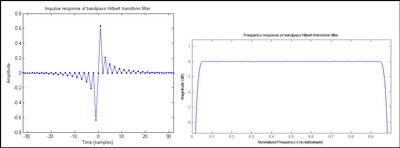
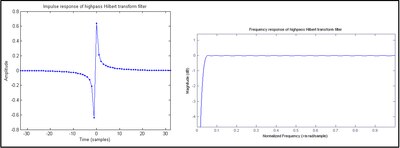


For a discrete function, with discrete-time Fourier transform (DTFT), , and discrete Hilbert transform the DTFT of in the region Template:Math is given by:
The inverse DTFT, using the convolution theorem, is:[17][18]
where
which is an infinite impulse response (IIR).
Practical considerations[19]
Method 1: Direct convolution of streaming data with an FIR approximation of which we will designate by Examples of truncated are shown in figures 1 and 2. Fig 1 has an odd number of anti-symmetric coefficients and is called Type III.[20] This type inherently exhibits responses of zero magnitude at frequencies 0 and Nyquist, resulting in a bandpass filter shape.[21][22] A Type IV design (even number of anti-symmetric coefficients) is shown in Fig 2.[23][24] It has a highpass frequency response.[25] Type III is the usual choice.[26][27] for these reasons:
- A typical (i.e. properly filtered and sampled) sequence has no useful components at the Nyquist frequency.
- The Type IV impulse response requires a sample shift in the sequence. That causes the zero-valued coefficients to become non-zero, as seen in Figure 2. So a Type III design is potentially twice as efficient as Type IV.
- The group delay of a Type III design is an integer number of samples, which facilitates aligning with to create an analytic signal. The group delay of Type IV is halfway between two samples.
The abrupt truncation of creates a rippling (Gibbs effect) of the flat frequency response. That can be mitigated by use of a window function to taper to zero.[28]
Method 2: Piecewise convolution. It is well known that direct convolution is computationally much more intensive than methods like overlap-save that give access to the efficiencies of the Fast Fourier transform via the convolution theorem.[29] Specifically, the discrete Fourier transform (DFT) of a segment of is multiplied pointwise with a DFT of the sequence. An inverse DFT is done on the product, and the transient artifacts at the leading and trailing edges of the segment are discarded. Over-lapping input segments prevent gaps in the output stream. An equivalent time domain description is that segments of length (an arbitrary parameter) are convolved with the periodic function:
When the duration of non-zero values of is the output sequence includes samples of outputs are discarded from each block of and the input blocks are overlapped by that amount to prevent gaps.
Method 3: Same as method 2, except the DFT of is replaced by samples of the distribution (whose real and imaginary components are all just or ) That convolves with a periodic summation:Template:Efn-ua
for some arbitrary parameter, is not an FIR, so the edge effects extend throughout the entire transform. Deciding what to delete and the corresponding amount of overlap is an application-dependent design issue.
Fig 3 depicts the difference between methods 2 and 3. Only half of the antisymmetric impulse response is shown, and only the non-zero coefficients. The blue graph corresponds to method 2 where is truncated by a rectangular window function, rather than tapered. It is generated by a Matlab function, hilb(65). Its transient effects are exactly known and readily discarded. The frequency response, which is determined by the function argument, is the only application-dependent design issue.
The red graph is corresponding to method 3. It is the inverse DFT of the distribution. Specifically, it is the function that is convolved with a segment of by the MATLAB function, hilbert(u,512).[30] The real part of the output sequence is the original input sequence, so that the complex output is an analytic representation of
When the input is a segment of a pure cosine, the resulting convolution for two different values of is depicted in Fig 4 (red and blue plots). Edge effects prevent the result from being a pure sine function (green plot). Since is not an FIR sequence, the theoretical extent of the effects is the entire output sequence. But the differences from a sine function diminish with distance from the edges. Parameter is the output sequence length. If it exceeds the length of the input sequence, the input is modified by appending zero-valued elements. In most cases, that reduces the magnitude of the edge distortions. But their duration is dominated by the inherent rise and fall times of the impulse response.
Fig 5 is an example of piecewise convolution, using both methods 2 (in blue) and 3 (red dots). A sine function is created by computing the Discrete Hilbert transform of a cosine function, which was processed in four overlapping segments, and pieced back together. As the FIR result (blue) shows, the distortions apparent in the IIR result (red) are not caused by the difference between and (green and red in Fig 3). The fact that is tapered (windowed) is actually helpful in this context. The real problem is that it's not windowed enough. Effectively, whereas the overlap-save method needs
Number-theoretic Hilbert transform
The number theoretic Hilbert transform is an extensionTemplate:Sfn of the discrete Hilbert transform to integers modulo an appropriate prime number. In this it follows the generalization of discrete Fourier transform to number theoretic transforms. The number theoretic Hilbert transform can be used to generate sets of orthogonal discrete sequences.Template:Sfn
See also
- Analytic signal
- Harmonic conjugate
- Hilbert spectroscopy
- Hilbert transform in the complex plane
- Hilbert–Huang transform
- Kramers–Kronig relations
- Riesz transform
- Single-sideband modulation
- Singular integral operators of convolution type
Notes
Page citations
References
Template:Sfn whitelist Template:Refbegin
- Template:Cite journal
- Template:Cite report
- Template:Springer
- Template:Cite book
- Template:Cite book
- Template:Cite journal
- Template:Cite conference
- Template:Cite book
- Template:Cite book
- Template:Cite book
- Template:Cite journal
- Template:Cite journal
- Template:Cite book
- Template:Cite book
- Template:Cite book
- Template:Cite book
- Template:Cite book
- Template:Cite web
- Template:Cite web; also http://www.fuchs-braun.com/media/d9140c7b3d5004fbffff8007fffffff0.pdf Template:Webarchive
- Template:Cite journal
- Template:Cite journal
- Template:Springer
- Template:Cite book
- Template:Cite book
- Template:Cite book
- Template:Cite book
- Template:Cite book
- Template:Citation
- Template:Cite book
- Template:Cite journal
- Template:Cite book
- Template:Cite journal
- Template:Cite book
- Template:Cite book
- Template:Cite book
- Template:Cite web; also https://www.dsprelated.com/freebooks/mdft/Analytic_Signals_Hilbert_Transform.html
- Template:Cite book
- Template:Cite book
- Template:Cite book
- Template:Cite book
- Template:Cite book
- Template:Cite book
Further reading
- Template:Cite book
- Template:Cite book
- Template:Cite conference
- Template:Cite journal
- Template:Cite journal
External links
- Derivation of the boundedness of the Hilbert transform
- Mathworld Hilbert transform — Contains a table of transforms
- Template:MathWorld
- Template:Cite web an entry level introduction to Hilbert transformation.
- ↑ Due to Template:Harvnb; see Template:Harvnb.
- ↑ Template:Harvnb.
- ↑ E.g., Template:Harvnb.
- ↑ E.g., Template:Harvnb.
- ↑ E.g., Template:Harvnb.
- ↑ This theorem is due to Template:Harvnb; see also Template:Harvnb.
- ↑ This result is due to Template:Harvnb; see also Template:Harvnb.
- ↑ See for example Template:Harvnb.
- ↑ See Template:Harvnb, Template:Harvnb, and Template:Harvnb.
- ↑ Template:Harvnb; see Template:Harvnb.
- ↑ Template:Harvnb; Template:Harvnb
- ↑ see Template:Harvnb.
- ↑ Template:Harvnb
- ↑ Template:Harvnb
- ↑ Template:Harvnb
- ↑ Template:Harvnb
- ↑ Template:Harvnb
- ↑ Template:Harvnb
- ↑ Template:Harvnb
- ↑ Template:Harvnb
- ↑ Template:Harvnb
- ↑ Template:Harvnb
- ↑ Template:Harvnb
- ↑ Template:Harvnb
- ↑ Template:Harvnb
- ↑ Template:Harvnb
- ↑ Template:Harvnb
- ↑ Template:Harvnb
- ↑ Template:Harvnb
- ↑ Template:Cite web