K–Ca dating
Template:Short description Potassium–calcium dating, abbreviated K–Ca dating, is a radiometric dating method used in geochronology. It is based upon measuring the ratio of a parent isotope of potassium (Template:Chem) to a daughter isotope of calcium (Template:Chem).[1] This form of radioactive decay is accomplished through beta decay.
Calcium is common in many minerals, with Template:Chem being the most abundant naturally occurring isotope of calcium (96.94%),[2] so use of this dating method to determine the ratio of daughter calcium produced from parent potassium is generally not practical. However, recent advancements in mass spectrometric techniques [e.g., thermal ionization mass spectrometry (TIMS) and collision-cell inductively-coupled plasma mass spectrometry (CC-ICP-MS)] are allowing radiogenic Ca isotope variations to be measured at unprecedented precisions in an increasing variety of materials,[3] including high Ca minerals (e.g., plagioclase, garnet, clinopyroxene)[4] and aqueous (e.g., seawater and riverine) samples.[5] In earlier studies, this technique was especially useful in minerals with low calcium contents (under 1/50th of the potassium content)[2] so that radiogenic ingrowth of 40-Ca could be more easily quantified. Examples of such minerals include lepidolite, potassium-feldspar, and late-formed muscovite or biotite from pegmatites (preferably older than Template:Ma). This method is also useful for zircon-poor, felsic-to-intermediate igneous rocks, various metamorphic rocks, and evaporite minerals (i.e. sylvite).[6][7]
Method
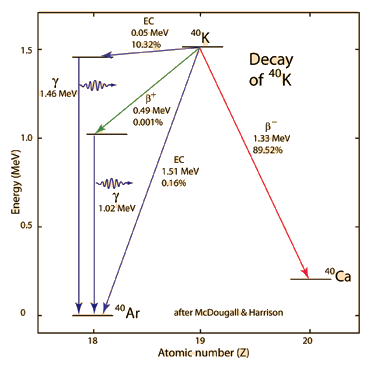
Potassium has three naturally occurring isotopes: stable Template:Chem, Template:Chem and radioactive Template:Chem. Template:Chem exhibits dual decay: through β-decay (E = 1.33 MeV), 89% of Template:Chem decays to Template:Chem, and the rest decays to Template:Chem via electron capture (E = 1.46 MeV).[1] While Template:Chem comprises only 0.001167% of total potassium mass, Template:Chem makes up 96.9821% of total calcium mass; thus, Template:Chem decay leads to significantly greater Template:Chem enrichment than any other isotope.[8] The decay constant for the decay to Template:Chem is denoted as λβ and equals Template:Val yr−1; the decay constant to Template:Chem is denoted as λEC and equals Template:Val yr−1.
The general equation for the decay time of a radioactive nucleus that decays to a single product is:
Where λ is the decay constant, t1/2 is the half-life, N0 is the initial concentration of the parent isotope, and N is the final concentration of the parent isotope.
Similarly, the equation for the decay time of a radioactive nucleus that decays to more than one product is:
Where a is the daughter product of interest, λa is the decay constant for daughter product a, and λt is the sum of decay constants for daughter products a and b.
This approach is taken in potassium-calcium dating where argon and calcium are both products of decay and can be expressed as:
Where CaTemplate:Sup is the measured amount of radiogenic Template:Chem in terms of parent isotope Template:Chem, and K0 is the initial concentration of Template:Chem.
Age equation
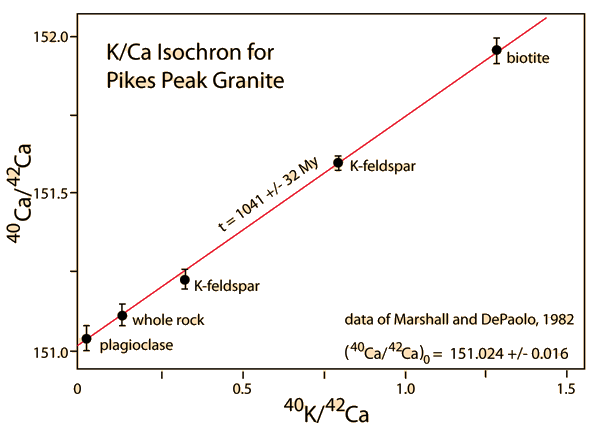
Age determination using potassium–calcium dating is best done using the isochron technique.[7] The isochron constructed for Pike’s Peak in Colorado and the K/Ca age for the granites in the area were found to be Template:Val. Rb-Sr dating of the same batholith gave results of Template:Val,[7] supporting the practicality of this method of dating. For comparison, the isochron method uses non-radiogenic Template:Chem to develop an isochron.
The following equation is used in the construction of the isochron plot:
- t is time elapsed
- ξ is the branching ratio (= λβ / λ total) = 0.8952
- Ca0 is the initial Template:Chem/Template:Chem isotope ratio
- Ca is the Template:Chem/Template:Chem isotope ratio
- K is the Template:Chem/Template:Chem isotope ratio
Applications
Chronological applications
This technique's primary application is towards determining the crystallization age of minerals or rocks enriched in potassium and depleted in calcium. Due to the long half life of Template:Chem (~1.25 billion years), K–Ca dating is most useful on samples older than 100,000 years. Given that the chosen sample has a relatively high current K/Ca ratio, and that the initial concentration of Template:Chem can be determined, any error in this initial Template:Chem concentration can be considered negligible when determining the sample's age.[8]
K–Ca dating is not a common radioactive dating method for metamorphic rocks. However, this system is considered more stable than both the K-Ar and Rb-Sr dating methods. This fact, combined with advances in precision of Template:Chem mass spectrometry, makes K–Ca dating a viable option for igneous and metamorphic rocks containing little to no zircon.[8]
Potassium-calcium dating is especially useful for diagenetic minerals and marine sediments, which are both assumed to have had the same initial calcium isotopic composition as Earth's seawater at the time of their formation. As such, being able to assume the initial Template:Chem/Template:Chem ratio as a constant, this dating method proves particularly fruitful for these respective samples.[8]
Non-chronological applications
Aside from radioactive dating, the K-Ca system is the only isotopic system capable of detecting elemental signatures in magmatic processes. Normalizing the Template:Chem/Template:Chem ratio to non-radioactive isotopes (Template:Chem/Template:Chem), it was found that the isotopic composition of calcium was similar across meteorites, lunar samples, and Earth's mantle.[8]
Advantages & disadvantages
Disadvantages
The primary disadvantage to K–Ca dating is the abundance of calcium in most minerals; this dating method cannot be used on minerals with a high preexisting calcium content, as the radioactively added calcium will increase calcium abundance in the sample only very slightly. As such, K–Ca dating is effective only in circumstances where K/Ca>50 (in a potassium-enriched, calcium-depleted sample).[2] Examples of such minerals include lepidolite, potassium-feldspar, and late-formed muscovite or biotite from pegmatites (preferably older than Template:Ma). This method is also useful for zircon-poor, felsic-to-intermediate igneous rocks, various metamorphic rocks, and evaporite minerals (i.e. sylvite).[6][7]
Another disadvantage to K–Ca dating is that the isotopic composition of calcium (Template:Chem compared to Template:Chem) is difficult to determine using mass spectrometry. Calcium is not easily ionized using a thermoionic source, and tends to isotopically fractionate during ionization.[2] As such, this dating method does not yield satisfactory results unless performed with extremely high precision. Until recently, K–Ca dating was not considered useful for samples younger than the Precambrian, with extremely depleted Template:Chem to Template:Chem ratios.
Advantages
However, if used effectively on the aforementioned minerals, the K–Ca dating method provides high-precision dating comparable to other isotopic dating methods. It is also most effective, comparatively, at providing major element abundances for crustal magma sources, if used with high precision.[7]
See also
References
- ↑ 1.0 1.1 Potassium-Calcium Isochrons. In: HyperPhysics site.
- ↑ 2.0 2.1 2.2 2.3 Potassium-calcium dating. A Dictionary of Earth Sciences, 2016.
- ↑ Template:Cite journal
- ↑ Template:Cite journal
- ↑ Template:Cite journal
- ↑ 6.0 6.1 Ahrens., L.H. The feasibility of a calcium method for the determination of geological age. Geochim. Cosmochim. Acta, 1 (1951), pp. 312–316.
- ↑ 7.0 7.1 7.2 7.3 7.4 Marshall, B.D., and DePaolo D.J., Precise age determinations and petrogenetic studies using the K-Ca method. Geochim. Cosmochim. Acta, 46 (1982), pp. 2537–2545.
- ↑ 8.0 8.1 8.2 8.3 8.4 Geyh, Mebus A. and Schleicher, Helmut, "Absolute Age Determination", Springer Verlag, 1990.