File:TRAPPIST-1e Const CMYK Print.png

From testwiki
Jump to navigation Jump to search
Original file (5,440 × 7,840 pixels, file size: 11.02 MB, MIME type: image/png)

This file is from Wikimedia Commons and may be used by other projects. The description on its file description page there is shown below.

Summary

Description
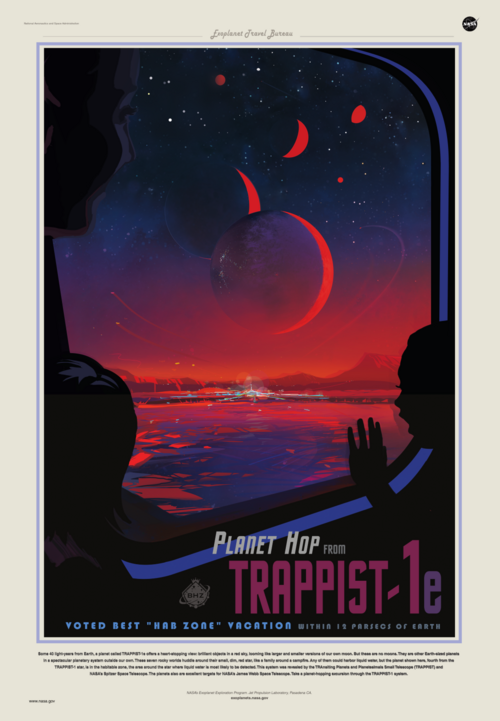
English: "Planet hop from TRAPPIST-1e - Voted best 'hab zone' vacation within 12 parsecs of Earth" Poster from the NASA Exoplanets Exploration Program's Exoplanet Travel Bureau
Date
Source https://exoplanets.nasa.gov/resources/2159/planet-hop-from-trappist-1e/
Author NASA/JPL-CalTech

Featured picture

Wikimedia Commons

This is a featured picture on Wikimedia Commons (Featured pictures) and is considered one of the finest images. See its nomination here.

If you have an image of similar quality that can be published under a suitable copyright license, be sure to upload it, tag it, and nominate it.

Licensing

Public domain This file is in the public domain in the United States because it was solely created by NASA. NASA copyright policy states that "NASA material is not protected by copyright unless noted". (See Template:PD-USGov, NASA copyright policy page or JPL Image Use Policy.)
Warnings:

Captions

TRAPPIST-1e travel poster

Items portrayed in this file

depicts

image/png

National Aeronautics and Space Administration / Exoplanet Travel Bureau / Planet Hop from TRAPPIST-1e / VOTED BEST "HAB ZONE" VACATION WITHIN 12 PARSECS OF EARTH / Some 40 light-years from Earth, a planet called TRAPPIST-1e offers a heart-skipping view: brilliant objects in a red sky, looming like larger and smaller versions of our own moon. But these are no moons. They are other Earth-sized planets in a spectacular planetary system outside our own. These seven rocky worlds huddle around their small, dim, red star, like a family around a campfire. Any of them could harbor liquid water, but the planet shown here, fourth from the TRAPPIST-1 star, is in the habitable zone, the area around the star where liquid water is most likely to be detected. This system was revealed by the TRAnsiting Planets and Planetesimals Small Telescope (TRAPPIST) and NASA's Spitzer Space Telescope. The planets are also excellent targets for NASA's James Webb Space Telescope. Take a planet-hopping excursion through the TRAPPIST-1 system. / NASA's Exoplanet Exploration Program. Jet Propulsion Laboratory, Pasadena CA. / exoplanets.nasa.gov / www.nasa.gov (English)

File history

Click on a date/time to view the file as it appeared at that time.

Date/TimeThumbnailDimensionsUserComment
current19:38, 2 November 2019Thumbnail for version as of 19:38, 2 November 20195,440 × 7,840 (11.02 MB)wikimediacommons>RhododendritesUser created page with UploadWizard

The following page uses this file: