File:Sampling the Discrete-time Fourier transform.svg
Summary
| Description |
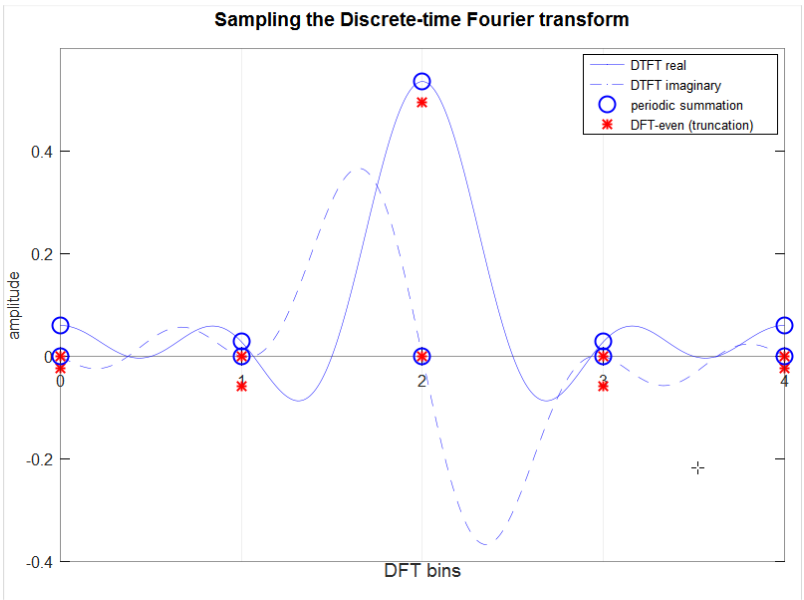
English: Definitions: DTFT=discrete-time Fourier transform; DFT=discrete Fourier transform Nine symmetric samples of a cosine function are shifted from the finite Fourier transform domain [-4,4] to the DFT domain [0,8], causing its DTFT to become complex-valued, except at the frequencies of an 8-length DFT. Pictured here are the real and imaginary parts of the DTFT after the cosine is multiplied by a symmetric Gaussian window function. Also shown (in red) are the estimates obtained by deleting the 9th data sample (equivalent to applying an 8-length DFT-even (aka periodic) window) and performing an 8-length DFT. The imaginary parts of the estimates exactly match the zero-valued DTFT function, which Harris[1]attributes to "DFT-even symmetry". But the real parts have a negative bias. Increasing the gain of the window function (the sum of its coefficients) improves the one positive-value estimate, but degrades the four negative ones.
|
| Date | |
| Source |
Own work based on:
|
| Author | Bob K |
| Other versions |
|
| SVG development |


Notes
Additional information can be found at Window_function#DFT-symmetry. And Sampling the DTFT links to this image.
Source code

Here is a listing of the source used to create this file.
This graphic was created by the following Octave script:
pkg load signal
graphics_toolkit gnuplot
%=======================================================
function out=gauss(M2,sigma)     % window function
out = exp(-.5*(((0:M2)-M2/2)/(sigma*M2/2)).^2);
endfunction
%=======================================================
% Dimensions of figure
  x1 = .07;                     % left margin
  x2 = .02;                     % right margin
  y1 = .07;                     % bottom margin for annotation
  y2 = .07;                     % top margin for title
  width = 1-x1-x2;
  height= 1-y1-y2;

  x_origin = x1;
  y_origin = 1;                 % start at top of graph area
%=======================================================
set(0, "DefaultAxesFontsize",12)
set(0, "DefaultTextFontsize",14)
figure("position",[50 100 800 600]);

y_origin = y_origin -y2 -height;        % position of top row
subplot("position",[x_origin y_origin width height])

N   = 8*9*10;
M   = 4;                                % finite Fourier transform domain is [-M,M]
M2  = 2*M;
M21 = M2+1;                             % sequence length
symmetric = gauss(M2,1);
symmetric = symmetric/sum(symmetric);
periodic  = symmetric(1:M2);
periodic  = periodic/sum(periodic);

% A similar window is:
% window = kaiser(M21+2, pi*.75)';
% window = window(2:end-1);  % Remove zero-valued end points

x = 0:M2;
y      = cos(2*pi*x/4);
y_sym  = y.*symmetric;
y_even = y(1:end-1).*periodic;

DTFT    = fft(y_sym,N);
DFT     = fft([y_sym(1)+y_sym(end) y_sym(2:end-1)]); % periodic summation
DFTeven = fft(y_even);                               % truncation (aka "DFT-even")

x = 0:N/2;
plot(x, real(DTFT(1+x)), "color","blue")
hold on
plot(x, imag(DTFT(1+x)), "color","blue", "linestyle","--")
set(gca, "xaxislocation","origin")
xlim([0 N/2])
ylim([-0.4 0.6])

x = (0:M);
DFT     = DFT(1+x);
DFTeven = DFTeven(1+x);
x = x*N/M2;
plot(x, real(DFT),     "color","blue", "o", "markersize",8, "linewidth",2)
plot(x, real(DFTeven), "color","red",  "*", "markersize",4, "linewidth",2)
plot(x, imag(DFT),     "color","blue", "o", "markersize",8, "linewidth",2)
plot(x, imag(DFTeven), "color","red",  "*", "markersize",4, "linewidth",2)

h = legend("DTFT real",...
           "DTFT imaginary",...
           "periodic summation",...
           "DFT-even (truncation)", "location","northeast");
set(h, "fontsize",10)
%legend boxoff

set(gca, "xtick", x, "xgrid","on", "xticklabel",[0 1 2 3 4])
xlabel("DFT bins", "fontsize",14)
ylabel("amplitude")
title("Sampling the Discrete-time Fourier transform", "fontsize",14);
Licensing
 
|
This file is made available under the Creative Commons CC0 1.0 Universal Public Domain Dedication. |
| The person who associated a work with this deed has dedicated the work to the public domain by waiving all of their rights to the work worldwide under copyright law, including all related and neighboring rights, to the extent allowed by law. You can copy, modify, distribute and perform the work, even for commercial purposes, all without asking permission.
|
File history
Click on a date/time to view the file as it appeared at that time.
| Date/Time | Thumbnail | Dimensions | User | Comment | |
|---|---|---|---|---|---|
| current | 17:02, 19 August 2020 | | 754 × 562 (46 KB) | wikimediacommons>Bob K | make some objects darker |
File usage
There are no pages that use this file.
