File:PIA22835-VoyagerProgram&Heliosphere-Chart-20181210.png


Summary
| Description |
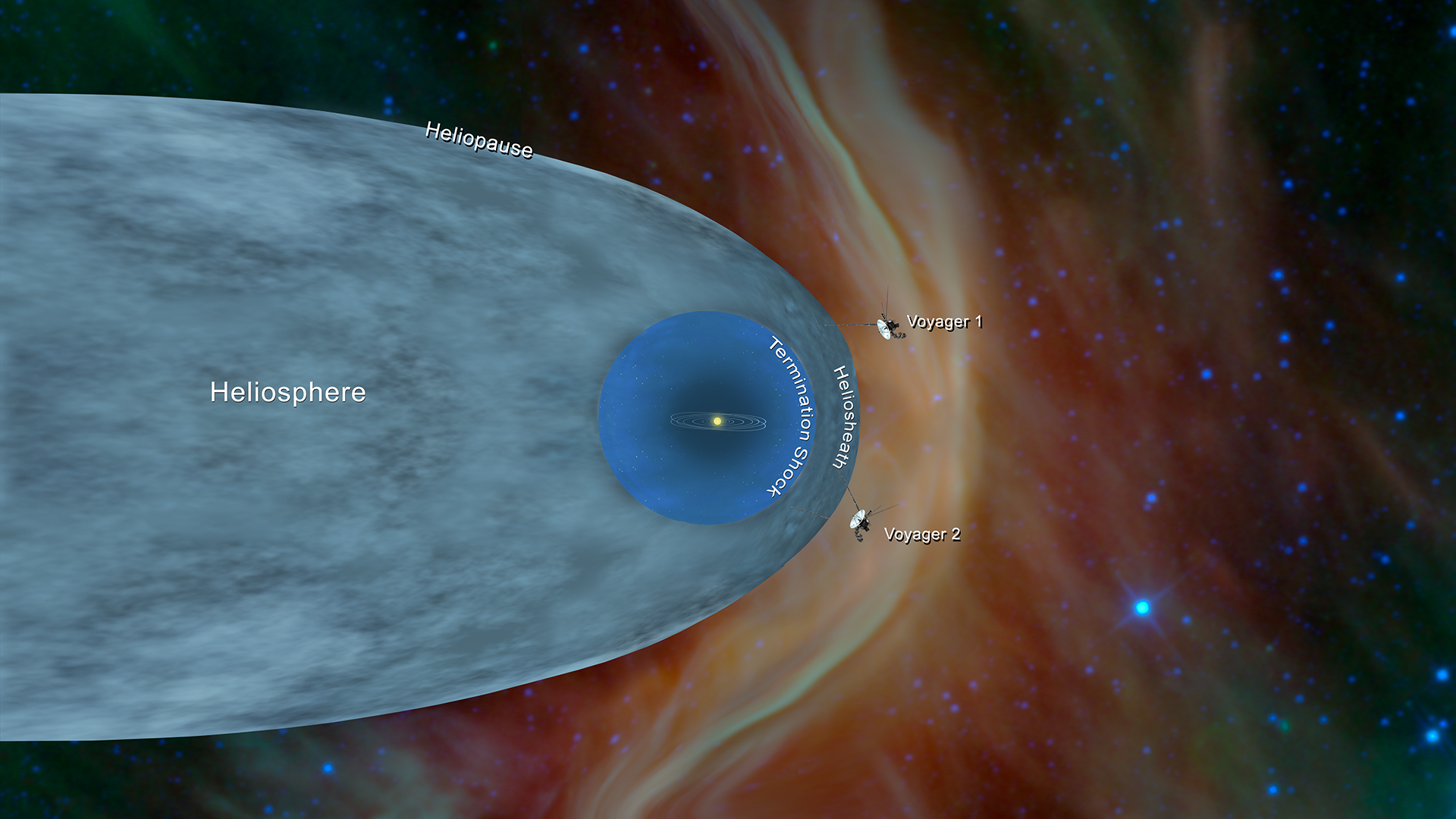
English: PIA22835: Two Interstellar Travelers
https://photojournal.jpl.nasa.gov/catalog/PIA22835 This illustration shows the position of NASA's Voyager 1 and Voyager 2 probes, outside of the heliosphere, a protective bubble created by the Sun that extends well past the orbit of Pluto. Voyager 1 crossed the heliopause, or the edge of the heliosphere, in August 2012. Heading in a different direction, Voyager 2 crossed another part of the heliopause in November 2018. One of the annotated images below shows plasma flow lines both inside and outside the heliopause. The direction of the solar plasma is different from the direction of the interstellar plasma. The Voyager spacecraft were built by JPL, which continues to operate both. JPL is a division of Caltech in Pasadena. California. The Voyager missions are a part of the NASA Heliophysics System Observatory, sponsored by the Heliophysics Division of the Science Mission Directorate in Washington. For more information about the Voyager spacecraft, visit https://www.nasa.gov/voyager and https://voyager.jpl.nasa.gov. |
| Date | |
| Source | https://photojournal.jpl.nasa.gov/figures/PIA22835_fig1.png |
| Author | NASA/JPL-Caltech |
Licensing

|
The copyright holder of this file, NASA/JPL-Caltech, allows anyone to use it for any purpose, provided that the copyright holder is properly attributed. Redistribution, derivative work, commercial use, and all other use is permitted. |
|
|
 
|
According to JPL's image use policy additional restriction is that no endorsement of any product or service by Caltech, JPL or NASA is claimed or implied.
Caltech's disclaimer: Caltech makes no representations or warranties with respect to ownership of copyrights in the images, and does not represent others who may claim to be authors or owners of copyright of any of the images, and makes no warranties as to the quality of the images. Caltech shall not be responsible for any loss or expenses resulting from the use of the images, and you release and hold Caltech harmless from all liability arising from such use. Usage on the English Wikipedia: On the English Wikipedia you can use the {{JPL Image}} template to display the copyright notice. (See w:Wikipedia:Using JPL images for details) |
File history
Click on a date/time to view the file as it appeared at that time.
| Date/Time | Thumbnail | Dimensions | User | Comment | |
|---|---|---|---|---|---|
| current | 22:28, 10 December 2018 | | 1,920 × 1,080 (2.37 MB) | wikimediacommons>Drbogdan | User created page with UploadWizard |
File usage
The following page uses this file:
