File:PIA19645-Asteroid-Euphrosyne-NEOWISE-20100517.jpg


Summary
| Description |
English: August 3, 2015
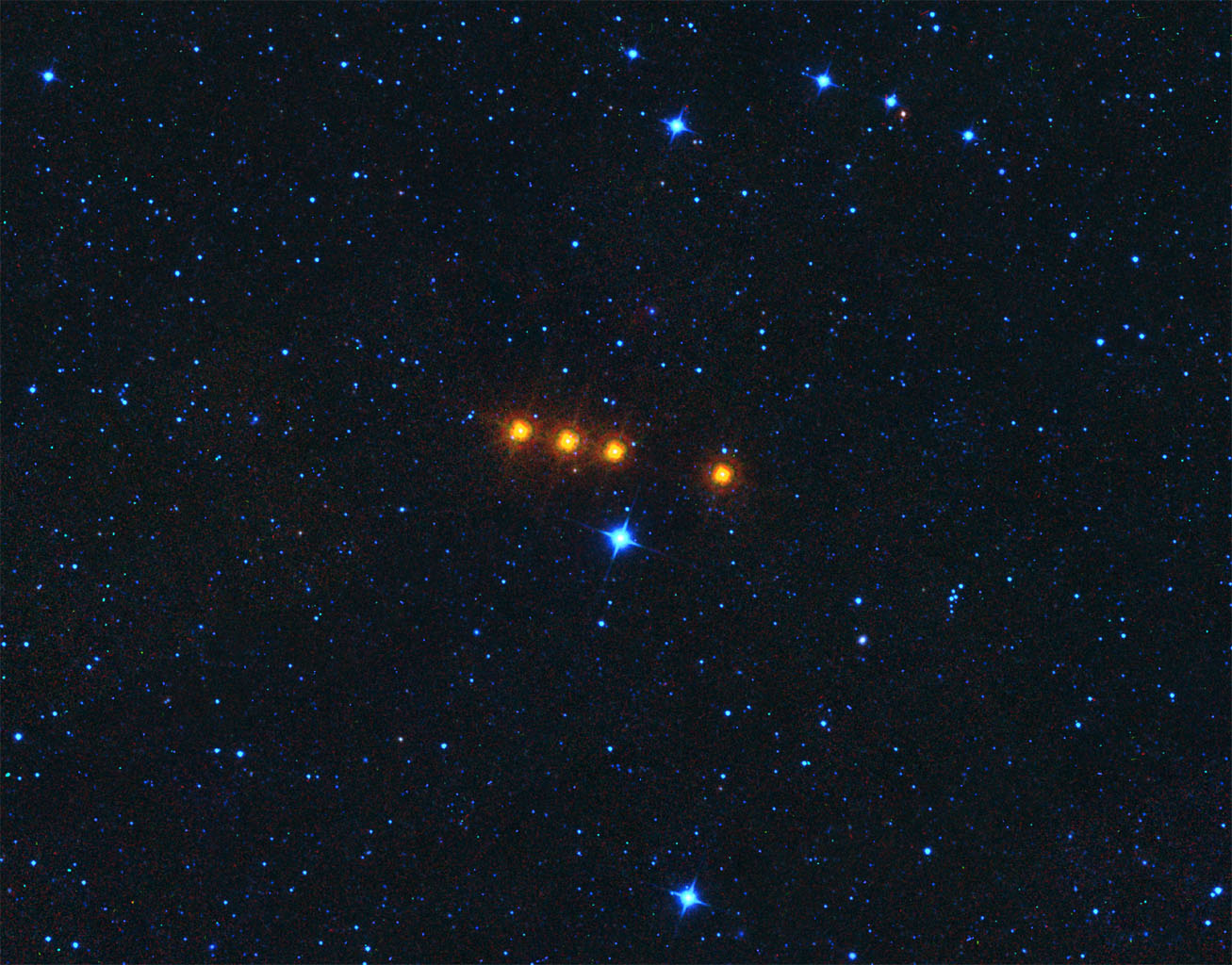
Asteroid Euphrosyne as Seen by WISE on May 17, 2010 http://www.jpl.nasa.gov/spaceimages/details.php?id=pia19645 http://www.jpl.nasa.gov/news/news.php?feature=4678 The asteroid Euphrosyne glides across a field of background stars in this time-lapse view from NASA's WISE spacecraft. Euphrosyne is quite dark in visible light, but glows brightly at infrared wavelengths. The asteroid Euphrosyne glides across a field of background stars in this time-lapse view from NASA's WISE spacecraft. WISE obtained the images used to create this view over a period of about a day around May 17, 2010, during which it observed the asteroid four times. Because WISE (renamed NEOWISE in 2013) is an infrared telescope, it senses heat from asteroids. Euphrosyne is quite dark in visible light, but glows brightly at infrared wavelengths. This view is a composite of images taken at four different infrared wavelengths: 3.4 microns (color-coded blue), 4.6 microns (cyan), 12 microns (green) and 22 microns (red). The moving asteroid appears as a string of red dots because it is much cooler than the distant background stars. Stars have temperatures in the thousands of degrees, but the asteroid is cooler than room temperature. Thus the stars are represented by shorter wavelength (hotter) blue colors in this view, while the asteroid is shown in longer wavelength (cooler) reddish colors. The WISE spacecraft was put into hibernation in 2011 upon completing its goal of surveying the entire sky in infrared light. WISE cataloged three quarters of a billion objects, including asteroids, stars and galaxies. In August 2013, NASA decided to reinstate the spacecraft on a mission to find and characterize more asteroids. JPL manages NEOWISE for NASA's Science Mission Directorate at the agency's headquarters in Washington. The Space Dynamics Laboratory in Logan, Utah, built the science instrument. Ball Aerospace & Technologies Corp. of Boulder, Colorado, built the spacecraft. Science operations and data processing take place at the Infrared Processing and Analysis Center at the California Institute of Technology in Pasadena. Caltech manages JPL for NASA. More information is online at http://www.nasa.gov/wise, http://wise.astro.ucla.edu and http://www.jpl.nasa.gov/wise. |
| Date | |
| Source | http://www.jpl.nasa.gov/spaceimages/images/largesize/PIA19645_hires.jpg |
| Author | NASA/JPL-Caltech |
Licensing

|
The copyright holder of this file, NASA/JPL-Caltech, allows anyone to use it for any purpose, provided that the copyright holder is properly attributed. Redistribution, derivative work, commercial use, and all other use is permitted. |
|
|
 
|
According to JPL's image use policy additional restriction is that no endorsement of any product or service by Caltech, JPL or NASA is claimed or implied.
Caltech's disclaimer: Caltech makes no representations or warranties with respect to ownership of copyrights in the images, and does not represent others who may claim to be authors or owners of copyright of any of the images, and makes no warranties as to the quality of the images. Caltech shall not be responsible for any loss or expenses resulting from the use of the images, and you release and hold Caltech harmless from all liability arising from such use. Usage on the English Wikipedia: On the English Wikipedia you can use the {{JPL Image}} template to display the copyright notice. (See w:Wikipedia:Using JPL images for details) |
File history
Click on a date/time to view the file as it appeared at that time.
| Date/Time | Thumbnail | Dimensions | User | Comment | |
|---|---|---|---|---|---|
| current | 03:30, 4 August 2015 | | 1,307 × 1,024 (287 KB) | wikimediacommons>Drbogdan | User created page with UploadWizard |
File usage
The following page uses this file:
