File:PIA19339-MostLuminousGalaxy-WISE-J224607.57-052635.0-20150521.jpg


Summary
| Description |
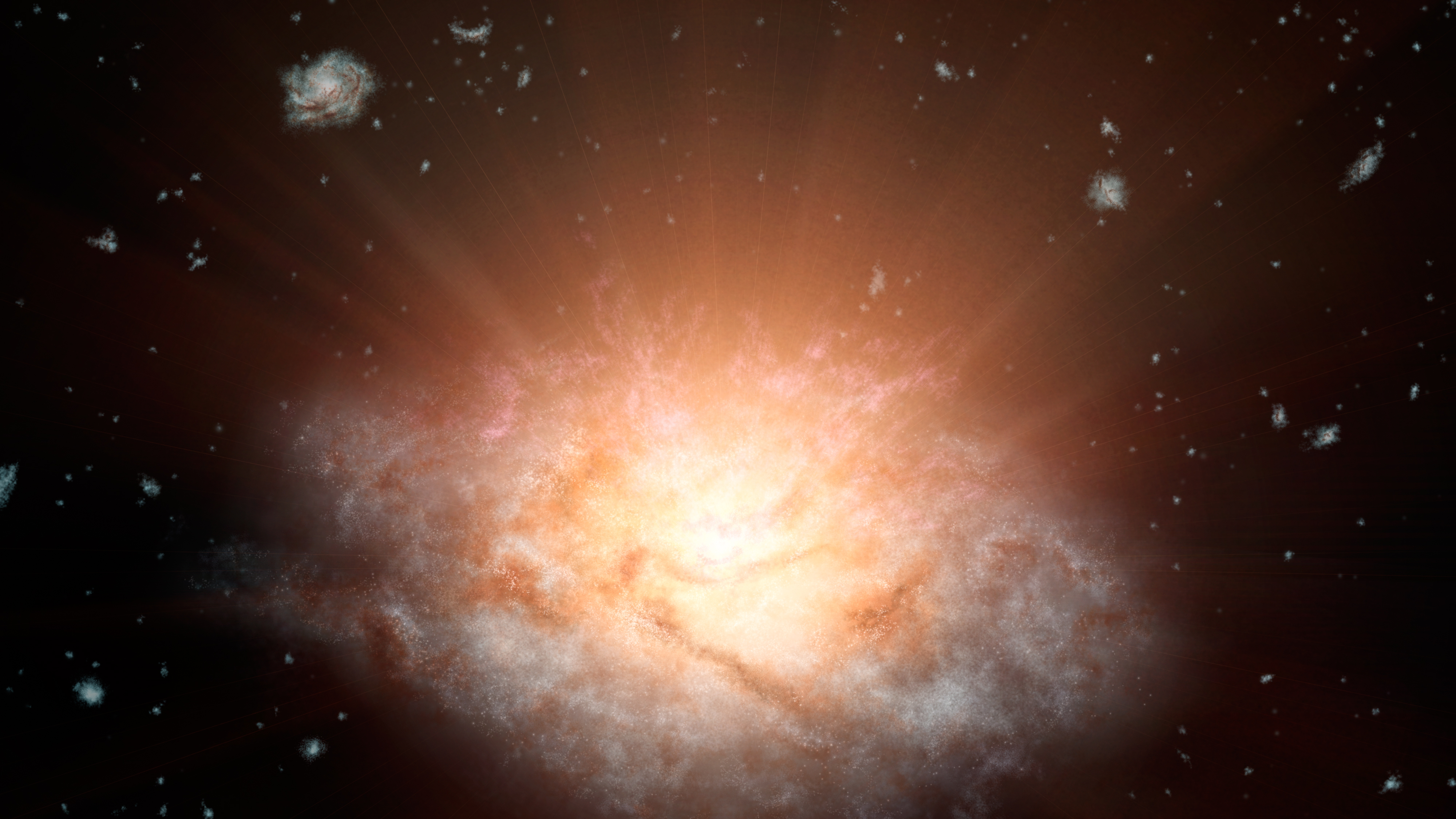
English: PIA19339: Dusty 'Sunrise' at Core of Galaxy (Artist's Concept)
http://photojournal.jpl.nasa.gov/catalog/PIA19339 This artist's concept of the galaxy named WISE J224607.57-052635.0, is erupting with light equal to more than 300 trillion sunset; it was discovered by NASA's Wide-Field Infrared Survey Explorer, or WISE. This artist's concept depicts the current record holder for the most luminous galaxy in the universe. The galaxy, named WISE J224607.57-052635.0, is erupting with light equal to more than 300 trillion suns. It was discovered by NASA's Wide-Field Infrared Survey Explorer, or WISE. The galaxy is smaller than the Milky Way, yet puts out 10,000 times more energy. Scientists think that a supermassive black hole at the center of this dusty galaxy is busily consuming gaseous material in a colossal growth spurt. As the gas is dragged toward the black hole, it heats up and blasts out visible, ultraviolet and X-ray light. The dust swaddling the galaxy absorbs this light and heats up, radiating longer-wavelength, infrared light. The dust also blocks our view of shorter, visible-light wavelengths, while letting longer-wavelengths through. This is similar to what happens when sunlight streams through our dusty atmosphere, producing a brilliant red sunrise. In fact, more than 99 percent of the light escaping from this dusty galaxy is infrared. As a result, it is much harder to see with optical telescopes. Because light from the galaxy hosting the black hole has traveled 12.5 billion years to reach us, astronomers are seeing the object as it was in the distant past. During this epoch, galaxies would have been more than five times closer together than they are now, as illustrated in the background of the artist's concept. This is due to the expansion of space -- space itself and the galaxies in it are stretching apart from each other at ever-increasing speeds. JPL manages and operates WISE for NASA's Science Mission Directorate in Washington. The spacecraft was put into hibernation mode in 2011, after it scanned the entire sky twice, thereby completing its main objectives. In September 2013, WISE was reactivated, renamed NEOWISE and assigned a new mission to assist NASA's efforts to identify potentially hazardous near-Earth objects. More information is online at http://www.nasa.gov/wise and http://wise.astro.ucla.edu and http://www.jpl.nasa.gov/wise. |
| Date | |
| Source | http://photojournal.jpl.nasa.gov/figures/PIA19339_fig1.jpg |
| Author | NASA/JPL-Caltech => http://www.ipac.caltech.edu/page/image_use_policy |
Licensing
  |
This media was created by the Jet Propulsion Laboratory (JPL) at Caltech. Their website states: "Unless otherwise noted, images and video on JPL public web sites (public sites ending with a jpl.nasa.gov address) may be used for any purpose without prior permission, subject to the special cases noted below. Publishers who wish to have authorization may print this page and retain it for their records; JPL does not issue image permissions on an image by image basis." Conditions:
By electing to download the material from this web site the user agrees:
Special Cases:
According to JPL's image use policy additional restriction is that no endorsement of any product or service by Caltech, JPL or NASA is claimed or implied. Caltech's disclaimer: Caltech makes no representations or warranties with respect to ownership of copyrights in the images, and does not represent others who may claim to be authors or owners of copyright of any of the images, and makes no warranties as to the quality of the images. Caltech shall not be responsible for any loss or expenses resulting from the use of the images, and you release and hold Caltech harmless from all liability arising from such use. Usage on the English Wikipedia: On the English Wikipedia you can use the {{JPL Image}} template to display the copyright notice. (See Wikipedia:Using JPL images for details)
|
File history
Click on a date/time to view the file as it appeared at that time.
| Date/Time | Thumbnail | Dimensions | User | Comment | |
|---|---|---|---|---|---|
| current | 23:20, 21 May 2015 | | 4,000 × 2,250 (3.63 MB) | wikimediacommons>Drbogdan | User created page with UploadWizard |
File usage
There are no pages that use this file.
