File:Hubble Showcases Hamilton’s Object.jpg
Jump to navigation
Jump to search
Size of this preview: 750 × 600 pixels. Other resolutions: 300 × 240 pixels | 600 × 480 pixels | 960 × 768 pixels | 1,280 × 1,024 pixels.


Original file (1,280 × 1,024 pixels, file size: 216 KB, MIME type: image/jpeg)

Summary
| Description |
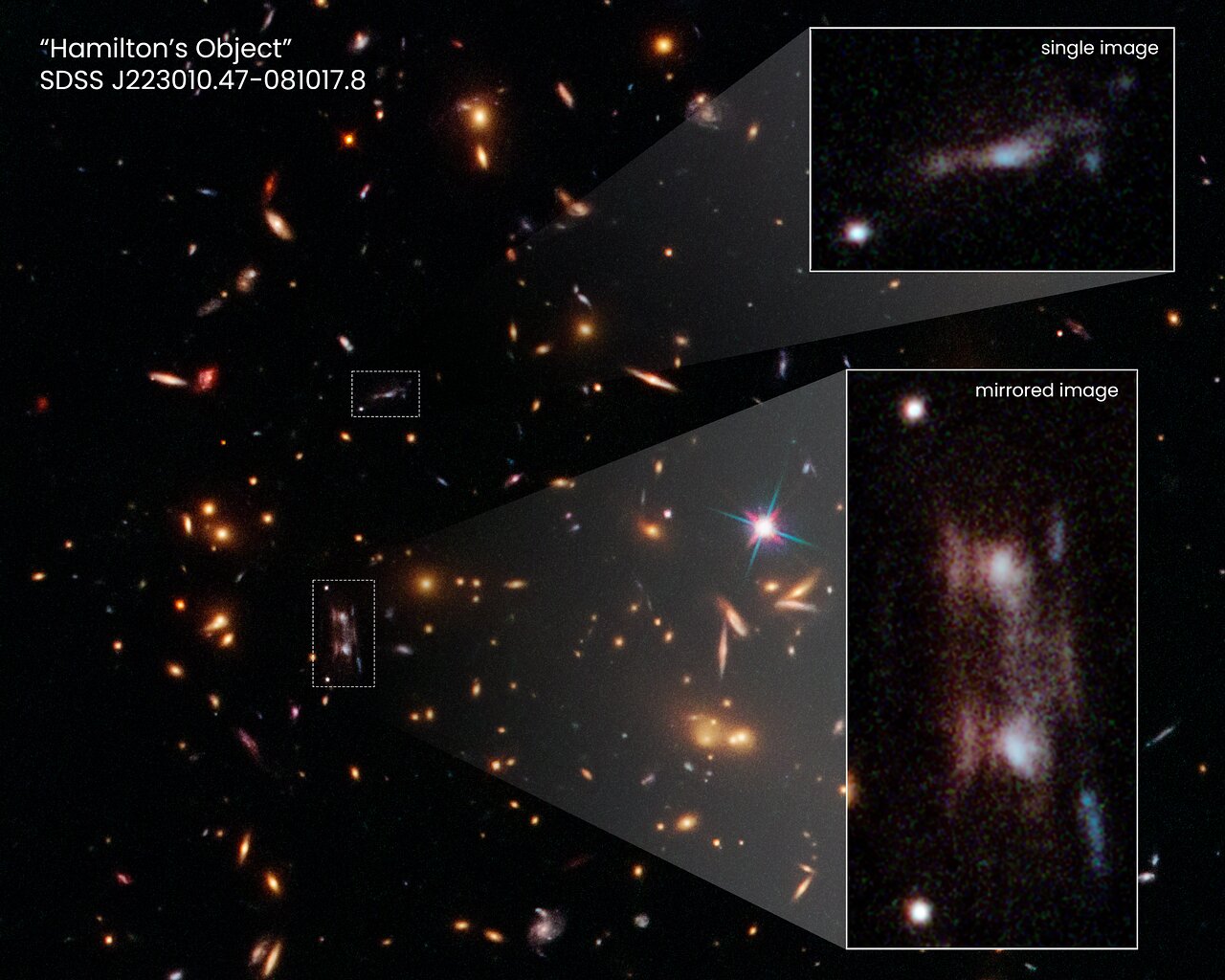
English: This NASA/ESA Hubble Space Telescope snapshot shows three magnified images of a distant galaxy embedded in a cluster of galaxies. These images are produced by a trick of nature called gravitational lensing. The galaxy cluster's immense gravity magnifies and distorts the light from the distant galaxy behind it, creating the multiple images. The galaxy cluster, catalogued as SDSS J223010.47-081017.8, is 7 billion light-years from Earth. Hubble has observed many gravitationally lensed galaxies. However, the images spotted in this Hubble snapshot are unique. Two of the magnified images, shown in the pull-out at bottom right, are exact copies of each other. The two bright ovals are the cores of the galaxy. This rare phenomenon occurs because the background galaxy straddles a ripple in the fabric of space. This “ripple” is an area of greatest magnification, caused by the gravity of dense amounts of dark matter, the unseen glue that makes up most of the universe's mass. As light from the faraway galaxy passes through the cluster along this ripple, two mirror images are produced, along with a third imagethat can be seen off to the side. A close-up of the third image is shown in the pull-out at top right. This image most closely resembles the remote galaxy, which is located more than 11 billion light-years away. Based on a reconstruction of this image, the researchers determined that the distant galaxy appears to an edge-on, barred spiral with ongoing, clumpy star formation. The mirror images are named “Hamilton’s Object" for the astronomer who discovered them. |
| Date | |
| Source | https://esahubble.org/images/opo2146a/ |
| Author | NASA, ESA, Richard E. Griffiths (UH Manoa), Jenny Wagner (ZAH). Joseph DePasquale (STScI) |
Licensing
  |
ESA/Hubble images, videos and web texts are released by the ESA under the Creative Commons Attribution 4.0 International license and may on a non-exclusive basis be reproduced without fee provided they are clearly and visibly credited. Detailed conditions are below; see the ESA copyright statement for full information. For images created by NASA or on the hubblesite.org website, or for ESA/Hubble images on the esahubble.org site before 2009, use the {{PD-Hubble}} tag.
Conditions:
Notes:
|
.jpg) |
This file is licensed under the Creative Commons Attribution 4.0 International license.
Attribution:
ESA/Hubble
- You are free:
- to share – to copy, distribute and transmit the work
- to remix – to adapt the work
- Under the following conditions:
- attribution – You must give appropriate credit, provide a link to the license, and indicate if changes were made. You may do so in any reasonable manner, but not in any way that suggests the licensor endorses you or your use.
File history
Click on a date/time to view the file as it appeared at that time.
| Date/Time | Thumbnail | Dimensions | User | Comment | |
|---|---|---|---|---|---|
| current | 15:54, 12 October 2021 | | 1,280 × 1,024 (216 KB) | wikimediacommons>Pandreve | Uploaded a work by NASA, ESA, Richard E. Griffiths (UH Manoa), Jenny Wagner (ZAH). Joseph DePasquale (STScI) from https://esahubble.org/images/opo2146a/ with UploadWizard |
File usage
The following page uses this file:
