Polygon with holes

Template:Multiple image In geometry, a polygon with holes is an area-connected planar polygon with one external boundary and one or more interior boundaries (holes).[1] Polygons with holes can be dissected into multiple polygons by adding new edges, so they are not frequently needed.
An ordinary polygon can be called simply-connected, while a polygon-with-holes is multiply-connected. An H-holed-polygon is H-connected.[2]
Degenerate holes
Degenerate cases may be considered, but a well-formed holed-polygon must have no contact between exterior and interior boundaries, or between interior boundaries. Nondegenerate holes should have 3 or more sides, excluding internal point boundaries (monogons) and single edge boundaries (digons).
Boundary orientation
Area fill algorithms in computational lists the external boundary vertices can be listed in counter-clockwise order, and interior boundaries clockwise. This allows the interior area to be defined as left of each edge.[3]
Conversion to ordinary polygon
A polygons with holes can be transformed into an ordinary unicursal boundary path by adding (degenerate) connecting double-edges between boundaries, or by dissecting or triangulating it into 2 or more simple polygons.

Example conversion of a single-holed polygon by connecting edges, or dissection

In polyhedra
Polygons with holes can be seen as faces in polyhedra, like a cube with a smaller cube externally placed on one of its square faces (augmented), with their common surfaces removed. A toroidal polyhedron can also be defined connecting a holed-face to a holed-faced on the opposite side (excavated). The 1-skeleton (vertices and edges) of a polyhedron with holed-faces is not a connected graph. Each set of connected edges will make a separate polyhedron if their edge-connected holes are replaced with faces.
The Euler characteristic of hole-faced polyhedron is χ = V - E + F = 2(1-g) + H, genus g, for V vertices, E edges, F faces, and H holes in the faces.
- Examples
-
 (genus 0) with two 1-holed-faces (top and bottom).
V=16, E=20, F=8, H=2.
3-connected -
 Toroid (genus 1) with two 1-holed-faces.
V=16, E=24, F=10, H=2.
2-connected -
 (genus 0) with one 1-holed-face.
V=16, E=24, F=11, H=1.
2-connected -
 (genus 0), with six 1-holed faces.
V=32, E=36, F=12, H=6.
7-connected -
 Toroid (genus 5), with six 1-holed faces.
V=40, E=72, F=30, H=6.
2-connected -
 Toroid (genus 2) with two 2-holed-faces.
V=24, E=36, F=14, H=4.
3-connected -
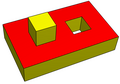 Toroid (genus 1) with one 2-holed-face, and one 1-holed-face.
V=24, E=36, F=15, H=3.
3-connected -
 (genus 0) with one 2-holed-face.
V=24, E=36, F=16, H=2.
3-connected -
 Toroid (genus 1) with two 1-holed-faces.
V=24, E=36, F=14, H=2.
2-connected -
 Toroid (genus 1) with two 1-holed-faces.
V=32, E=48, F=18, H=2.
2-connected


- Examples with degenerate holes
A face with a point hole is considered a monogonal hole, adding one vertex, and one edge, and can attached to a degenerate monogonal hosohedron hole, like a cylinder hole with zero radius. A face with a degenerate digon hole adds 2 vertices and 2 coinciding edges, where the two edges attach to two coplanar faces, as a dihedron hole.


See also
- Prince Rupert's cube — largest cube that can pass through a unit cube's hole.