Testwiki:Reference desk/Archives/Mathematics/2020 December 6
Template:Error:not substituted
|- ! colspan="3" align="center" | Mathematics desk |- ! width="20%" align="left" | < December 5 ! width="25%" align="center"|<< Nov | December | Jan >> ! width="20%" align="right" |Current desk > |}
| Welcome to the Wikipedia Mathematics Reference Desk Archives |
|---|
| The page you are currently viewing is a transcluded archive page. While you can leave answers for any questions shown below, please ask new questions on one of the current reference desk pages. |
December 6
Breaking down a gyroid into layers
I'm trying to figure out how a gyroid surface, expressed as
can be sliced horizontally.
This is a solved problem, as illustrated by the figures below. The first image shows a cross section of a cube generated by a 3D printing slicer to fill a cube with a gyroid infill, clearly showing that the slicer software figured out how to break the surface down into horizontal layers. The second image shows an animation of a gyroid surface being built up vertically in steps. The third is a unit cell, which would be ideal if I could figure out how to create it with some thickness, but I thought maybe the slicing approach would be simpler. I could be wrong though.
-
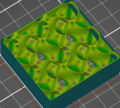 A 5% gyroid infill cross section from 3D slicer software
 -
 A gyroid surface built up in horizontal steps
 -
 A gyroid unit cell (3D interactive)


My goal here is to see if I can create a model of a gyroid surface in OpenSCAD, which I can then use as I please as a component of a 3D object rather than structural infill. I don't know yet if that is even feasible, but if I can generate coordinates of triangular facets, I can create any object.
The equation is simple enough. To generate a layer, I just fix the z height to some value, and generate y values as a function of x. Using Wolfram Alpha to solve the equation above for y, I get:
The problem is, when I try to plot this, I get curves with discontinuities that look sort of like a gyroid cross section in a piecewise fashion, but clearly aren't the same.
I've been searching for days and have not found any algorithm for generating vertices or facets or cross sections of a gyroid. And in spite of the seeming simplicity of the equation I am feeling somewhat stumped. How should I approach this? ~Anachronist (talk) 02:46, 6 December 2020 (UTC)
- I have not looked into your solution, but here is how I'd solve the gyroid equation for
- First, determine and (modulo ) such that and This can be done by taking
- and
- Then the equation can be rewritten as
- From this equation you can see a numerical problem arising when (or very close to it). The values of and cannot simultaneously be zero, however; otherwise, all values for would solve the equation. But assume . Then , so
- The solution set for is empty whenever and the inequation implies that not attempting to solve such cases also will avoid dividing by values of that are (close to) zero.
- Put Then the solutions for are given by:
- Taking the Minkowski sum of the set of triples a small ball will give this some thickness. Caveat lector: I have not tested this. --Lambiam 13:12, 6 December 2020 (UTC)