Fibonacci word fractal
The Fibonacci word fractal is a fractal curve defined on the plane from the Fibonacci word.
Definition


This curve is built iteratively by applying the Odd–Even Drawing rule to the Fibonacci word 0100101001001...:
For each digit at position k:
- If the digit is 0:
- If the digit is 1:
- Draw a line segment and stay straight
To a Fibonacci word of length (the nth Fibonacci number) is associated a curve made of segments. The curve displays three different aspects whether n is in the form 3k, 3k + 1, or 3k + 2.
Properties

Some of the Fibonacci word fractal's properties include:[2][3]
- The curve contains segments, right angles and flat angles.
- The curve never self-intersects and does not contain double points. At the limit, it contains an infinity of points asymptotically close.
- The curve presents self-similarities at all scales. The reduction ratio is . This number, also called the silver ratio, is present in a great number of properties listed below.
- The number of self-similarities at level n is a Fibonacci number \ −1. (more precisely: ).
- The curve encloses an infinity of square structures of decreasing sizes in a ratio (see figure). The number of those square structures is a Fibonacci number.
- The curve can also be constructed in different ways (see gallery below):
- Iterated function system of 4 and 1 homothety of ratio and
- By joining together the curves and
- Lindenmayer system
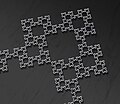
- By an iterated construction of 8 square patterns around each square pattern.
- By an iterated construction of octagons
- The Hausdorff dimension of the Fibonacci word fractal is , with the golden ratio.
- Generalizing to an angle between 0 and , its Hausdorff dimension is , with .
- The Hausdorff dimension of its frontier is .
- Exchanging the roles of "0" and "1" in the Fibonacci word, or in the drawing rule yields a similar curve, but oriented 45°.
- From the Fibonacci word, one can define the «dense Fibonacci word», on an alphabet of 3 letters: 102210221102110211022102211021102110221022102211021... Template:OEIS. The usage, on this word, of a more simple drawing rule, defines an infinite set of variants of the curve, among which:
- a "diagonal variant"
- a "svastika variant"
- a "compact variant"
- It is conjectured that the Fibonacci word fractal appears for every sturmian word for which the slope, written in continued fraction expansion, ends with an infinite sequence of "1"s.
Gallery
-
 Curve after iterations.
 -
 Self-similarities at different scales.
 -
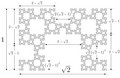 Dimensions.
 -
 Construction by juxtaposition (1)
 -
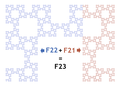 Construction by juxtaposition (2)
 -
 Order 18, with some sub-rectangles colored.
 -
-
 Construction by iterated suppression of square patterns.
 -
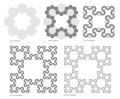 Construction by iterated octagons.
 -
 Construction by iterated collection of 8 square patterns around each square pattern.
 -
 With a 60° angle.
 -
 Inversion of "0" and "1".
 -
 Variants generated from the dense Fibonacci word.
 -
 The "compact variant"
 -
 The "svastika variant"
 -
 The "diagonal variant"
 -
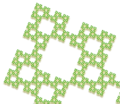 The "π/8 variant"
 -
 Artist creation (Samuel Monnier).


The Fibonacci tile

The juxtaposition of four curves allows the construction of a closed curve enclosing a surface whose area is not null. This curve is called a "Fibonacci tile".
- The Fibonacci tile almost tiles the plane. The juxtaposition of 4 tiles (see illustration) leaves at the center a free square whose area tends to zero as k tends to infinity. At the limit, the infinite Fibonacci tile tiles the plane.
- If the tile is enclosed in a square of side 1, then its area tends to .

Fibonacci snowflake

The Fibonacci snowflake is a Fibonacci tile defined by:[5]
- if
- otherwise.
with and , "turn left" and "turn right", and .
Several remarkable properties:[5][6]
- It is the Fibonacci tile associated to the "diagonal variant" previously defined.
- It tiles the plane at any order.
- It tiles the plane by translation in two different ways.
- its perimeter at order n equals , where is the nth Fibonacci number.
- its area at order n follows the successive indexes of odd row of the Pell sequence (defined by ).
See also
References
- ↑ Ramírez, José L.; Rubiano, Gustavo N. (2014). "Properties and Generalizations of the Fibonacci Word Fractal", The Mathematical Journal, Vol. 16.
- ↑ Monnerot-Dumaine, Alexis (February 2009). "The Fibonacci word fractal", independent (hal.archives-ouvertes.fr).
- ↑ Template:Cite arXiv
- ↑ Ramírez, Rubiano, and De Castro (2014). "A generalization of the Fibonacci word fractal and the Fibonacci snowflake", Theoretical Computer Science, Vol. 528, p.40-56. [1]
- ↑ 5.0 5.1 Blondin-Massé, Alexandre; Brlek, Srečko; Garon, Ariane; and Labbé, Sébastien (2009). "Christoffel and Fibonacci tiles", Lecture Notes in Computer Science: Discrete Geometry for Computer Imagery, p.67-8. Springer. Template:ISBN.
- ↑ A. Blondin-Massé, S. Labbé, S. Brlek, M. Mendès-France (2011). "Fibonacci snowflakes".
External links
- "Generate a Fibonacci word fractal", OnlineMathTools.com.