Ss
Template:Short description Template:Lowercase title Template:About Template:Distinguish Template:Infobox grapheme
In German orthography, the letter ß, called Template:Lang (Template:IPA, S-Z) or Template:Lang (Template:IPA, "sharp S"), represents the Template:IPAslink phoneme in Standard German when following long vowels and diphthongs. The letter-name Template:Wikt-lang combines the names of the letters of Template:Angbr (Template:Lang) and Template:Angbr (Template:Lang) in German. The character's Unicode names in English are double s,[1] sharp s[2] and eszett.[2] The Eszett letter is currently used only in German, and can be typographically replaced with the double-s digraph Template:Angbr, if the ß-character is unavailable. In the 20th century, the ß-character was replaced with ss in the spelling of Swiss Standard German (Switzerland and Liechtenstein), while remaining Standard German spelling in other varieties of the German language.[3]
The letter originates as the Template:Angbr digraph as used in late medieval and early modern German orthography, represented as a ligature of Template:Angbr (long s) and Template:Angbr (tailed z) in blackletter typefaces, yielding Template:Angbr.Template:Efn This developed from an earlier usage of Template:Angbr in Old and Middle High German to represent a separate sibilant sound from Template:Angbr; when the difference between the two sounds was lost in the 13th century, the two symbols came to be combined as Template:Angbr in some situations.
Traditionally, Template:Angbr did not have a capital form, although some type designers introduced de facto capitalized variants. In 2017, the Council for German Orthography officially adopted a capital, Template:Angbr, as an acceptable variant in German orthography, ending a long orthographic debate.[4] Since 2024 the capital Template:Angbr (ligature) has been preferred over Template:Angbr (two letters).[5]
Lowercase Template:Angbr was encoded by ECMA-94 (1985) at position 223 (hexadecimal DF), inherited by Latin-1 and Unicode (Template:Unichar).[6]
The HTML entity ß was introduced with HTML 2.0 (1995). The capital Template:Angbr was encoded by Unicode in 2008 at (Template:Unichar).
Usage
Current usage
In standard German, three letters or combinations of letters commonly represent Template:IPA (the voiceless alveolar fricative) depending on its position in a word: Template:Angbr, Template:Angbr, and Template:Angbr. According to current German orthography, Template:Angbr represents the sound Template:IPA:
- when it is written after a diphthong or long vowel and is not followed by another consonant in the word stem: Template:Lang, Template:Lang, Template:Lang, Template:Lang [Exceptions: Template:Lang and words with final devoicing (e.g., Template:Lang)];[7] and
- when a word stem ending with Template:Angbr takes an inflectional ending beginning with a consonant: Template:Lang, Template:Lang.[8]
In verbs with roots where the vowel changes length, this means that some forms may be written with Template:Angbr, others with Template:Angbr: Template:Lang, Template:Lang, Template:Lang.[7]
The use of Template:Angbr distinguishes minimal pairs such as Template:Lang (Template:IPA, to rip) and Template:Lang (Template:IPA, to travel) on the one hand (Template:IPA vs. Template:IPA), and Template:Lang (Template:IPA, penance) and Template:Lang (Template:IPA, buses) on the other (long vowel before Template:Angbr, short vowel before Template:Angbr).[9]Template:Rp
Some proper names may use Template:Angbr after a short vowel, following the old orthography; this is also true of some words derived from proper names (e.g., Template:Lang, named after Ernst Litfaß).[10]Template:Rp
If no Template:Angbr is available in a font, then the official orthography calls for Template:Angbr to be replaced with Template:Angbr.[11] Since 2024, when writing in capital letters Template:Angbr has been preferred, but Template:Angbr may be used instead.[5] Previously, Template:Angbr was the preferred form.[12][13]
In pre-1996 orthography

According to the orthography in use in German prior to the German orthography reform of 1996, Template:Angbr was written to represent Template:IPA:
- word internally following a long vowel or diphthong: Template:Lang, Template:Lang; and
- at the end of a syllable or before a consonant, so long as Template:IPA is the end of the word stem: Template:Lang, Template:Lang, Template:Lang.[10]Template:Rp
In the old orthography, word stems spelled Template:Angbr internally could thus be written Template:Angbr in certain instances, without this reflecting a change in vowel length: Template:Lang (from Template:Lang), Template:Lang (from Template:Lang), Template:Lang and Template:Lang (from Template:Lang), Template:Lang (comparative: Template:Lang).[9]Template:Rp[14] In rare occasions, the difference between Template:Angbr and Template:Angbr could help differentiate words: Template:Lang (expiration of a pass) and Template:Lang (appropriate).[10]Template:Rp

As in the new orthography, it was possible to write Template:Angbr for Template:Angbr if the character was not available. When using all capital letters, the pre-1996 rules called for rendering Template:Angbr as Template:Angbr except when there was ambiguity, in which case it should be rendered as Template:Angbr. The common example for such a case is Template:Lang (Template:Lang "in moderate amounts") vs. Template:Lang (Template:Lang "in massive amounts"); in this example the spelling difference between Template:Angbr vs. Template:Angbr produces completely different meanings.Template:Cn
Switzerland and Liechtenstein
In Swiss Standard German, Template:Angbr usually replaces every Template:Angbr.[15][16] This is officially sanctioned by the reformed German orthography rules, which state in §25 E2: "Template:Lang" ("In Switzerland, one may always write 'ss'"). Liechtenstein follows the same practice. There are very few instances where the difference between spelling Template:Angbr and Template:Angbr affects the meaning of a word, and these can usually be told apart by context.[17]Template:Rp[18]
Other uses


Occasionally, Template:Angbr has been used in unusual ways:
- As the Greek lowercase Template:Angbr (beta). The original IBM PC CP437 contains a glyph that minimizes their differences placed between Template:Angbr (alpha) and Template:Angbr (gamma) but named "Sharp s Small".[19] Substitution was also done using other character sets such as ISO/IEC 8859-1 even though they contain no other Greek letters. The lowercase eszett has also been misused as Template:Angbr in scientific writing and vice versa.[20]
- In Prussian Lithuanian, as in the first book published in Lithuanian, Martynas Mažvydas' Simple Words of Catechism,[21] as well as in Sorbian (see example on the left).
- For sadhe in Akkadian glosses, in place of the standard Template:Angbr, when that character is unavailable due to limitations of HTML.[22]
- The letter appeared in the alphabet made by Jan Kochanowski for the Polish language, that was used from the 16th until the 18th century. It represented the voiceless postalveolar fricative (Template:IPA) sound.[23][24] It was for example used in the Jakub Wujek Bible.[25]
- Some authors have used it in German at the beginning of words to transcribe the voiceless s of certain accents.[26]
History
Origin and development

As a result of the High German consonant shift, Old High German developed a sound generally spelled Template:Angbr or Template:Angbr that was probably pronounced Template:IPA and was contrasted with a sound, probably pronounced Template:IPA (voiceless alveolar retracted sibilant) or Template:IPA (voiced alveolar retracted sibilant), depending on the place in the word, and spelled Template:Angbr.[27] Given that Template:Angbr could also represent the affricate Template:IPA, some attempts were made to differentiate the sounds by spelling Template:IPA as Template:Angbr or Template:Angbr: Template:Lang (Template:Langx), Template:Lang (Template:Langx), Template:Lang (Template:Langx).[28] In Middle High German, Template:Angbr simplified to Template:Angbr at the end of a word or after a long vowel, but was retained word internally after a short vowel: Template:Lang (Template:Langx) vs. Template:Lang (Template:Langx) and Template:Lang (Template:Langx).[29]

In the thirteenth century, the phonetic difference between Template:Angbr and Template:Angbr was lost at the beginning and end of words in all dialects except for Gottscheerish.[27] Word-internally, Old and Middle High German Template:Angbr came to be pronounced Template:IPA (the voiced alveolar sibilant), while Old and Middle High German Template:Angbr continued to be pronounced Template:IPA. This produces the contrast between modern standard German Template:Lang and Template:Lang. The former is pronounced Template:IPA and comes from Template:Langx, while the latter is pronounced Template:IPA and comes from Template:Langx.[30]
In the late medieval and early modern periods, Template:IPA was frequently spelled Template:Angbr or Template:Angbr. The earliest appearance of ligature resembling the modern Template:Angbr is in a fragment of a manuscript of the poem Wolfdietrich from around 1300.[17]Template:Rp[30] In the Gothic book hands and bastarda scripts of the late medieval period, Template:Angbr is written with long s and the Blackletter "tailed z", as Template:Angbr. A recognizable ligature representing the Template:Angbr digraph develops in handwriting in the early 14th century.[31]Template:Rp

By the late 1400s, the choice of spelling between Template:Angbr and Template:Angbr was usually based on the sound's position in the word rather than etymology: Template:Angbr (Template:Angbr) tended to be used in word final position: Template:Lang (Template:Langx, Template:Langx), Template:Lang (Template:Langx, Template:Langx); Template:Angbr (Template:Angbr) tended to be used when the sound occurred between vowels: Template:Lang (Template:Langx, Template:Langx).[32]Template:Rp While Martin Luther's early 16th-century printings also contain spellings such as Template:Lang (Template:Langx), early modern printers mostly changed these to Template:Angbr: Template:Lang. Around the same time, printers began to systematically distinguish between Template:Lang (the, that [pronoun]) and Template:Lang (that [conjunction]).[32]Template:Rp
In modern German, the Old and Middle High German Template:Angbr is now represented by either Template:Angbr, Template:Angbr, or, if there are no related forms in which Template:IPA occurs intervocalically, with Template:Angbr: Template:Lang (Template:Langx), Template:Lang (Template:Langx), and Template:Lang (Template:Langx).[29]
Standardization of use
The pre-1996 German use of Template:Angbr was codified by the eighteenth-century grammarians Johann Christoph Gottsched (1748) and Johann Christoph Adelung (1793) and made official for all German-speaking countries by the German Orthographic Conference of 1901. In this orthography, the use of Template:Angbr was modeled after the use of long and "round"-s in Fraktur. Template:Angbr appeared both word internally after long vowels and also in those positions where Fraktur required the second s to be a "round" or "final" s, namely the ends of syllables or the ends of words.[17]Template:Rp In his Deutsches Wörterbuch (1854) Jacob Grimm called for Template:Angbr or Template:Angbr to be written for all instances of Middle and Old High German etymological Template:Angbr (e.g., Template:Lang instead of Template:Lang from Template:Langx); however, his etymological proposal could not overcome established usage.[32]Template:Rp
In Austria-Hungary prior to the German Orthographic Conference of 1902, an alternative rule formulated by Johann Christian August Heyse in 1829 had been officially taught in the schools since 1879, although this spelling was not widely used. Heyse's rule matches current usage after the German orthography reform of 1996 in that Template:Angbr was only used after long vowels.[17]Template:Rp
Use in Roman type


In early modern Latin type (antiqua), a ligature similar to modern Template:Angbr developed out of a long s followed by a round s (Template:Angbr), and as such was used in languages such as Italian in alternation with Template:Angbr, usually based on requirements of space on the page.[33]Template:Rp However, despite its resemblance to the modern Template:Angbr, this ligature was not commonly used as an equivalent to the Fraktur Template:Angbr in German.[34][35] This ligature generally fell out of use in the eighteenth century, together with the use of long s in antiqua.[31]Template:Rp German works printed in Roman type in the late 18th and early 19th centuries such as Johann Gottlieb Fichte's Template:Lang did not provide any equivalent to the Template:Angbr.[31]Template:Rp
Jacob Grimm began using Template:Angbr in his Template:Lang (1819); however, it varied with Template:Angbr word internally.[31]Template:Rp Grimm eventually rejected the use of the character; in their Template:Lang (1838), the Brothers Grimm favored writing it as Template:Angbr.[35]Template:Rp The First Orthographic Conference in Berlin (1876) recommended that ß be represented as Template:Angbr – however, both suggestions were ultimately rejected.[32]Template:Rp[17]Template:Rp In 1879, a proposal for various letter forms was published in the Journal für Buchdruckerkunst. A committee of the Typographic Society of Leipzig chose the "Sulzbacher form". In 1903, it was proclaimed as the new standard for the Eszett in Roman type.[35]Template:Rp
Until the abolition of Fraktur in 1941, it was common for family names to be written with Template:Angbr in Fraktur and Template:Angbr in Roman type. The formal abolition resulted in inconsistencies in how names are written in modern German (such as between Heuss and Heuß).[10]Template:Rp
Abolition and attempted abolitions
The Swiss and Liechtensteiners ceased to use Template:Angbr in the twentieth century. This has been explained variously by the early adoption of Roman type in Switzerland, the use of typewriters in Switzerland that did not include Template:Angbr in favor of French and Italian characters, and peculiarities of Swiss German that cause words spelled with Template:Angbr or Template:Angbr to be pronounced with gemination.[17]Template:Rp The Education Council of Zürich had decided to stop teaching the letter in 1935, whereas the Neue Zürcher Zeitung continued to write Template:Angbr until 1971.[36] Swiss newspapers continued to print in Fraktur until the end of the 1940s, and the abandonment of ß by most newspapers corresponded to them switching to Roman typesetting.[37]
When the Nazi German government abolished the use of blackletter typesetting in 1941, it was originally planned to also abolish the use of Template:Angbr. However, Hitler intervened to retain Template:Angbr, while deciding against the creation of a capital form.[38] In 1954, a group of reformers in West Germany similarly proposed, among other changes to German spelling, the abolition of Template:Angbr; their proposals were publicly opposed by German-language writers Thomas Mann, Hermann Hesse, and Friedrich Dürrenmatt and were never implemented.[39] Although the German Orthography Reform of 1996 reduced the use of Template:Angbr in standard German, Adrienne Walder writes that an abolition outside of Switzerland appears unlikely.[17]Template:Rp
Development of a capital form


Because Template:Angbr had been treated as a ligature, rather than as a full letter of the German alphabet, it had no capital form in early modern typesetting. Moreover, allcaps was not normally used in Fraktur printing.[4] There were, however, proposals to introduce capital forms of Template:Angbr for use in allcaps writing (where Template:Angbr would otherwise usually be represented as either Template:Angbr or Template:Angbr). A capital was first seriously proposed in 1879, but did not enter official or widespread use.[40] The Orthographic Conference of 1903 called for the use of Template:Angbr in allcaps until a capital letter could be proposed.[4] Historical typefaces offering a capitalized Template:Lang mostly date to the time between 1905 and 1930. The first known typefaces to include capital Template:Lang were produced by the Template:Lang foundry in Leipzig, in 1905/06. Template:Lang at the time widely advocated the use of this type, but its use nevertheless remained very limited.
The preface to the 1925 edition of the Template:Lang dictionary expressed the desirability of a separate glyph for capital Template:Angbr: Template:Quote Template:Quote
The Template:Lang was edited separately in East and West Germany during the 1950s to 1980s. The East German Template:Lang of 1957 (15th ed.) introduced a capital Template:Angbr in its typesetting without revising the rule for capitalization. The 16th edition of 1969 still announced that an uppercase Template:Angbr was in development and would be introduced in the future. The 1984 edition again removed this announcement and simply stated that there is no capital version of Template:Angbr.[41]
In the 2000s, there were renewed efforts on the part of certain typographers to introduce a capital, Template:Angbr. A proposal to include a corresponding character in the Unicode set submitted in 2004[42] was rejected.[43][44] A second proposal submitted in 2007 was successful, and the character was included in Unicode version 5.1.0 in April 2008 (Template:Unichar).[45] The international standard associated with Unicode (UCS), ISO/IEC 10646, was updated to reflect the addition on 24 June 2008. The capital letter was finally adopted as an option in standard German orthography in 2017.[12] As of 2024, Template:Angbr is now the preferred option for depicting the character in capital letters, with Template:Angbr as a second option.[5]
Representation
Graphical variants
Template:More references needed The recommendation of the Sulzbacher form (1903) was not followed universally in 20th-century printing. There were four distinct variants of Template:Angbr in use in Antiqua fonts:

- Template:Angbr without ligature, but as a single type, with reduced spacing between the two letters;
- the ligature of Template:Angbr and Template:Angbr inherited from the 16th-century Antiqua typefaces;
- a ligature of Template:Angbr and Template:Angbr, adapting the blackletter ligature to Antiqua; and
- the Sulzbacher form.
The first variant (no ligature) has become practically obsolete. Most modern typefaces follow either 2 or 4, with 3 retained in occasional usage, notably in street signs in Bonn and Berlin. The design of modern Template:Angbr tends to follow either the Sulzbacher form, in which Template:Angbr (tailed z) is clearly visible, or else be made up of a clear ligature of Template:Angbr and Template:Angbr.[35]Template:Rp
Use of typographic variants in street signs:
-

-

-
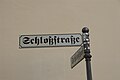 Blackletter form of the ſʒ ligature (Erfurt street signs)
 -
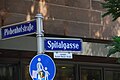 Sulzbacher form (Nuremberg street signs)
 -
 Two distinct blackletter typefaces in Mainz. The red sign spells Template:Lang with ſs; the blue sign uses the standard blackletter ſʒ ligature.


The inclusion of a capital Template:Angbr in Unicode in 2008 revived the century-old debate among font designers as to how such a character should be represented. The main difference in the shapes of Template:Angbr in contemporary fonts is the depiction with a diagonal straight line vs. a curved line in its upper right part, reminiscent of the ligature of tailed z or of round s, respectively. The code chart published by the Unicode Consortium favours the former possibility,[46] which has been adopted by Unicode capable fonts including Arial, Calibri, Cambria, Courier New, Dejavu Serif, Liberation Sans, Liberation Mono, Linux Libertine and Times New Roman; the second possibility is more rare, adopted by Dejavu Sans. Some fonts adopt a third possibility in representing Template:Angbr following the Sulzbacher form of Template:Angbr, reminiscent of the Greek Template:Angbr (beta); such a shape has been adopted by FreeSans and FreeSerif, Liberation Serif and Verdana.[47]
Typing the character
Template:More citations needed

In Germany and Austria, a 'ß' key is present on computer and typewriter keyboards, normally to the right-hand end on the number row. The German typewriter keyboard layout was defined in DIN 2112, first issued in 1928.[48]
In other countries, the letter is not marked on the keyboard, but a combination of other keys can produce it. Often, the letter is input using a modifier and the 's' key. The details of the keyboard layout depend on the input language and operating system: on some keyboards with US-International (or local 'extended') setting, the symbol is created using Template:Keypress (or Template:Keypress) in Microsoft Windows, Linux and ChromeOS; in MacOS, one uses Template:Keypress on the US, US-Extended, and UK keyboards. In Windows, one can use Template:KeypressTemplate:Keypress. On Linux Template:Keypress works, and Template:Keypress for uppercase. Some modern virtual keyboards show ß when the user presses and holds the 's' key.
The HTML entity (for the lowercase form) is ß. In TeX and LaTeX, \ss produces ß.[49]Template:Efn A German language support package for LaTeX exists in which ß is produced by "s (similar to umlauts, which are produced by "a, "o, and "u with this package).[50]
Additionally, there are keyboard layouts that accommodate Template:Keypress, such as DIN 2137-2 (Template:Keypress).
Unicode
There are two code points in Unicode:
In modern browsers, lowercase "ß" will be converted to "SS" when the element containing it is set to uppercase using text-transform: uppercase in Cascading Style Sheets. The JavaScript in Google Chrome and Mozilla Firefox will convert "ß" to "SS" when converted to uppercase (e.g., "ß".toUpperCase()).[51]
The lower-case letter exists in many earlier encodings that covered European languages. In several ISO 8859Template:Efn and WindowsTemplate:Efn encodings it is at Template:Tt, the value inherited by Unicode. In DOS code pagesTemplate:Efn it is at Template:Tt. Mac OS encodingsTemplate:Efn put it at Template:Tt. Some EBCDIC codesTemplate:Efn put it at Template:Tt. The upper-case form was rarely, if ever, encoded in single-byte encodings.
See also
Notes
References
- ↑ Template:Cite web
- ↑ 2.0 2.1 Template:Citation
- ↑ Leitfaden zur deutschen Rechtschreibung ("Guide to German Orthography") Template:Webarchive, 3rd edition (2007) Template:In lang from the Swiss Federal Chancellery, retrieved 22-Apr-2012
- ↑ 4.0 4.1 4.2 Template:Cite web
- ↑ 5.0 5.1 5.2 Template:Cite web
- ↑ C1 Controls and Latin-1 Supplement glossed 'uppercase is "SS" or 1E9E ẞ; typographically the glyph for this character can be based on a ligature of 017F ſ, with either 0073 s or with an old-style glyph for 007A z (the latter similar in appearance to 0292 ʒ). Both forms exist interchangeably today.'
- ↑ 7.0 7.1 Template:Cite web
- ↑ Template:Cite book
- ↑ 9.0 9.1 Template:Cite book
- ↑ 10.0 10.1 10.2 10.3 Template:Cite book
- ↑ Template:Cite web
- ↑ 12.0 12.1 Template:Cite web
- ↑ Template:Cite web
- ↑ Template:Cite book
- ↑ Template:Ill "Warum die Schweizer weiterhin kein Eszett schreiben." in Die Neuregelung der deutschen Rechtschreibung. Begründung und Kritik. Gerhard Augst, et al., eds. Niemayer: 1997. (Archived.)
- ↑ "Rechtschreibung: Leitfaden zur deutschen Rechtschreibung." Schweizerische Bundeskanzlei, in Absprache mit der Präsidentin der Staatsschreiberkonferenz. 2017. pp. 19, 21–22.
- ↑ 17.0 17.1 17.2 17.3 17.4 17.5 17.6 Template:Cite journal
- ↑ "Rechtscreibung: Leitfaden zur deutschen Rechtschreibung." Schweizerische Bundeskanzlei, in Absprache mit der Präsidentin der Staatsschreiberkonferenz. 2017. pp. 21–22.
- ↑ Template:Cite web
- ↑ Template:Cite journal
- ↑ Template:Cite book
- ↑ Template:Cite web
- ↑ Template:Cite web
- ↑ Template:Cite web
- ↑ Template:Cite web
- ↑ For example Ssein, ja ßein soll es ßie, ßie, ßie! in Template:Cite work
- ↑ 27.0 27.1 Template:Cite book
- ↑ Template:Cite book
- ↑ 29.0 29.1 Template:Cite book
- ↑ 30.0 30.1 Template:Cite journal
- ↑ 31.0 31.1 31.2 31.3 Template:Cite journal
- ↑ 32.0 32.1 32.2 32.3 Template:Cite book
- ↑ Template:Cite book
- ↑ Template:Citation
- ↑ 35.0 35.1 35.2 35.3 Template:Citation
- ↑ Template:Cite book
- ↑ Template:Cite book
- ↑ Schreiben des Reichsministers und Chefs der Reichskanzlei an den Reichsminister des Innern vom 20. Juli 1941. BA, Potsdam, R 1501, Nr. 27180. cited in: Der Schriftstreit von 1881 bis 1941 von Silvia Hartman, Peter Lang Verlag. Template:ISBN
- ↑ Template:Cite book
- ↑ Template:Lang. Heft 9, 2006.
- ↑ Template:Lang
- ↑ Template:Cite web
- ↑ Template:Cite web
- ↑ Template:Cite web
- ↑ Template:Cite web Template:Cite web
- ↑ Template:Cite web
- ↑ Template:Cite web
- ↑ Vom Sekretariat zum Office Management: Geschichte — Gegenwart — Zukunft, Springer-Verlag (2013), p. 68.
- ↑ Template:Cite web
- ↑ Template:Cite web
- ↑ Template:Cite web