Satellite knot
Template:Short description In the mathematical theory of knots, a satellite knot is a knot that contains an incompressible, non boundary-parallel torus in its complement.[1] Every knot is either hyperbolic, a torus, or a satellite knot. The class of satellite knots include composite knots, cable knots, and Whitehead doubles. A satellite link is one that orbits a companion knot K in the sense that it lies inside a regular neighborhood of the companion.[2]Template:Rp
A satellite knot can be picturesquely described as follows: start by taking a nontrivial knot lying inside an unknotted solid torus . Here "nontrivial" means that the knot is not allowed to sit inside of a 3-ball in and is not allowed to be isotopic to the central core curve of the solid torus. Then tie up the solid torus into a nontrivial knot.
This means there is a non-trivial embedding and . The central core curve of the solid torus is sent to a knot , which is called the "companion knot" and is thought of as the planet around which the "satellite knot" orbits. The construction ensures that is a non-boundary parallel incompressible torus in the complement of . Composite knots contain a certain kind of incompressible torus called a swallow-follow torus, which can be visualized as swallowing one summand and following another summand.
Since is an unknotted solid torus, is a tubular neighbourhood of an unknot . The 2-component link together with the embedding is called the pattern associated to the satellite operation.
A convention: people usually demand that the embedding is untwisted in the sense that must send the standard longitude of to the standard longitude of . Said another way, given any two disjoint curves , preserves their linking numbers i.e.: .
Basic families
When is a torus knot, then is called a cable knot. Examples 3 and 4 are cable knots. The cable constructed with given winding numbers (m,n) from another knot K, is often called the (m,n) cable of K.
If is a non-trivial knot in and if a compressing disc for intersects in precisely one point, then is called a connect-sum. Another way to say this is that the pattern is the connect-sum of a non-trivial knot with a Hopf link.
If the link is the Whitehead link, is called a Whitehead double. If is untwisted, is called an untwisted Whitehead double.
Examples
-
 Example 1: A connect-sum of a trefoil and figure-8 knot.
 -
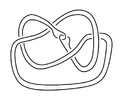 Example 2: The Whitehead double of the figure-8.
 -
 Example 3: A cable of a connect-sum.
 -
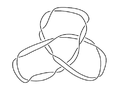 Example 4: A cable of a trefoil.
 -
 Example 5: A knot which is a 2-fold satellite i.e.: it has non-parallel swallow-follow tori.
 -
 Example 6: A knot which is a 2-fold satellite i.e.: it has non-parallel swallow-follow tori.


Examples 5 and 6 are variants on the same construction. They both have two non-parallel, non-boundary-parallel incompressible tori in their complements, splitting the complement into the union of three manifolds. In 5, those manifolds are: the Borromean rings complement, trefoil complement, and figure-8 complement. In 6, the figure-8 complement is replaced by another trefoil complement.
Origins
In 1949[3] Horst Schubert proved that every oriented knot in decomposes as a connect-sum of prime knots in a unique way, up to reordering, making the monoid of oriented isotopy-classes of knots in a free commutative monoid on countably-infinite many generators. Shortly after, he realized he could give a new proof of his theorem by a close analysis of the incompressible tori present in the complement of a connect-sum. This led him to study general incompressible tori in knot complements in his epic work Knoten und Vollringe,[4] where he defined satellite and companion knots.
Follow-up work
Schubert's demonstration that incompressible tori play a major role in knot theory was one several early insights leading to the unification of 3-manifold theory and knot theory. It attracted Waldhausen's attention, who later used incompressible surfaces to show that a large class of 3-manifolds are homeomorphic if and only if their fundamental groups are isomorphic.[5] Waldhausen conjectured what is now the Jaco–Shalen–Johannson-decomposition of 3-manifolds, which is a decomposition of 3-manifolds along spheres and incompressible tori. This later became a major ingredient in the development of geometrization, which can be seen as a partial-classification of 3-dimensional manifolds. The ramifications for knot theory were first described in the long-unpublished manuscript of Bonahon and Siebenmann.[6]
Uniqueness of satellite decomposition
In Knoten und Vollringe, Schubert proved that in some cases, there is essentially a unique way to express a knot as a satellite. But there are also many known examples where the decomposition is not unique.[7] With a suitably enhanced notion of satellite operation called splicing, the JSJ decomposition gives a proper uniqueness theorem for satellite knots.[8][9]
See also
References
- ↑ Colin Adams, The Knot Book: An Elementary Introduction to the Mathematical Theory of Knots, (2001), Template:Isbn
- ↑ Template:Cite book
- ↑ Schubert, H. Die eindeutige Zerlegbarkeit eines Knotens in Primknoten. S.-B Heidelberger Akad. Wiss. Math.-Nat. Kl. 1949 (1949), 57–104.
- ↑ Schubert, H. Knoten und Vollringe. Acta Math. 90 (1953), 131–286.
- ↑ Waldhausen, F. On irreducible 3-manifolds which are sufficiently large.Ann. of Math. (2) 87 (1968), 56–88.
- ↑ F.Bonahon, L.Siebenmann, New Geometric Splittings of Classical Knots, and the Classification and Symmetries of Arborescent Knots, [1]
- ↑ Motegi, K. Knot Types of Satellite Knots and Twisted Knots. Lectures at Knots '96. World Scientific.
- ↑ Eisenbud, D. Neumann, W. Three-dimensional link theory and invariants of plane curve singularities. Ann. of Math. Stud. 110
- ↑ Budney, R. JSJ-decompositions of knot and link complements in S^3. L'enseignement Mathematique 2e Serie Tome 52 Fasc. 3–4 (2006). arXiv:math.GT/0506523