Effective potential
Template:Short description The effective potential (also known as effective potential energy) combines multiple, perhaps opposing, effects into a single potential. In its basic form, it is the sum of the 'opposing' centrifugal potential energy with the potential energy of a dynamical system. It may be used to determine the orbits of planets (both Newtonian and relativistic) and to perform semi-classical atomic calculations, and often allows problems to be reduced to fewer dimensions.
Definition

The basic form of potential is defined as: where
- L is the angular momentum
- r is the distance between the two masses
- μ is the reduced mass of the two bodies (approximately equal to the mass of the orbiting body if one mass is much larger than the other); and
- U(r) is the general form of the potential.
The effective force, then, is the negative gradient of the effective potential: where denotes a unit vector in the radial direction.
Important properties
There are many useful features of the effective potential, such as
To find the radius of a circular orbit, simply minimize the effective potential with respect to , or equivalently set the net force to zero and then solve for : After solving for , plug this back into to find the maximum value of the effective potential .
A circular orbit may be either stable or unstable. If it is unstable, a small perturbation could destabilize the orbit, but a stable orbit would return to equilibrium. To determine the stability of a circular orbit, determine the concavity of the effective potential. If the concavity is positive, the orbit is stable:
The frequency of small oscillations, using basic Hamiltonian analysis, is where the double prime indicates the second derivative of the effective potential with respect to and it is evaluated at a minimum.
Gravitational potential

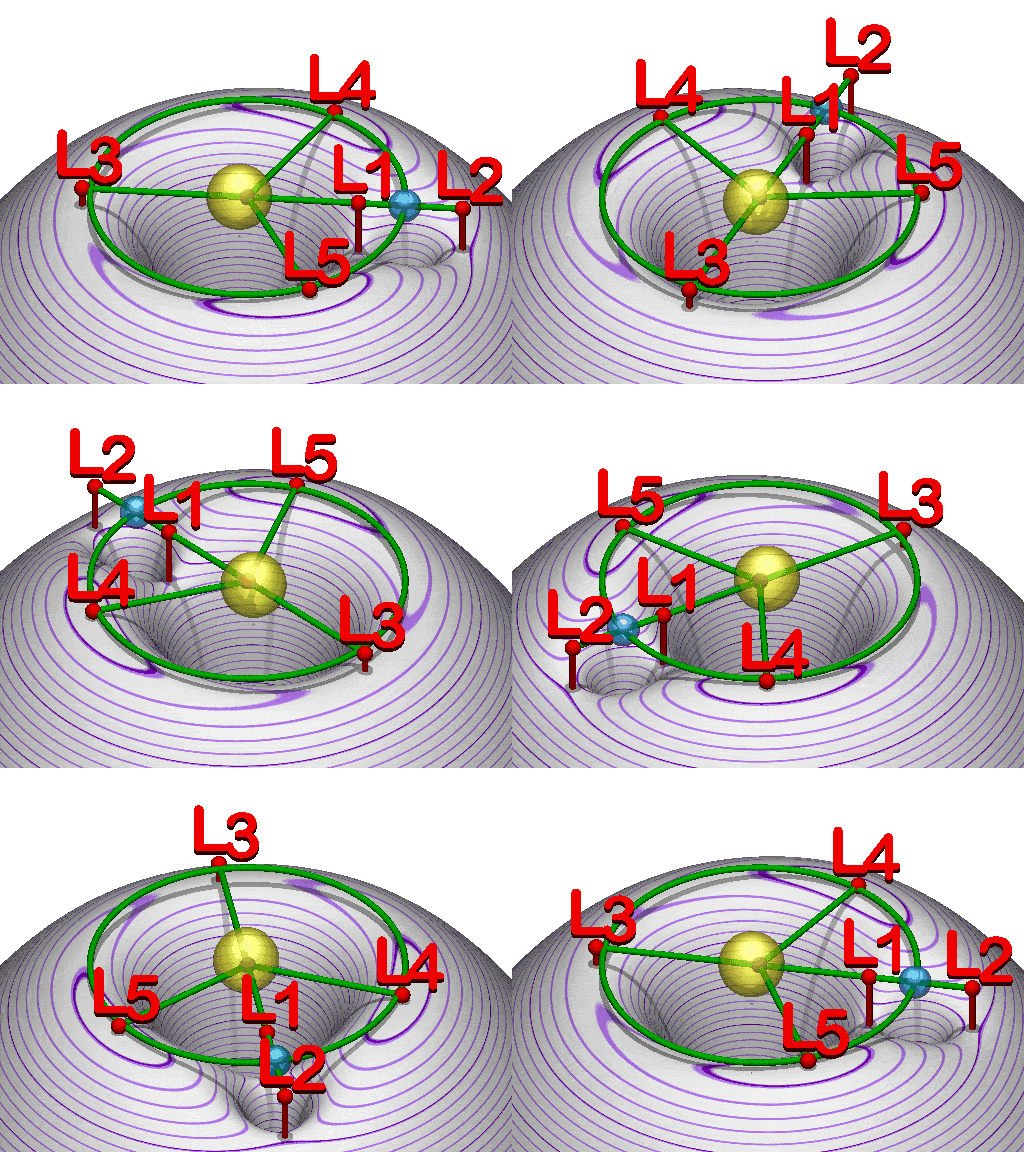
Consider a particle of mass m orbiting a much heavier object of mass M. Assume Newtonian mechanics, which is both classical and non-relativistic. The conservation of energy and angular momentum give two constants E and L, which have values when the motion of the larger mass is negligible. In these expressions,
- is the derivative of r with respect to time,
- is the angular velocity of mass m,
- G is the gravitational constant,
- E is the total energy, and
- L is the angular momentum.
Only two variables are needed, since the motion occurs in a plane. Substituting the second expression into the first and rearranging gives where is the effective potential.[Note 1] The original two-variable problem has been reduced to a one-variable problem. For many applications the effective potential can be treated exactly like the potential energy of a one-dimensional system: for instance, an energy diagram using the effective potential determines turning points and locations of stable and unstable equilibria. A similar method may be used in other applications, for instance determining orbits in a general relativistic Schwarzschild metric.
Effective potentials are widely used in various condensed matter subfields, e.g. the Gauss-core potential (Likos 2002, Baeurle 2004) and the screened Coulomb potential (Likos 2001).
See also
Notes
References
Further reading
Cite error: <ref> tags exist for a group named "Note", but no corresponding <references group="Note"/> tag was found