Small-angle approximation

For small angles, the trigonometric functions sine, cosine, and tangent can be calculated with reasonable accuracy by the following simple approximations:
provided the angle is measured in radians. Angles measured in degrees must first be converted to radians by multiplying them by Template:Tmath.
These approximations have a wide range of uses in branches of physics and engineering, including mechanics, electromagnetism, optics, cartography, astronomy, and computer science.[1][2] One reason for this is that they can greatly simplify differential equations that do not need to be answered with absolute precision.
There are a number of ways to demonstrate the validity of the small-angle approximations. The most direct method is to truncate the Maclaurin series for each of the trigonometric functions. Depending on the order of the approximation, is approximated as either or as .[3]
Justifications
Graphic
The accuracy of the approximations can be seen below in Figure 1 and Figure 2. As the measure of the angle approaches zero, the difference between the approximation and the original function also approaches 0.
-
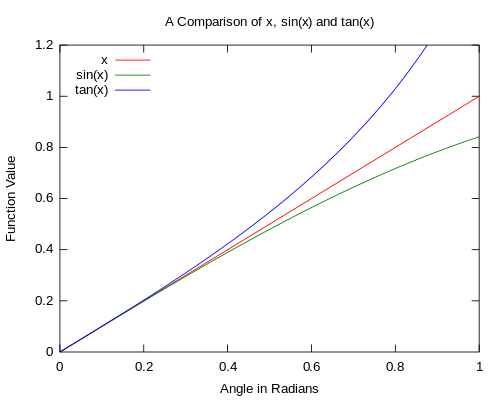 Figure 1. A comparison of the basic odd trigonometric functions to Template:Mvar. It is seen that as the angle approaches 0 the approximations become better.
 -
 Figure 2. A comparison of Template:Math to Template:Math. It is seen that as the angle approaches 0 the approximation becomes better.


Geometric
 The red section on the right, Template:Math, is the difference between the lengths of the hypotenuse, Template:Mvar, and the adjacent side, Template:Mvar. As is shown, Template:Mvar and Template:Mvar are almost the same length, meaning Template:Math is close to 1 and Template:Math helps trim the red away.
The opposite leg, Template:Mvar, is approximately equal to the length of the blue arc, Template:Mvar. Gathering facts from geometry, Template:Math, from trigonometry, Template:Math and Template:Math, and from the picture, Template:Math and Template:Math leads to:
Simplifying leaves,
Calculus
Using the squeeze theorem,[4] we can prove that which is a formal restatement of the approximation for small values of θ.
A more careful application of the squeeze theorem proves that from which we conclude that for small values of θ.
Finally, L'Hôpital's rule tells us that which rearranges to for small values of θ. Alternatively, we can use the double angle formula . By letting , we get that .
Algebraic

The Taylor series expansions of trigonometric functions sine, cosine, and tangent near zero are:[5]
where Template:Tmath is the angle in radians. For very small angles, higher powers of Template:Tmath become extremely small, for instance if Template:Tmath, then Template:Tmath, just one ten-thousandth of Template:Tmath. Thus for many purposes it suffices to drop the cubic and higher terms and approximate the sine and tangent of a small angle using the radian measure of the angle, Template:Tmath, and drop the quadratic term and approximate the cosine as Template:Tmath.
If additional precision is needed the quadratic and cubic terms can also be included, Template:Tmath, Template:Tmath, and Template:Tmath.
Dual numbers
One may also use dual numbers, defined as numbers in the form , with and satisfying by definition and . By using the MacLaurin series of cosine and sine, one can show that and . Furthermore, it is not hard to prove that the Pythagorean identity holds:
Error of the approximations

Near zero, the relative error of the approximations Template:Tmath, Template:Tmath, and Template:Tmath is quadratic in Template:Tmath: for each order of magnitude smaller the angle is, the relative error of these approximations shrinks by two orders of magnitude. The approximation Template:Tmath has relative error which is quartic in Template:Tmath: for each order of magnitude smaller the angle is, the relative error shrinks by four orders of magnitude.
Figure 3 shows the relative errors of the small angle approximations. The angles at which the relative error exceeds 1% are as follows:
- Template:Tmath at about 0.14 radians (8.1°)
- Template:Tmath at about 0.17 radians (9.9°)
- Template:Tmath at about 0.24 radians (14.0°)
- Template:Tmath at about 0.66 radians (37.9°)
Angle sum and difference
The angle addition and subtraction theorems reduce to the following when one of the angles is small (β ≈ 0):
cos(α + β) ≈ cos(α) − β sin(α), cos(α − β) ≈ cos(α) + β sin(α), sin(α + β) ≈ sin(α) + β cos(α), sin(α − β) ≈ sin(α) − β cos(α).
Specific uses
Astronomy
In astronomy, the angular size or angle subtended by the image of a distant object is often only a few arcseconds (denoted by the symbol ″), so it is well suited to the small angle approximation.[6] The linear size (Template:Mvar) is related to the angular size (Template:Mvar) and the distance from the observer (Template:Mvar) by the simple formula:
where Template:Mvar is measured in arcseconds.
The quantity Template:Val is approximately equal to the number of arcseconds in a circle (Template:Val), divided by Template:Math, or, the number of arcseconds in 1 radian.
The exact formula is
and the above approximation follows when Template:Math is replaced by Template:Mvar.
Motion of a pendulum
Template:Main The second-order cosine approximation is especially useful in calculating the potential energy of a pendulum, which can then be applied with a Lagrangian to find the indirect (energy) equation of motion.
When calculating the period of a simple pendulum, the small-angle approximation for sine is used to allow the resulting differential equation to be solved easily by comparison with the differential equation describing simple harmonic motion.
Optics
In optics, the small-angle approximations form the basis of the paraxial approximation.
Wave Interference
The sine and tangent small-angle approximations are used in relation to the double-slit experiment or a diffraction grating to develop simplified equations like the following, where Template:Mvar is the distance of a fringe from the center of maximum light intensity, Template:Mvar is the order of the fringe, Template:Mvar is the distance between the slits and projection screen, and Template:Mvar is the distance between the slits: [7]
Structural mechanics
The small-angle approximation also appears in structural mechanics, especially in stability and bifurcation analyses (mainly of axially-loaded columns ready to undergo buckling). This leads to significant simplifications, though at a cost in accuracy and insight into the true behavior.
Piloting
The 1 in 60 rule used in air navigation has its basis in the small-angle approximation, plus the fact that one radian is approximately 60 degrees.
Interpolation
The formulas for addition and subtraction involving a small angle may be used for interpolating between trigonometric table values:
Example: sin(0.755) where the values for sin(0.75) and cos(0.75) are obtained from trigonometric table. The result is accurate to the four digits given.
See also
References
- ↑ Cite error: Invalid
<ref>tag; no text was provided for refs namedHolbrow2010 - ↑ Cite error: Invalid
<ref>tag; no text was provided for refs namedPlesha2012 - ↑ Template:Cite web
- ↑ Cite error: Invalid
<ref>tag; no text was provided for refs namedLarson2006 - ↑ Template:Cite book
- ↑ Cite error: Invalid
<ref>tag; no text was provided for refs namedGreen1985 - ↑ Template:Cite web