Ethyl acetate was first synthesized by the Count de Lauraguais in 1759 by distilling a mixture of ethanol and acetic acid.[2]
In 2004, an estimated 1.3 million tonnes were produced worldwide.[1][3] The combined annual production in 1985 of Japan, North America, and Europe was about 400,000 tonnes. The global ethyl acetate market was valued at $3.3 billion in 2018.[4]
Ethyl acetate is synthesized in industry mainly via the classic Fischer esterification reaction of ethanol and acetic acid. This mixture converts to the ester in about 65% yield at room temperature:
Ethyl acetate is used primarily as a solvent and diluent, being favored because of its low cost, low toxicity, and agreeable odor.[1] For example, it is commonly used to clean circuit boards and in some nail varnish removers (acetone is also used). Coffee beans and tea leaves are decaffeinated with this solvent.[6] It is also used in paints as an activator or hardener. Ethyl acetate is present in confectionery, perfumes, and fruits. In perfumes it evaporates quickly, leaving the scent of the perfume on the skin.
Ethyl acetate is an asphyxiant for use in insect collecting and study.[7] In a killing jar charged with ethyl acetate, the vapors will kill the collected insect quickly without destroying it. Because it is not hygroscopic, ethyl acetate also keeps the insect soft enough to allow proper mounting suitable for a collection. However, ethyl acetate is regarded as potentially doing damage to insect DNA, making specimens processed this way less than ideal for subsequent DNA sequencing.[8]
Ethyl acetate is the most common ester in wine, being the product of the most common volatile organic acid – acetic acid, and the ethyl alcohol generated during the fermentation. The aroma of ethyl acetate is most vivid in younger wines and contributes towards the general perception of "fruitiness" in the wine. Sensitivity varies, with most people having a perception threshold around 120 mg/L. Excessive amounts of ethyl acetate are considered a wine fault.
Reactions
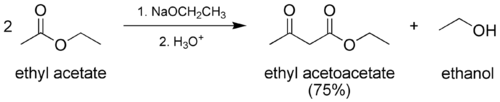
Ethyl acetate is only weakly Lewis basic, like a typical carboxylic acid ester.
Ethyl acetate hydrolyses to give acetic acid and ethanol. Bases accelerate the hydrolysis, which is subject to the Fischer equilibrium mentioned above. In the laboratory, and usually for illustrative purposes only, ethyl esters are typically hydrolyzed in a two-step process starting with a stoichiometric amount of a strong base, such as sodium hydroxide. This reaction gives ethanol and sodium acetate, which is unreactive toward ethanol:
Vapor pressure of ethyl acetateHeat of evaporation of ethyl acetate
Under normal conditions, ethyl acetate exists as a colorless, low-viscosity, and flammable liquid. Its melting point is −83 °C, with a melting enthalpy of 10.48 kJ/mol. At atmospheric pressure, the compound boils at 77 °C. The vaporization enthalpy at the boiling point is 31.94 kJ/mol. The vapor pressure function follows the Antoine equation
The Template:LD50 for rats is 5620 mg/kg,[20] indicating low acute toxicity. Given that the chemical is naturally present in many organisms, there is little risk of toxicity.
Overexposure to ethyl acetate may cause irritation of the eyes, nose, and throat. Severe overexposure may cause weakness, drowsiness, and unconsciousness.[21] Humans exposed to a concentration of 400 ppm in 1.4 mg/L ethyl acetate for a short time were affected by nose and throat irritation.[22] Ethyl acetate is an irritant of the conjunctiva and mucous membrane of the respiratory tract. Animal experiments have shown that, at very high concentrations, the ester has central nervous system depressant and lethal effects; at concentrations of 20,000 to 43,000 ppm (2.0–4.3%), there may be pulmonary edema with hemorrhages, symptoms of central nervous system depression, secondary anemia and liver damage. In humans, concentrations of 400 ppm cause irritation of the nose and pharynx; cases have also been known of irritation of the conjunctiva with temporary opacity of the cornea. In rare cases exposure may cause sensitization of the mucous membrane and eruptions of the skin. The irritant effect of ethyl acetate is weaker than that of propyl acetate or butyl acetate.[23]
↑ 11.011.1V. Majer, V. Svoboda: Enthalpies of Vaporization of Organic Compounds: A Critical Review and Data Compilation. Blackwell Scientific Publications, Oxford 1985, ISBN 0-632-01529-2.
↑K. B. Wiberg, L. S. Crocker, K. M. Morgan: Thermochemical studies of carbonyl compounds. 5. Enthalpies of reduction of carbonyl groups. In: J. Am. Chem. Soc. 113, 1991, pp. 3447–3450. doi:10.1021/ja00009a033.
↑G. S. Parks, H. M. Huffman, M. Barmore: Thermal data on organic compounds. XI. The heat capacities, entropies and free energies of ten compounds containing oxygen or nitrogen. In: J. Am. Chem. Soc. 55, 1933, S. 2733–2740, doi:10.1021/ja01334a016.
↑ 14.014.1D. R. Stull, Jr.: The Chemical Thermodynamics of Organic Compounds. Wiley, New York, 1969.
↑D. Ambrose, J. H. Ellender, H. A. Gundry, D. A. Lee, R. Townsend: Thermodynamic properties of organic oxygen compounds. LI. The vapour pressures of some esters and fatty acids. In: J. Chem. Thermodyn. 13, 1981, S. 795–802. doi:10.1016/0021-9614(81)90069-0.
↑S. Young, G. L. Thomas: The vapour pressures, molecular volumes, and critical constants of ten of the lower esters. In: J. Chem. Soc. 63, 1893, S. 1191.