Girth (graph theory): Difference between revisions
imported>David Eppstein →Girth and graph coloring: eliminate deprecated diagonal fraction format |
(No difference)
|
Latest revision as of 08:28, 19 December 2024
Template:Short description In graph theory, the girth of an undirected graph is the length of a shortest cycle contained in the graph.[1] If the graph does not contain any cycles (that is, it is a forest), its girth is defined to be infinity.[2] For example, a 4-cycle (square) has girth 4. A grid has girth 4 as well, and a triangular mesh has girth 3. A graph with girth four or more is triangle-free.
Cages
Template:Main A cubic graph (all vertices have degree three) of girth Template:Mvar that is as small as possible is known as a Template:Mvar-cage (or as a Template:Math-cage). The Petersen graph is the unique 5-cage (it is the smallest cubic graph of girth 5), the Heawood graph is the unique 6-cage, the McGee graph is the unique 7-cage and the Tutte eight cage is the unique 8-cage.[3] There may exist multiple cages for a given girth. For instance there are three nonisomorphic 10-cages, each with 70 vertices: the Balaban 10-cage, the Harries graph and the Harries–Wong graph.
-
 The Petersen graph has a girth of 5
 -
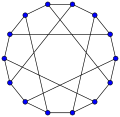 The Heawood graph has a girth of 6
 -
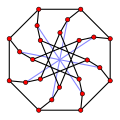 The McGee graph has a girth of 7
 -
 The Tutte–Coxeter graph (Tutte eight cage) has a girth of 8


Girth and graph coloring
For any positive integers Template:Mvar and Template:Math, there exists a graph with girth at least Template:Mvar and chromatic number at least Template:Math; for instance, the Grötzsch graph is triangle-free and has chromatic number 4, and repeating the Mycielskian construction used to form the Grötzsch graph produces triangle-free graphs of arbitrarily large chromatic number. Paul Erdős was the first to prove the general result, using the probabilistic method.[4] More precisely, he showed that a random graph on Template:Mvar vertices, formed by choosing independently whether to include each edge with probability Template:Math, has, with probability tending to 1 as Template:Mvar goes to infinity, at most Template:Math cycles of length Template:Mvar or less, but has no independent set of size Template:Math. Therefore, removing one vertex from each short cycle leaves a smaller graph with girth greater than Template:Mvar, in which each color class of a coloring must be small and which therefore requires at least Template:Mvar colors in any coloring.
Explicit, though large, graphs with high girth and chromatic number can be constructed as certain Cayley graphs of linear groups over finite fields.[5] These remarkable Ramanujan graphs also have large expansion coefficient.
Related concepts
The odd girth and even girth of a graph are the lengths of a shortest odd cycle and shortest even cycle respectively.
The Template:Visible anchor of a graph is the length of the longest (simple) cycle, rather than the shortest.
Thought of as the least length of a non-trivial cycle, the girth admits natural generalisations as the 1-systole or higher systoles in systolic geometry.
Girth is the dual concept to edge connectivity, in the sense that the girth of a planar graph is the edge connectivity of its dual graph, and vice versa. These concepts are unified in matroid theory by the girth of a matroid, the size of the smallest dependent set in the matroid. For a graphic matroid, the matroid girth equals the girth of the underlying graph, while for a co-graphic matroid it equals the edge connectivity.[6]
Computation
The girth of an undirected graph can be computed by running a breadth-first search from each node, with complexity where is the number of vertices of the graph and is the number of edges.[7] A practical optimization is to limit the depth of the BFS to a depth that depends on the length of the smallest cycle discovered so far.[8] Better algorithms are known in the case where the girth is even[9] and when the graph is planar.[10] In terms of lower bounds, computing the girth of a graph is at least as hard as solving the triangle finding problem on the graph.
References
- ↑ R. Diestel, Graph Theory, p.8. 3rd Edition, Springer-Verlag, 2005
- ↑ Template:Mathworld
- ↑ Template:Citation. Electronic supplement to the book Distance-Regular Graphs (Brouwer, Cohen, and Neumaier 1989, Springer-Verlag).
- ↑ Template:Citation.
- ↑ Template:Citation
- ↑ Template:Citation.
- ↑ Template:Cite web
- ↑ Template:Cite web
- ↑ Template:Cite web
- ↑ Template:Cite journal