Wright omega function: Difference between revisions
imported>Dan422442 m turned a w into ω |
(No difference)
|
Latest revision as of 02:14, 8 August 2024
Template:Short description Template:Use American English

In mathematics, the Wright omega function or Wright function,[note 1] denoted ω, is defined in terms of the Lambert W function as:
Uses
One of the main applications of this function is in the resolution of the equation z = ln(z), as the only solution is given by z = e−ω(π i).
y = ω(z) is the unique solution, when for x ≤ −1, of the equation y + ln(y) = z. Except for those two values, the Wright omega function is continuous, even analytic.
Properties
The Wright omega function satisfies the relation .
It also satisfies the differential equation
wherever ω is analytic (as can be seen by performing separation of variables and recovering the equation ), and as a consequence its integral can be expressed as:
Its Taylor series around the point takes the form :
where
in which
is a second-order Eulerian number.
Values
Plots
- Plots of the Wright omega function on the complex plane
-
 z = Re(ω(x + i y))
 -
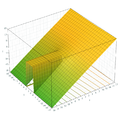 z = Im(ω(x + i y))
 -
 ω(x + i y)


Notes
References
Cite error: <ref> tags exist for a group named "note", but no corresponding <references group="note"/> tag was found